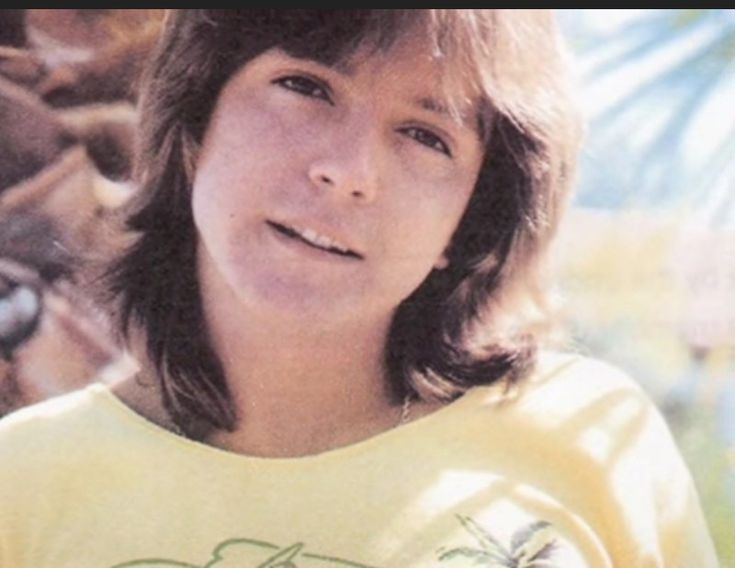
On Like Father, Like Son, David Cassidy turns resemblance into reckoning, hearing his father’s brilliance and distance inside his own voice.
Released in 1992 on Didn’t You Used to Be…, Like Father, Like Son is one of the most personal corners of David Cassidy’s adult catalog. It is not simply a song about family resemblance. It is a song about inheritance in the deeper, more difficult sense: the habits we absorb, the gifts we cannot deny, the shadows we spend years trying to understand. At its center stands Jack Cassidy, David’s father, a gifted Broadway and television performer whose charisma, discipline, ambition, and complicated presence formed part of the emotional weather around his son’s life.
By the time David recorded Like Father, Like Son, he had already lived several public lives. To many listeners, he was still the young face from The Partridge Family, the singer whose image was carried on bedroom walls, lunch boxes, magazines, and television screens in the early 1970s. But the title of the 1992 album, Didn’t You Used to Be…, carried its own weary intelligence. It sounded like the sentence people say when they recognize a former sensation but cannot quite separate the person from the memory. The album arrived in a period when Cassidy was working to be heard not as a souvenir of teen-idol fame, but as a grown performer with a history, a voice, and unresolved stories of his own.
That makes Like Father, Like Son especially revealing. The phrase itself can be affectionate, even proud, but in Cassidy’s hands it becomes more layered. It suggests the tenderness of resemblance and the discomfort of it at the same time. David had come from a family where performance was not a distant dream but a daily language. His mother, Evelyn Ward, was an actress. His father, Jack Cassidy, was a polished stage and screen presence, remembered for his Broadway work as well as his sharply drawn television appearances. David later became famous alongside Shirley Jones, his real-life stepmother, on a television series that blurred the line between family image and family reality in ways few young stars could have easily managed.
What makes the song moving is not that it explains everything. It does not turn the father-son story into a neat confession or a solved argument. Instead, it seems to linger in the space where love, admiration, resentment, and recognition can all exist at once. David Cassidy’s relationship with Jack has often been discussed as complex, marked by distance as well as deep influence. Jack represented a kind of theatrical authority: elegant, talented, demanding, and larger than ordinary life. For a son who would become famous in a different, more commercial and far more feverish era of pop culture, that presence could be both a model and a burden.
In the setting of Didn’t You Used to Be…, the song feels like an adult pause. It is not the sound of the frantic crowds that surrounded Cassidy at the height of his fame. It is closer to the sound of someone standing after the applause has faded, asking what remains when celebrity, family history, and private memory all meet in the same room. The early 1990s production context gives the track the shape of a mature pop reflection, but its emotional center is older than any decade. It belongs to the long human question of how much of a parent lives inside a child, even when that child has spent a lifetime trying to become his own man.
David’s voice is crucial to that feeling. He had a gift for sounding open without becoming theatrical in the obvious sense. On a song like Like Father, Like Son, that quality matters. A singer can oversell a personal subject and drain it of truth, but Cassidy’s strength here lies in the sense of restraint. He lets the title do part of the work. He lets the listener hear the phrase as a mirror, not a slogan. The song does not need to accuse or forgive in dramatic terms. Its power comes from the quiet recognition that family likeness is rarely simple. Sometimes it is a comfort. Sometimes it is a warning. Sometimes it is both in the same breath.
The presence of Jack Cassidy behind the song also changes the way one hears David’s broader career. The young man who became a mass-culture phenomenon had not come from nowhere. He had inherited a performer’s instinct, an awareness of timing, a sense of how to hold attention. Yet his fame arrived in a form that could trap him, turning him into a public image before he had fully settled into himself. In that light, Like Father, Like Son feels less like a biographical footnote and more like a late conversation with lineage. It asks whether talent is a blessing when it comes tangled with expectation, whether admiration can survive disappointment, and whether a son can claim the best of what he inherited without being consumed by the rest.
That is why the song still deserves careful listening. It opens a door beyond the familiar photographs and television memories, beyond the polished smile that once sold millions of records and filled arenas with noise. It reminds us that behind every public voice is a private history of influence, rivalry, longing, and unfinished understanding. David Cassidy did not have to spell out every detail for the song to matter. By placing Like Father, Like Son on Didn’t You Used to Be…, he allowed a family echo to become part of his adult musical identity.
In the end, the song is not only about Jack Cassidy, and it is not only about David. It is about the uneasy grace of seeing someone else in yourself and deciding what to do with that reflection. It is about the way a voice can carry bloodlines, old rooms, stage lights, silences, and questions that never quite leave. For listeners who remember David Cassidy as a bright young star, Like Father, Like Son offers something quieter and more revealing: a man looking back at the father who helped shape him, and listening closely to what still remained.
