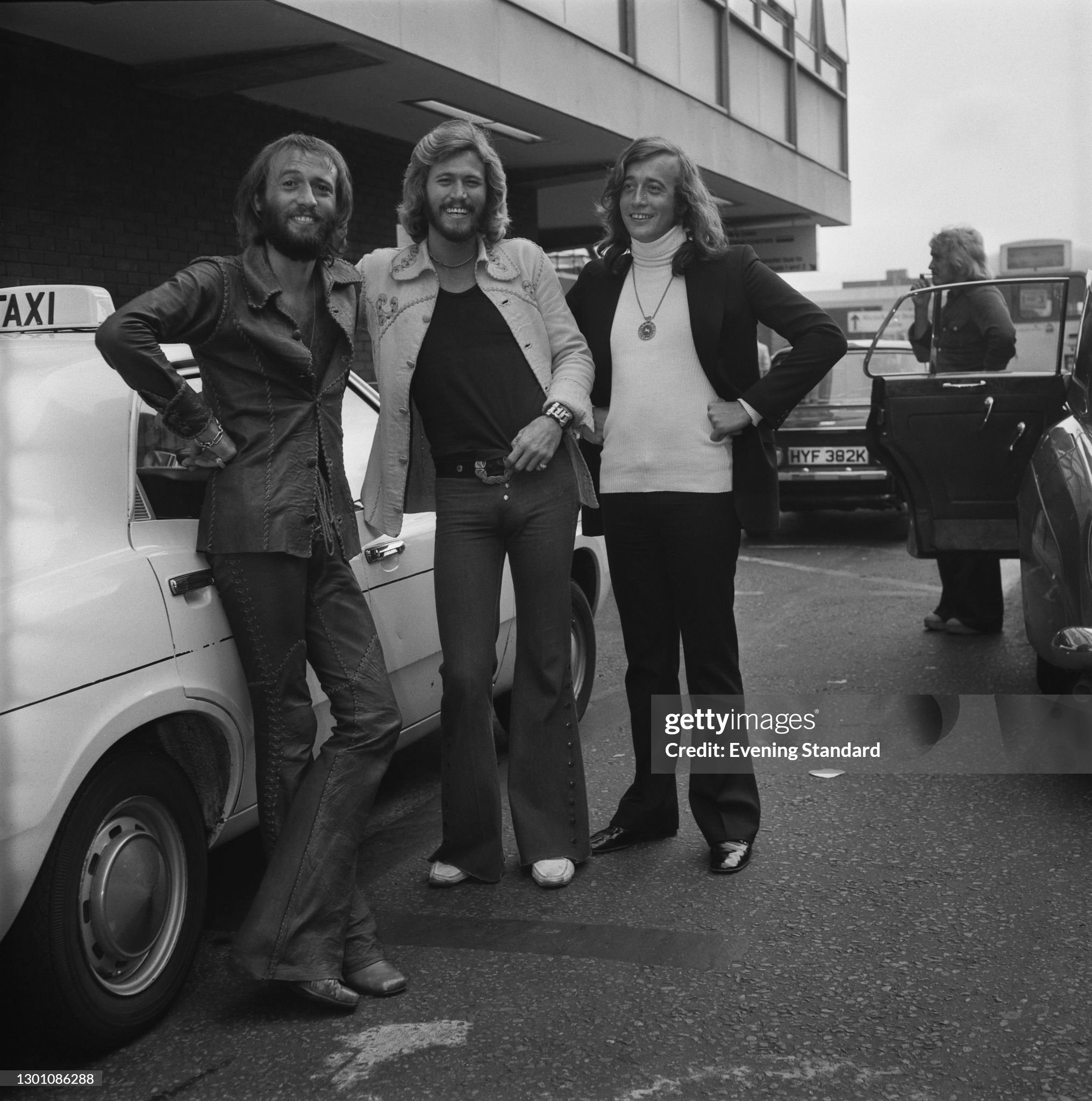
Behind the sleek rush of Night Fever, the Bee Gees tucked away a rougher live reminder of the road that carried them there.
When RSO Records issued Bee Gees’ Night Fever as a single in 1978, the A-side arrived with the full force of the Saturday Night Fever moment behind it. It was polished, urgent, and perfectly shaped for an era when the dance floor seemed to have become the center of popular culture. But the flip side of that massively successful single carried a very different kind of energy: a live version of Down the Road, recorded at the L.A. Forum in 1976, before the brothers’ disco-era image had fully overtaken the public imagination.
That B-side choice matters because Down the Road was not born in the white-hot glow of 1978. The song first appeared on Mr. Natural, the 1974 album the Bee Gees made with producer Arif Mardin during a searching and transitional period. Written by Barry Gibb, Robin Gibb, and Maurice Gibb, it belonged to the chapter just before the group’s mid-1970s reinvention fully took hold. Mr. Natural was not the commercial earthquake that would follow, but it was a significant record in the Bee Gees’ evolution: tougher, more R&B-aware, and pointed toward a new rhythmic confidence.
By the time the live Down the Road appeared on the back of Night Fever, the contrast was almost like a secret conversation between two versions of the same band. One side represented the Bee Gees at their most immaculate and world-conquering, gliding through the soundtrack era with an ease that sounded inevitable. The other side reminded listeners that this sound had not simply appeared out of nowhere. It had been worked toward, tested on stages, built through reinvention, and hardened by years of uncertainty, touring, and musical risk.
The L.A. Forum recording came from the concert period captured on Here at Last… Bee Gees… Live, released in 1977. On stage, the brothers were not merely studio architects of harmonies and hooks. They were fronting a muscular live band, with players such as guitarist Alan Kendall, drummer Dennis Bryon, and keyboardist Blue Weaver helping give the material a broader, more physical shape. In that setting, Down the Road had room to breathe differently from its studio origin. It carried the push of amplified guitars, the response of a large room, and the slightly dangerous feeling of a band leaning into motion rather than perfection.
That is what makes its placement behind Night Fever so intriguing. A B-side can be treated as an afterthought, but for listeners who turned the record over, this one opened a side door into the Bee Gees’ deeper story. The A-side belonged to the bright surface of 1978, to radio saturation, film culture, and a beat that seemed to move through an entire decade. The B-side reached back to the stage, to sweat and volume, to a song from an album that had helped the group move from one identity toward another.
There is also something revealing in hearing the Bee Gees this way. Popular memory often reduces them to the falsetto brilliance of the disco years, as if the brothers were only architects of Saturday-night glamour. But Down the Road argues against that simplification. It shows the band’s harder edges: the blues-rock charge, the rhythmic bite, the willingness to sound a little less polished and a little more physical. Even the title feels fitting in retrospect. The Bee Gees were always moving down the road, from Australian stages to British pop, from baroque ballads to soul-inflected reinvention, from uncertain commercial years to one of the most visible cultural moments of the 1970s.
In 1978, most people came to Night Fever for the shimmer. That was understandable. The song was built to dominate the air, to seem both effortless and exact. But the live Down the Road on the other side gave the single a kind of hidden backbone. It quietly insisted that the Bee Gees’ success was not only a matter of fashion, falsetto, or soundtrack timing. It came from a long apprenticeship in melody, performance, harmony, and survival.
Decades later, that B-side feels less like a curiosity and more like evidence. It catches the Bee Gees standing between eras: not yet completely absorbed into the mythology of Saturday Night Fever, but already carrying the confidence that would soon make them unavoidable. The crowd at the L.A. Forum hears a working band in command of the stage. The listener holding the 1978 single hears something even stranger and richer: the sound of the past tucked behind the future, waiting for anyone willing to turn the record over.
