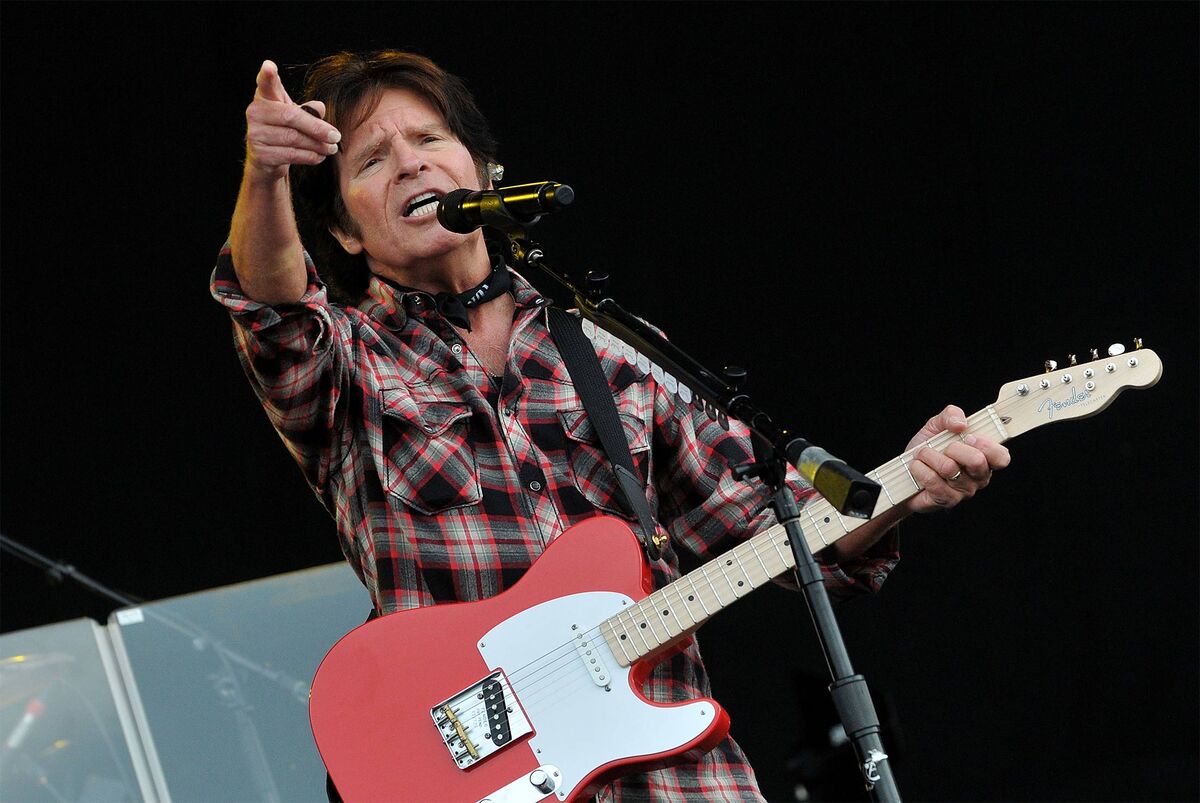
In 1996, Carl Perkins and John Fogerty turned an old Sun Records spark into a living conversation between rockabilly’s first fire and roots rock’s enduring echo.
The 1996 duet between Carl Perkins and John Fogerty on All Mama’s Children belongs to a very particular moment: the Perkins-centered tribute album Go Cat Go!, a project that gathered admirers around one of rock and roll’s founding voices while allowing Perkins himself to remain at the center of the room. This was not simply a cover version, and it was not a museum-polished recreation of the 1950s. It was a meeting between a man who helped invent rockabilly’s vocabulary and a later roots-rock figure who had absorbed that language so deeply it had become part of his own musical pulse.
All Mama’s Children reaches back to Perkins’ Sun Records era, when country rhythm, blues bite, and hillbilly swing were being thrown together with a force that still feels startlingly alive. The song, written by Carl Perkins with Johnny Cash, carried the looseness and urgency of early rock and roll before the music had hardened into categories. It had the slap, the grin, the forward lean. It sounded like a jukebox that had learned how to jump. By the time Perkins revisited it with Fogerty on Go Cat Go!, the song already had decades of history behind it, but the performance refuses to treat that history as fragile glass.
That is what makes this collaboration so rewarding. Fogerty does not enter the track as a guest trying to modernize Perkins, nor as a respectful bystander afraid to disturb the original spirit. He comes in as someone whose own work with Creedence Clearwater Revival had always been rooted in the same American soil: the snap of country guitar, the drive of early rock, the plainspoken authority of Southern-inflected storytelling, even when filtered through California rooms and radio-era imagination. Fogerty understood that Perkins’ music was not polite nostalgia. It was movement. It was tension. It was rhythm with dirt on its shoes.
Perkins, for his part, carries the song with the unmistakable ease of someone returning to a path he helped clear. His voice and guitar do not need to announce their importance. They know where the corners are. They know when to lean into the beat and when to let the groove breathe. In a lesser tribute setting, a younger guest might crowd the elder artist with volume or reverence. Here, the pleasure comes from balance. Fogerty’s rasp and drive meet Perkins’ rockabilly authority, and the result feels less like a formal salute than a shared grin across generations.
The album Go Cat Go! arrived at a time when many of rock’s origin stories were being revisited with fresh affection. The compact disc era had encouraged box sets, reissues, tributes, and late-career collaborations that brought early rock and roll pioneers back into the broader conversation. But the best of these moments did more than remind listeners who came first. They showed that the old music still had working parts. All Mama’s Children with John Fogerty does exactly that. It does not merely point backward to the Sun studio glow; it carries that feeling into the mid-1990s without sanding off its rough edges.
There is also something quietly meaningful in the choice of song. Perkins will always be linked in popular memory with Blue Suede Shoes, a record so famous it can sometimes overshadow the full range of his writing and playing. But All Mama’s Children reveals another side of the same engine: playful, propulsive, built for voices that enjoy the push and tumble of the phrase. Bringing Fogerty into that song opens a clearer line between Sun rockabilly and the swampy, backbeat-driven spirit that later powered so much American roots rock. You can hear the family resemblance without anyone needing to explain it.
The duet’s emotional force is not grand or theatrical. It is warmer than that. It lies in the sound of recognition: Fogerty recognizing a source, Perkins recognizing a fellow believer, the song recognizing that it still has legs. Some collaborations feel assembled; this one feels discovered. The guitar attack, the vocal grain, the sense of rhythmic mischief all suggest that the music did not have to be revived because it had never really gone still. It had simply been waiting for the right hands to set it moving again.
For listeners who know Fogerty mainly through Bad Moon Rising, Fortunate Son, or Proud Mary, his appearance beside Perkins helps illuminate the roots beneath his own famous sound. For listeners who know Perkins chiefly as a 1950s pioneer, the duet shows how far his influence traveled, not as a relic but as an active current. All Mama’s Children on Go Cat Go! is a compact reminder that rock and roll history is not only made of milestones. Sometimes it is made of handoffs, nods, shared choruses, and the unmistakable click when two artists from different chapters find the same beat.
What remains after the track ends is not just admiration for a clever pairing. It is the feeling of a circle closing without becoming final. Perkins brought the spark from the Sun Records dawn; Fogerty carried evidence of where that spark had traveled. Together, on this 1996 recording, they made All Mama’s Children sound less like an old number being revisited and more like a family story still being told aloud, with the rhythm still bright enough to light the room.
