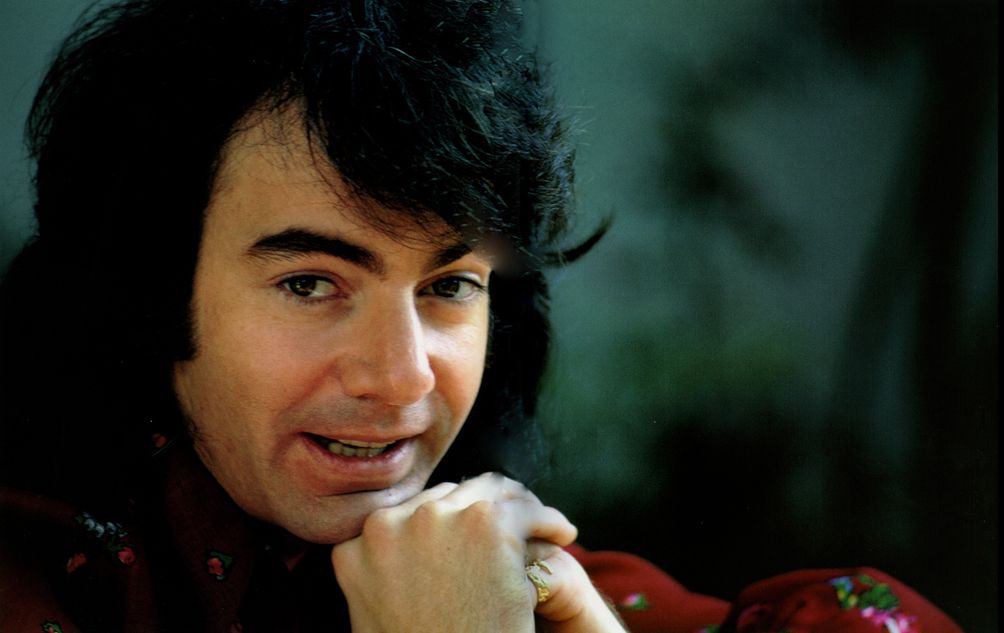
Before Neil Diamond became the voice of grand confession and crowd-sized choruses, “Do It” caught him in motion: urgent, eager, and still close to the restless New York pulse that shaped his earliest records.
In 1966, when Neil Diamond released “Solitary Man” on Bang Records, the single introduced a recording artist who had already spent years learning how to write to the beat of other people’s expectations. But on the original B-side, “Do It,” there is another kind of introduction. Not the lonely, wounded self-examination that made the A-side so memorable, but something quicker, leaner, and more impatient. If “Solitary Man” sounded like a young songwriter discovering how much pain he could fit into a pop single, “Do It” sounded like that same artist refusing to stand still long enough to be defined by only one mood.
That matters when listening back to Diamond’s early era. By the time the world came to know him through larger, more sweeping records, his voice had become associated with emotional scale: the deep chest tone, the dramatic rise, the sense that every phrase was reaching for something just beyond the room. But the Bang Records period preserves a different tension. This was still the sound of a writer-performer moving out of the Brill Building world and into a more direct spotlight, carrying with him the discipline of hit-making craft but also the hunger to sound unmistakably like himself. “Do It” sits right in that threshold.
As a song, it does not ask for solemnity. It pushes forward. There is a punch in the arrangement, a compact confidence in the way the record moves, and a youthful insistence in Diamond’s delivery that feels tied to the mid-1960s New York pop and R&B atmosphere around him. You can hear a singer still close to the machinery of singles culture, where two sides of a 45 could reveal two different instincts: one side to draw people in, the other to prove there was more fuel in the tank than the headline track alone suggested. “Do It” may have lived in the shadow of “Solitary Man,” but shadows in pop history are often where personality survives in its rawest form.
What makes the pairing so revealing is the contrast. “Solitary Man” is inward-looking, bruised, and already marked by the emotional directness that would become central to Diamond’s best-known work. “Do It,” by comparison, feels like action instead of reflection. It carries less self-protection. The title itself is almost an instruction, a small burst of motion. Put next to the A-side, it shows that early Diamond was not only a writer of romantic uncertainty. He could also cut a record with snap and drive, a record that trusted rhythm and attitude to carry the message.
There is something especially moving about hearing that kind of confidence before the mythology of success fully settles in. Early recordings often let us hear artists before they become monuments to themselves. On “Do It,” Diamond is not yet the figure later audiences would project onto him. He is still a young man in a competitive singles market, testing how his voice sits inside a tougher groove, seeing how much edge he can keep while remaining unmistakably melodic. That creates its own kind of excitement. The record feels less polished as identity and more alive as possibility.
Bang Records was an important chapter in that transformation. It was the label home of Diamond’s first major steps as a recording artist, and those early sessions captured the blend that would make him so distinctive: pop structure, soulful attack, and a voice that could turn from conversational to commanding within a single phrase. Listeners who only know the later, broader version of his artistry can be surprised by how tight and immediate these early sides sound. They are not built for grandeur. They are built for impact.
That is why “Do It” deserves more than a passing mention as a footnote or collector’s detail. Its value is not only that it was the original B-side to “Solitary Man”. Its value is that it helps complete the picture of where Neil Diamond was in 1966: ambitious, versatile, and still shaping the public version of himself one 45 at a time. The song reminds us that careers are rarely born fully formed. Sometimes they arrive in pairs, with one side carrying the emotional wound and the other carrying the nerve to keep moving.
And that may be the real pleasure of returning to records like this. They let history breathe a little. They take a name that later became enormous and return it to a smaller room, where the singer is still reaching, still testing, still finding the exact weight of his own voice. On “Do It,” you can hear not just an early Neil Diamond song, but an early Neil Diamond decision: to push forward, to make the record hit, and to leave enough spark on the flip side to suggest that the story had only just begun.
