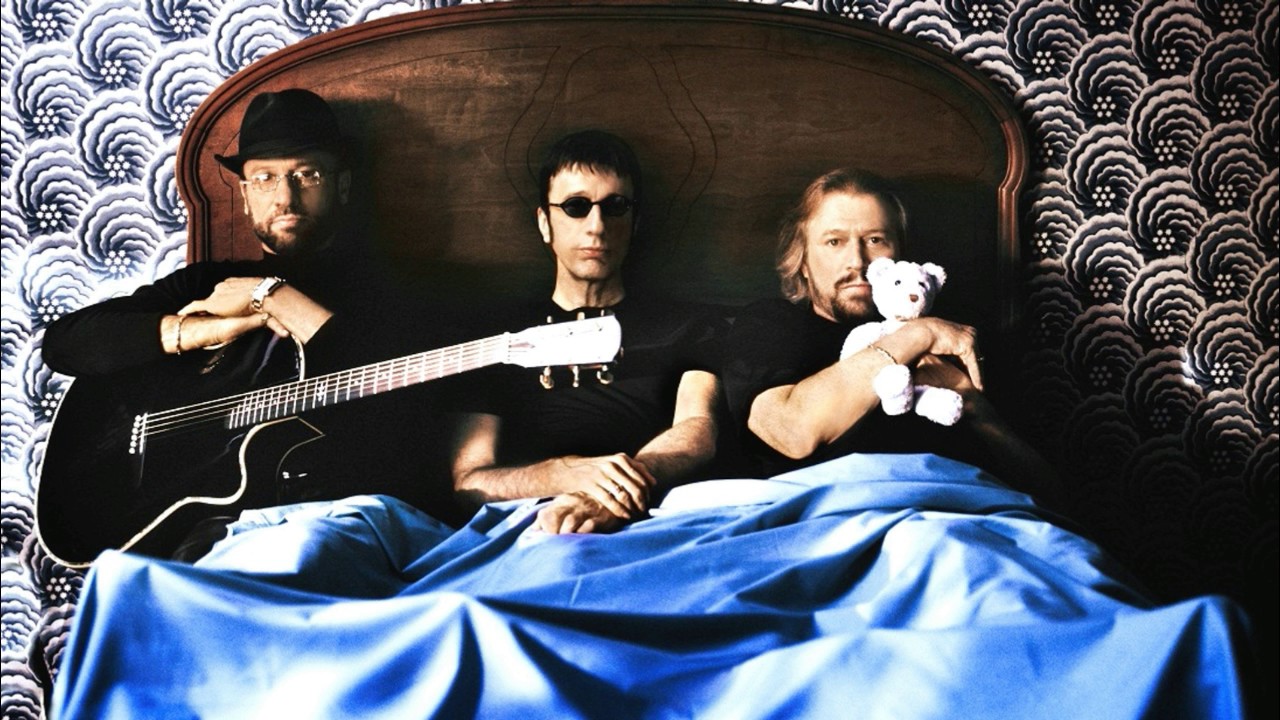
On a record built around the Gibb brothers’ own writing, “Such a Shame” feels like a hidden doorway—briefly letting another voice, and another possibility, into the world of the Bee Gees.
When the Bee Gees released Idea in 1968, they were already deep into the richly arranged, emotionally intricate sound that had made their late-1960s work so distinctive. Barry, Robin, and Maurice Gibb were not simply the group’s singers and public faces; they were also the engine of its songwriting identity. That is what makes “Such a Shame” such a striking anomaly. Tucked inside Idea, it remains the only song on a Bee Gees album not written by a Gibb brother, and it goes one step further by placing guitarist Vince Melouney on lead vocals. In a catalog so closely tied to one family’s voice and imagination, that is more than a curiosity. It is a small but revealing crack in the frame.
That hidden-story quality is what gives the track its fascination. Most listeners approach a Bee Gees album expecting the unmistakable emotional signatures of the brothers themselves: Barry’s grounded warmth, Robin’s high, quivering ache, Maurice’s subtle musical glue holding the edges together. Even when their arrangements turned elaborate, their records still felt intensely personal, almost sealed by the family bond at the center of the music. “Such a Shame” interrupts that assumption. It does not arrive with fanfare, and that may be part of its power. Instead, it sits quietly in the album, carrying the unusual charge of a song that seems to have wandered in from just outside the house.
Vince Melouney was hardly an outsider in the ordinary sense. As the group’s guitarist during this period, he was part of the expanding Bee Gees lineup in their ambitious late-1960s phase. But hearing him step into the vocal spotlight changes the emotional temperature at once. A different lead voice changes more than the melody line; it changes the center of gravity. On a Bee Gees record, that shift is immediately felt. Melouney’s presence suggests a version of the band that might have become more open, more collective, less defined by the tightly held identity of the Gibb brothers as writers and interpreters of their own material.
That idea matters because Idea itself belongs to a particularly interesting stretch in the group’s history. Released after the breakthrough years that established their reputation for ornate pop and melancholy sophistication, the album captures a band in motion—still experimenting, still widening its studio palette, still negotiating what exactly the Bee Gees were going to be. In that setting, “Such a Shame” feels less like an accident than a fleeting alternate path. For one song, the rules loosen. The usual authorship disappears. The family-centered vocal identity steps aside. Another member gets the microphone. Another sensibility enters the room.
That does not mean the track stops sounding like the late-1960s Bee Gees. It still belongs to the atmosphere of Idea, an album shaped by the group’s taste for melody, mood, and pop craftsmanship. But because it comes from outside their usual writing circle, the song carries a slightly different weight. It reminds us how much the group’s identity depended not only on how they sang, but on what they chose to sing. The Gibb brothers were so complete a songwriting unit that any deviation becomes instantly revealing. “Such a Shame” shows just how rare that deviation was.
There is also something quietly moving about the way the song survives inside the album. It is not one of the most frequently discussed titles in the Bee Gees story. It does not dominate retrospective conversations about the band’s 1960s work. Yet that very modesty is part of why it endures for devoted listeners. Some songs become important not because they tower over an artist’s catalog, but because they expose its boundaries. “Such a Shame” tells us where the normal line was—and how unusual it was to cross it.
For fans who know the Bee Gees mainly through the great Gibb-penned singles, this track can feel almost uncanny at first. Not because it betrays the band, but because it reveals how carefully the band’s identity had been built. A group can have several members, but still revolve around one central authorship, one emotional language, one internal chemistry that outsiders rarely touch. Here, for just a few minutes, that circle opens. Vince Melouney is allowed not just to play within the sound, but to stand at its center.
That is the hidden story inside “Such a Shame”. It is not merely a footnote about credits or a trivia answer about album sequencing. It is a glimpse of a Bee Gees record behaving differently from what history taught us to expect. On Idea, amid songs so closely linked to the Gibb brothers’ own sensibility, this one track suggests another version of the band flickering into view and then fading just as quickly. That fleeting change is exactly what makes it memorable. Sometimes the smallest exception tells you the most about the rule, and sometimes a nearly forgotten album cut can illuminate an entire group’s identity more clearly than the hits ever could.
