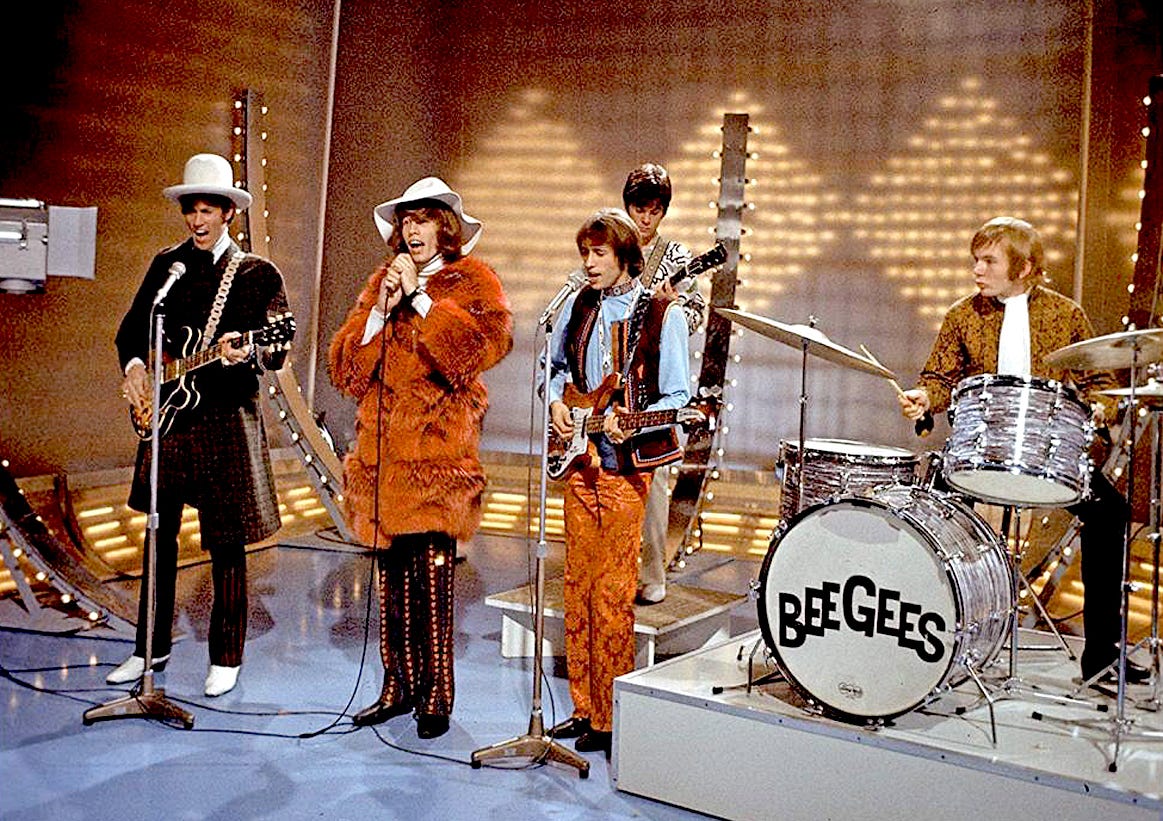
A tender plea wrapped in velvet harmony, “Fanny (Be Tender with My Love)” quietly revealed the new Bee Gees before the world fully heard what Main Course had begun.
There are songs that arrive like a grand announcement, and there are songs that slip into the room more gently, only to reveal later that they were standing at the doorway of a whole new era. “Fanny (Be Tender with My Love)” belongs to that second kind. Drawn from the Bee Gees’ 1975 album Main Course, the song became a U.S. No. 12 hit on the Billboard Hot 100, and for many listeners it remains one of the most graceful records from the group’s mid-1970s rebirth. Yet its real importance goes deeper than chart placement. This was one of the records that showed, with unusual softness and control, how the Bee Gees were reshaping themselves through rhythm, atmosphere, and the increasingly expressive use of Barry Gibb’s higher register.
By the time Main Course was taking shape, the brothers had already lived several musical lives. They had been masters of dramatic late-1960s pop, careful craftsmen of melody, and writers of songs full of melancholy and theatrical beauty. But the early 1970s had not always been kind to their momentum, especially in the United States. What changed during the Main Course period was not simply style, but confidence. Recording in Miami and working in a setting deeply connected to contemporary American soul and R&B currents, the group began to rethink groove, texture, and vocal placement. The guidance of Arif Mardin during this period mattered greatly, because he understood how to preserve the brothers’ songwriting identity while opening the door to a more modern rhythmic pulse.
That is the recording context that makes “Fanny (Be Tender with My Love)” so fascinating. It is not the loudest declaration of the Bee Gees’ transition, and it is certainly not as swaggering as “Jive Talkin’”. Instead, it lets the change happen in a more intimate frame. The arrangement breathes with an R&B-influenced smoothness: the rhythm section moves with restraint, the keyboards and guitars are polished but never showy, and the harmonies sit inside the track like silk. Most importantly, Barry’s vocal approach points toward the future. His falsetto transition was becoming one of the defining sounds of the group’s next chapter, and on “Fanny” it is used not as a dramatic trick, but as emotional shading. That choice matters. It gives the song its aching tenderness and makes the performance feel both vulnerable and quietly sophisticated.
The song was written by Barry, Robin, and Maurice Gibb, and like many of their best compositions, it balances direct emotion with a kind of mystery. The title alone is unforgettable: “Fanny (Be Tender with My Love)”. It sounds almost like a whispered request rather than a pop hook. Lyrically, the song is a plea for care, trust, and emotional gentleness. There is longing in it, but also caution. The singer is not simply declaring love; he is asking that love be handled delicately. That emotional posture fits the record’s sonic character beautifully. The performance never pushes too hard. It leans in. It knows that fragility can be more moving than force.
One reason the track continues to resonate is that it sits at such an intriguing point in the Bee Gees story. If a listener comes to it after hearing the thunderous confidence of the late-1970s hits, “Fanny” can sound almost understated. But that understatement is exactly the point. This is a transitional masterpiece. The lush pop craftsmanship of the earlier Bee Gees is still present, especially in the melodic architecture and the emotional seriousness of the writing. At the same time, the record is unmistakably looking ahead. The pulse is looser, the phrasing more rhythm-conscious, the vocal strategy more sensual, and the production more spacious. In that sense, “Fanny” is one of the clearest windows into how Main Course became such a pivotal album.
Its chart life confirmed that listeners were hearing something special. Though often overshadowed in hindsight by the colossal success that would follow, “Fanny (Be Tender with My Love)” performed strongly, rising to No. 12 in the United States and giving the group another important American hit from Main Course. In the UK, it also reached the Top 20. Those numbers matter because they show this was not merely an album cut admired by devoted fans. It connected. Radio embraced it, and audiences responded to its warmth, elegance, and unmistakable emotional pull. It proved that the Bee Gees’ evolving sound was not limited to upbeat singles; it could carry a ballad just as powerfully.
Listening now, what lingers most is the sense of control. Nothing in the record feels accidental. The harmonies are rich without becoming heavy. The groove is modern for its time without sacrificing songcraft. Barry’s lead vocal carries a soft ache, while the group’s blend reminds us that few family acts ever sounded this intuitively fused. There is also something moving about the timing of it. Before the global phenomenon, before the white suits, before the soundtrack era turned them into a cultural force beyond scale, there was this: three brothers refining their sound in the studio, listening closely to what contemporary soul and R&B could do for their writing, and discovering that reinvention did not require abandoning their identity.
That may be why “Fanny (Be Tender with My Love)” still feels so human. It was made in a moment of artistic recalibration, when experience, uncertainty, craft, and instinct were all meeting in the same room. It stands as one of the loveliest pieces on Main Course, but also as one of the album’s most revealing. If “Nights on Broadway” and “Jive Talkin’” announced the new direction with more flash, “Fanny” revealed its heart. And sometimes that is where the real story is found: not in the loudest turning point, but in the quiet song that let the future arrive with tenderness.
