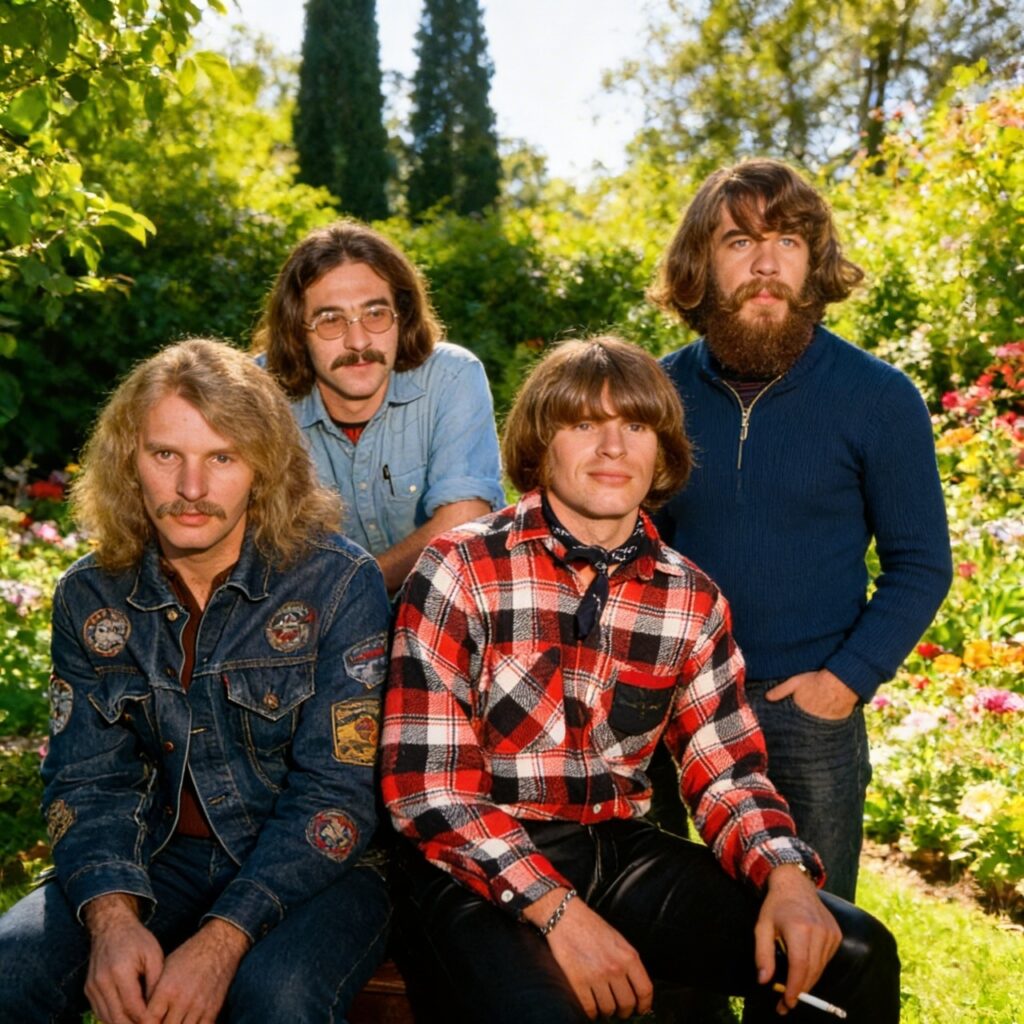

Bayou Country was more than a breakthrough record for Creedence Clearwater Revival in 1969; it was John Fogerty‘s hard-edged, deeply human portrait of labor, motion, and the dignity of ordinary life.
When people talk about the working-man spirit in John Fogerty‘s writing, Bayou Country is one of the clearest places to begin. Released in early 1969, the album became the first major turning point for Creedence Clearwater Revival, rising to No. 7 on the Billboard 200. Its signature single, “Proud Mary”, climbed to No. 2 on the Billboard Hot 100 and helped turn the group into a national force. But charts only tell part of the story. What gave Bayou Country its staying power was the way it sounded lived-in, weathered, and emotionally earned. It did not speak in grand theories. It spoke in sweat, movement, pressure, and survival.
That is what makes the phrase “the working man” fit this period so well. Not because Bayou Country is a concept album about labor in any narrow sense, but because the whole record is shaped by a blue-collar worldview. John Fogerty wrote with the instincts of someone who distrusted pretense, preferred directness, and understood that life often feels like a long road with no room for self-pity. In an era when much of rock music was expanding into psychedelia, abstraction, and indulgence, Creedence Clearwater Revival did something almost radical: they got to the point. The songs were tight, muscular, and free of waste. Even at their most atmospheric, they never drifted.
There is also a fascinating tension at the heart of the album. Fogerty was not from Louisiana. He was a Californian, raised in El Cerrito, and yet he created one of the most convincing Southern rock mythologies of the age. That has always been part of his mystery. But the reason the music works is not geography alone. It works because the emotional truth is real. Bayou Country is filled with people on the move, people under strain, people living close to the bone. This is not the South as a postcard. It is the South as a soundscape of work, night, weather, river current, rail lines, and grit. Fogerty may have imagined the bayou from a distance, but he understood the emotional world of labor and endurance from the inside.
The opening track, “Born on the Bayou”, announces that world immediately. It is one of the great scene-setting performances in American rock, thick with humidity and menace, but also with resolve. The song does not feel decorative. It feels inhabited. Then comes “Bootleg”, where underground commerce and makeshift survival replace romance or glamour. Even the imagery of hidden whiskey and back-road dealing carries a larger social feeling: this is music about people outside comfort, making their own way as best they can. “Graveyard Train” pushes deeper into folk-blues territory, all rumble and ritual, while “Keep on Chooglin'” turns repetition into propulsion, as if momentum itself were a form of faith.
If one song on Bayou Country most openly reveals Fogerty‘s class instinct, it may be “Penthouse Pauper”. It is rough, sarcastic, and impatient with privilege. The title alone says much about the worldview underneath the album: wealth can be empty, comfort can be false, and status does not necessarily bring meaning. That same skepticism runs quietly through the entire record. Creedence Clearwater Revival never sounded impressed by luxury. They sounded impressed by toughness, stamina, and the ability to keep going.
And then there is “Proud Mary”, still one of the most beloved songs Fogerty ever wrote. It is often remembered for its irresistible hook and riverboat imagery, but beneath that easy motion lies a deeper truth. The song is about release, yes, but also about leaving behind strain and finding dignity in movement rather than in status. In the context of Bayou Country, “Proud Mary” is not simply a catchy single. It is the album’s most graceful expression of a blue-collar dream: not luxury, not power, just the chance to move forward, breathe easier, and keep rolling.
The sound of the record matters as much as the lyrics. Doug Clifford‘s drumming has the solidity of factory rhythm and freight-line certainty. Stu Cook‘s bass keeps everything grounded. Tom Fogerty‘s guitar work helps thicken the frame without crowding it. Above all, John Fogerty‘s voice carries the grain of experience. He did not sing like a distant observer. He sang as though every line had already passed through dust, engine smoke, and long hours. That is why the album still feels so immediate. It does not present working life as noble decoration. It gives it pulse and tension.
Looking back, Bayou Country now feels like the sound of a band discovering not only its signature style, but its moral center. Creedence Clearwater Revival would go on to make larger cultural statements in songs such as “Fortunate Son” and to deepen their populist streak on later records, but the foundations are already here. This was where John Fogerty made clear that his great subject was not fantasy for its own sake. It was the American worker, the drifter, the survivor, the person who keeps moving because standing still is not an option.
That is why Bayou Country still lands with such force. It reminds listeners of a time when rock and roll could be cinematic without losing its calluses, mythic without becoming false, and popular without forgetting the people who carried the weight of ordinary days. In 1969, that was a revelation. Today, it still feels like truth.
