
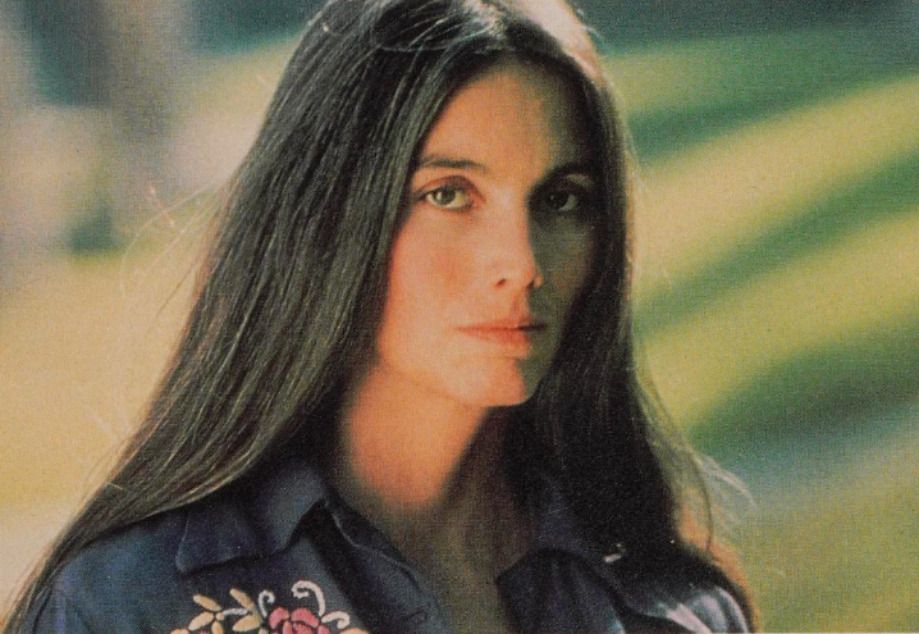
Kern River becomes something almost sacred in Emmylou Harris‘s hands: a river ballad about love, regret, and the kind of memory that never truly loosens its grip.
There are songs that tell a story, and then there are songs that seem to carry an entire landscape inside them. Kern River belongs to that second kind. Though the song was written and first recorded by Merle Haggard, it found an especially haunting second life when Emmylou Harris performed it with the Nash Ramblers on the live album At the Ryman. Haggard’s original version, released in 1985 as the title track from his album Kern River, reached No. 10 on Billboard’s Hot Country Singles chart. Emmylou Harris‘s version was not built around chart ambition, and it did not become a major chart single of its own, but in many ways that only deepened its power. This was not a performance chasing radio. It was a performance chasing truth.
The song itself is one of the finest narrative pieces in modern country music. In Haggard’s writing, the Kern River is more than a location in California. It is a place where youth, desire, danger, and sorrow all meet at once. The lyric begins with what feels like a familiar memory of summer freedom, of taking a girl down to the river, of a world that still seems open and unwarned. But the mood shifts quietly, and then completely. What begins with warmth and innocence becomes a ballad of irreversible loss. Haggard drew from the real reputation of the Kern River, a river long known in California for both beauty and peril, and from the emotional geography of the Bakersfield world he knew so well. That is part of what gives the song its force: it feels lived in, not invented.
When Emmylou Harris sings Kern River, she does not try to outdo Haggard or imitate him. She does something finer than that. She enters the song as a careful witness. Her voice, always one of the most expressive instruments in American music, brings a different shade of feeling to the lyric. Where Haggard sounds close to the dust and the road, Harris sounds like memory itself drifting back through an old room. She sings with restraint, which is exactly why the ache lands so deeply. Nothing is exaggerated. Nothing is pushed too hard. The sadness is allowed to breathe.
That setting matters, too. At the Ryman, released in 1992, was more than just a live album. It became part of the historic revival of the Ryman Auditorium, a room already soaked in country music history. Hearing Emmylou Harris sing Kern River there gives the performance an added weight. The old wood, the hush of the audience, the elegance of the Nash Ramblers, all of it turns the song into something almost ceremonial. It feels less like entertainment than remembrance. The arrangement is beautifully judged: traditional without sounding museum-like, emotional without becoming sentimental. Fiddle, guitar, and rhythm move gently beneath her, never crowding the lyric, always serving the story.
Part of the greatness of Kern River is that its meaning keeps widening the longer one lives with it. On the surface, it is a story song. Beneath that, it is a meditation on how quickly a beautiful moment can darken. And deeper still, it becomes a song about the places we carry inside us forever. Most people, if they have traveled far enough through life, know what that means. There is always some river, some road, some summer evening that remains sharper than it should. Not because it was perfect, but because it changed us. In that sense, Kern River is not only about one place in California. It is about the geography of memory.
This is precisely why the song suits Emmylou Harris so well. Across her career, whether on records like Pieces of the Sky, Quarter Moon in a Ten Cent Town, Wrecking Ball, or in countless collaborations, she has always been drawn to material where emotion moves beneath the surface instead of announcing itself too loudly. She has a rare gift for finding the loneliness inside a line, the weather inside a melody. In Kern River, she finds both. Her performance reminds us that country music, at its best, does not rely on decoration. It relies on human feeling, plain words, and the courage to let silence do some of the work.
There is also something deeply respectful in her choice to sing this song. Merle Haggard was one of the towering writers and interpreters of American country music, and Emmylou Harris has always understood the art of honoring a great song without flattening it into tribute. She keeps the song’s original bones intact, but her phrasing gives it a gentler, more reflective glow. It is as if Haggard’s river has been seen again years later, under different light, by someone who understands that grief rarely leaves us in the same voice it first arrived.
That is why this version lasts. Not because it was louder, bigger, or more commercially aggressive than the original, but because it reveals another chamber inside the song. Kern River in Emmylou Harris‘s hands becomes a quiet epic, one of those performances that seems to suspend time for a few minutes. You hear the river, yes. But you also hear distance, tenderness, and the long echo of a story no one in the room can entirely shake. Some songs fade when they are covered. This one deepened. And in that old room at the Ryman, Emmylou Harris made sure it would be remembered not only as a fine song by Merle Haggard, but as one of country music’s most enduring meditations on memory and regret.
