
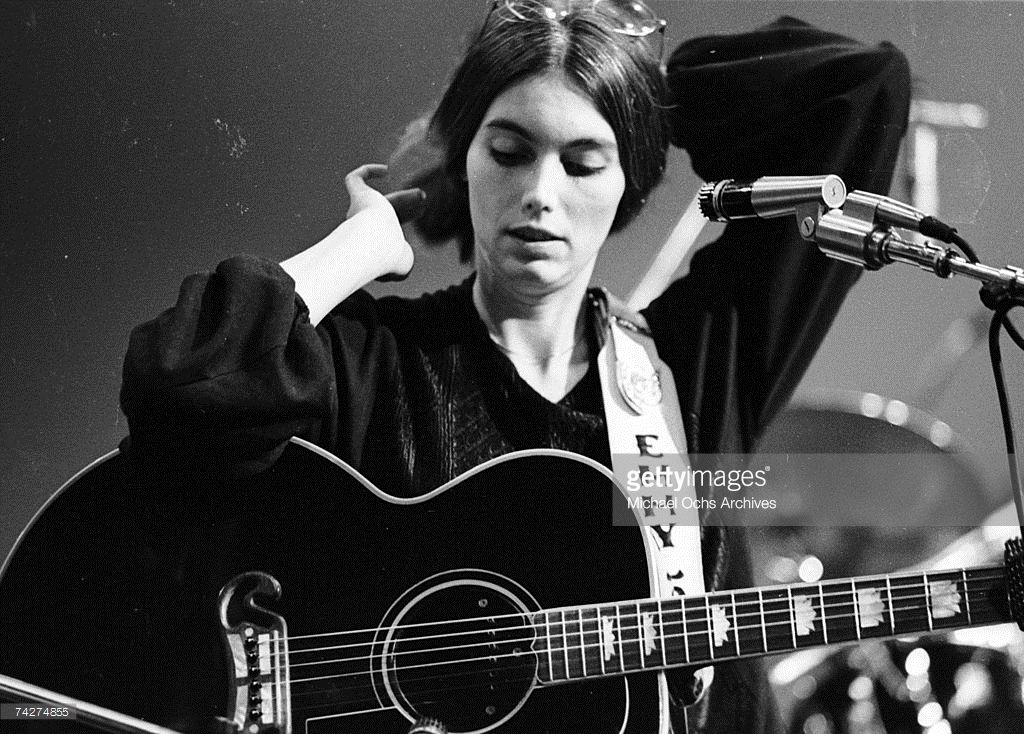
When Emmylou Harris sings “Bury Me Beneath The Willow,” an old sorrow seems to stop moving and simply hover in the air — so pure, so patient, that time itself appears to listen.
The first important facts belong at the beginning, because they explain why “Bury Me Beneath The Willow” feels older than any one singer and yet so deeply personal in Emmylou Harris’s voice. The song is a traditional folk ballad, documented as early as 1909 and known by several titles, including “Bury Me Beneath the Weeping Willow.” Its lyric is heartbreak in one of its oldest American forms: a forsaken woman asking to be buried under the willow tree, hoping the man who left her might still think of her. The song was also part of the Carter Family inheritance, recorded by them in 1927, and that matters enormously, because Emmylou never approached old country songs as museum pieces. She approached them as living memory.
For Emmylou Harris, the song’s most important early recording connection comes through Pieces of the Sky, released on February 7, 1975 — the major-label debut that truly launched her career. That album reached No. 7 on Billboard’s country albums chart, and it announced, with uncommon grace, that Harris was not merely another gifted singer arriving in Nashville’s orbit. She was already something rarer: an artist who could place The Beatles, Dolly Parton, Merle Haggard, and old traditional material inside the same emotional world without making any of it feel forced. In that setting, “Bury Me Beneath The Willow” was not a novelty revival. It was part of a larger artistic declaration about roots, loss, and belonging.
That is why time seems to stand still when she sings it. Many performers treat old mountain or Carter Family material as heritage — admirable, worthy, perhaps a little formal. Emmylou Harris had the far more difficult gift of making such songs sound newly wounded. She did not “update” them in the flashy sense. She listened for the ache already inside them and then sang from within that ache. With “Bury Me Beneath The Willow,” she understands that the lyric is simple only on paper. In truth it contains a whole world: abandonment, memory, pride, grief, and that strange old country impulse to turn heartbreak into something almost beautiful enough to live inside. The song does not need theatrical sorrow. It needs a singer willing to trust stillness, and Harris always knew how to do that.
There is also something profoundly fitting about where this song sits in her artistic identity. Rhino’s retrospective notes on Pieces of the Sky emphasize how strongly that album was shaped by Harris’s time with Gram Parsons and by the broad, adventurous range of her taste. That range is exactly what gave her old songs such unusual authority. She was not singing traditional country because it was expected of her. She was choosing it, lovingly and intelligently, as part of a larger vision of American music. So when she sang “Bury Me Beneath The Willow,” she was not retreating into the past. She was proving that the past still had breath in it.
The song’s afterlife around Harris only deepens that impression. Decades later, she returned to it for Orthophonic Joy: The 1927 Bristol Sessions Revisited in 2015, where the track list again placed “Bury Me Beneath The Willow” in direct conversation with the Carter Family legacy. That later recording is revealing. Artists do not keep returning to songs like this unless the songs speak to something central in them. Harris came back because she had always understood the song’s inner weather — its tenderness, its rural plainness, its refusal to separate beauty from sorrow. It had never stopped belonging to her.
And then there is that lovely side story from the Trio world. A later review of Trio recalled that Dolly Parton, Linda Ronstadt, and Emmylou Harris had first sung “Bury Me Beneath the Willow” together back at Harris’s house, and then performed it on Parton’s TV show in the 1970s, years before their landmark album collaboration was finally completed. That detail feels almost symbolic. Of course this was one of the songs these women would gather around. It is a song of old American womanhood, old American grief, old American harmony. And Emmylou, with that willow-branch voice of hers, was right at the center of it.
So why does time seem to stand still when Emmylou Harris sings “Bury Me Beneath The Willow”? Because she strips away everything nonessential. No strain, no show, no need to prove reverence. She simply enters the song until it no longer feels old or new, famous or obscure, traditional or revived. It just feels true. And that is the rarest thing any singer can do with a classic. Emmylou Harris does not merely preserve “Bury Me Beneath The Willow.” She lets it bloom again in the silence around her voice, where heartbreak is no longer hurried by time, and where an old song can still break the heart as gently as if it had been sung for the very first time.
