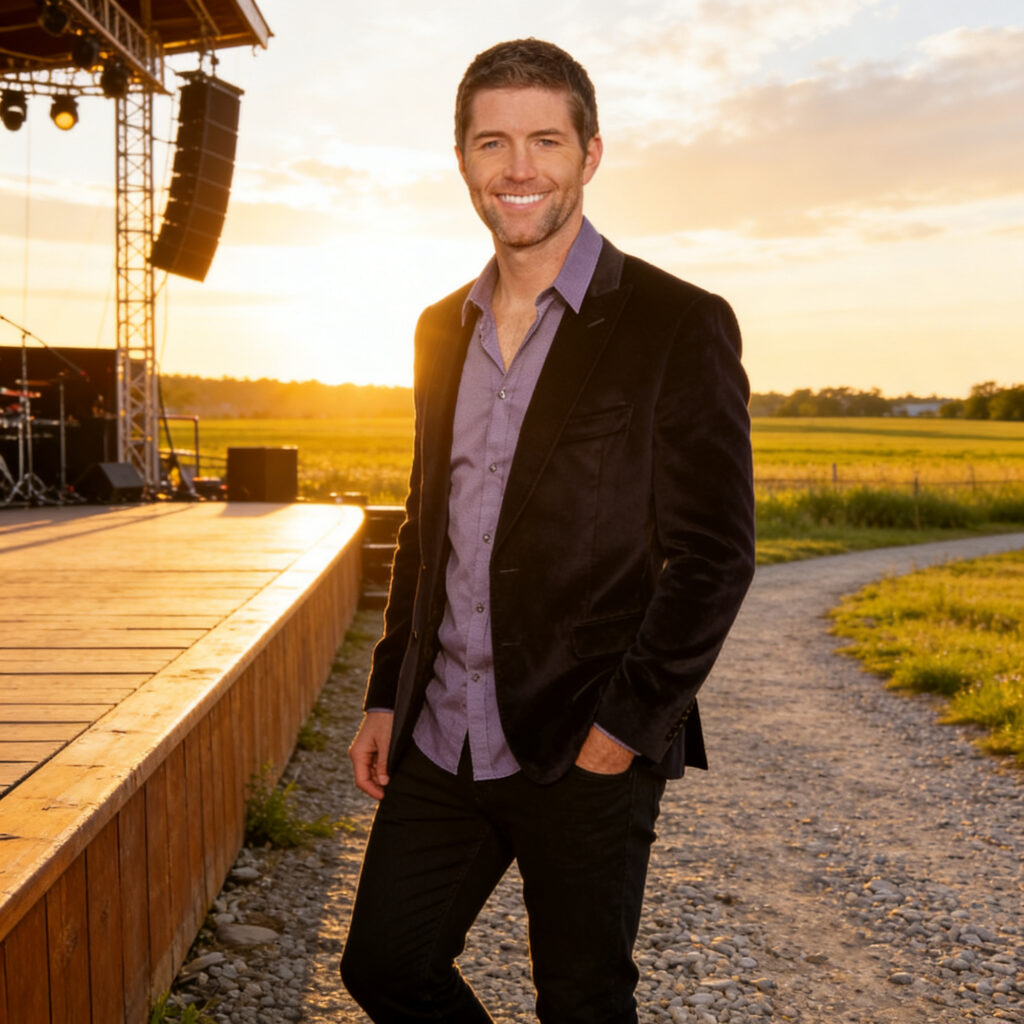
On a historic Nashville stage, Josh Turner turned Merle Haggard’s “Silver Wings” into a quiet act of respect, carried by a voice old enough in spirit to understand the song’s leaving.
On Josh Turner’s 2007 Cracker Barrel exclusive live album Live At The Ryman, his performance of “Silver Wings” stands apart as more than a well-chosen cover. It is a young country singer standing inside one of the genre’s most storied rooms, reaching back toward Merle Haggard with restraint rather than imitation. The setting matters. The Ryman Auditorium in Nashville, long known as the former home of the Grand Ole Opry and often called country music’s “Mother Church,” has a way of making songs feel accountable to history. A voice cannot simply pass through that room without brushing against what came before.
By the time this live album appeared, Turner had already built a public identity around traditional country values. His breakthrough single “Long Black Train” had announced him as a singer with a church-bell baritone and a taste for moral gravity. “Your Man” and “Would You Go with Me” showed he could bring that deep voice into contemporary country radio without losing the older grain in his sound. But “Silver Wings” asked for something different. It was not a showcase for power. It was a test of tone, patience, and humility.
Merle Haggard recorded “Silver Wings” during his classic Capitol period, and the song appeared on the 1969 album A Portrait of Merle Haggard. Written by Haggard, it has lived a curious life in country music: not merely as a catalog item, but as one of those songs that listeners carried around like a private keepsake. Its central image is simple enough to be instantly understood: an airplane leaving, silver wings disappearing, someone left behind with more feeling than language. Haggard had a rare gift for making plain words sound as if they had been weathered by real consequence. He did not need to decorate loneliness. He let it sit in the room.
That is the difficulty facing anyone who sings “Silver Wings”. The song resists overstatement. Push too hard, and it becomes melodrama. Smooth it out too much, and the ache disappears. On Live At The Ryman, Turner’s tribute works because he does not treat Haggard as a mountain to climb. He treats him as a standard to honor. His low register gives the song a different weight from Haggard’s original phrasing. Where Haggard could sound like a man trying to keep his voice level while watching his life pull away, Turner brings a darker, more rounded resonance, as if the sorrow has already settled into memory.
The performance also gains meaning from the live setting. A studio cover can be polished until every corner gleams, but a live Ryman performance carries air around it. You can sense the public nature of the moment: a singer before an audience, a classic country song entering a room built for songs that have survived applause, silence, and time. Turner’s version does not feel like an attempt to update Haggard. It feels like a pause in the concert where the younger artist steps out of his own hit-making lane and acknowledges the road beneath him.
In 2007, a tribute to Haggard did not yet carry the memorial distance it would later acquire. It was a living salute to a writer and singer whose influence still moved through the bloodstream of country music. That distinction gives Turner’s “Silver Wings” a particular warmth. It is not framed as farewell to the man himself, but as reverence for a song that had already traveled far beyond its original era. Turner seems to understand that the most respectful thing he can do is leave space: space around the melody, space around the words, space for Haggard’s shadow to remain visible.
What makes the performance linger is its modesty. There is no need for dramatic reinvention. The emotional power comes from the meeting of three elements: Haggard’s beautifully spare song, Turner’s solemn baritone, and the Ryman’s deep country memory. Together, they create the feeling of an old conversation being resumed rather than a museum piece being displayed. The song’s airplane still leaves. The person left behind still watches. But in Turner’s hands, the distance feels measured not only in miles, but in generations of singers learning how to carry a country song without breaking its truth.
That is why this Live At The Ryman performance remains such a meaningful piece of Turner’s early catalog. It shows an artist secure enough to lower his voice in the presence of a giant, and thoughtful enough to let “Silver Wings” remain what it has always been: a plainspoken country lament with open sky above it, empty space beneath it, and a final image that keeps moving away no matter how many times the song is sung.
