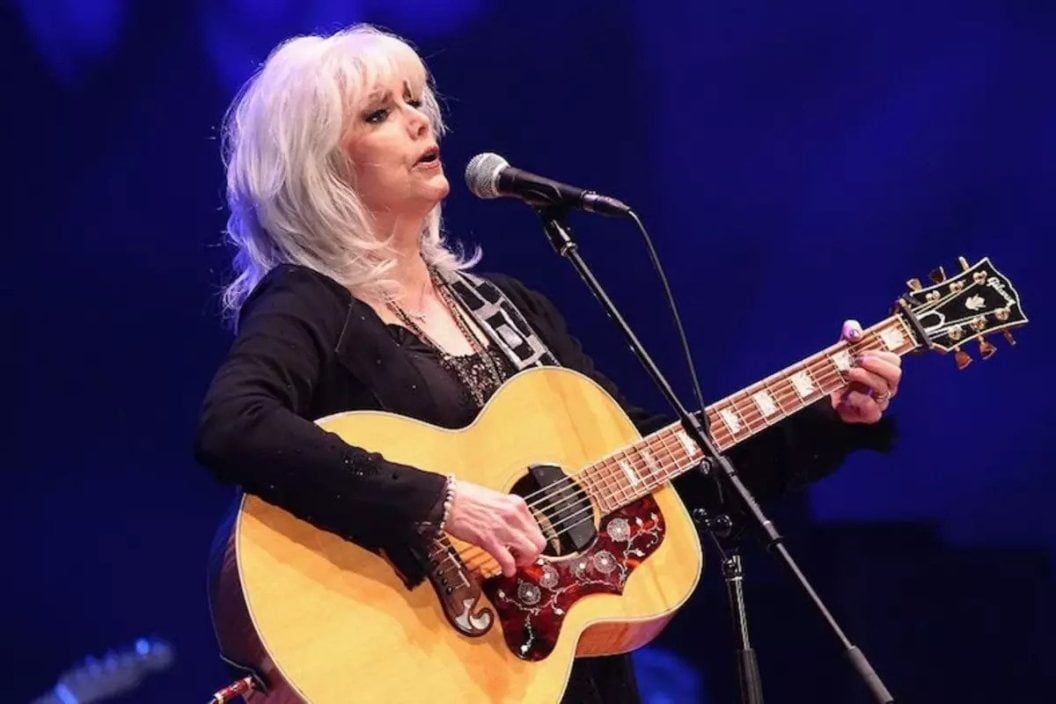
A Love That Will Never Grow Old is not simply a soundtrack song—it is the aching promise at the center of Brokeback Mountain, where love endures even when life gives it no safe place to live.
There are songs that arrive with fanfare, and there are songs that seem to drift in on the wind, carrying something too private to be spoken plainly. Emmylou Harris’s A Love That Will Never Grow Old, written by Bernie Taupin and Gustavo Santaolalla for the 2005 film Brokeback Mountain, belongs to the second kind. It does not shout. It does not plead for attention. Yet once it settles into the heart, it is almost impossible to forget. For many listeners, it became one of the most quietly devastating songs associated with a modern film.
From the start, this was never a conventional chart story. A Love That Will Never Grow Old was not a radio-driven country smash, and it did not become a major Billboard Hot 100 hit. Its path was different, and in some ways more lasting. The song’s true triumph came through the emotional power of the film and through recognition from the industry: it won the Golden Globe Award for Best Original Song, a major honor that confirmed what many listeners already felt—that this was not background music, but one of the emotional keys to Brokeback Mountain itself.
That matters, because Brokeback Mountain was a film that depended as much on feeling as on dialogue. Directed by Ang Lee, the 2005 picture told the story of a bond that could not fully exist in the open world around it. The landscape was wide, the silences were long, and so much of the emotional life of the story lived beneath the surface. A song chosen for that world had to understand restraint. It had to feel older than the moment, almost like a truth carried across generations. Emmylou Harris, with her clear, weathered, compassionate voice, was an inspired choice.
What makes her performance so remarkable is its tenderness. She sings A Love That Will Never Grow Old with the kind of wisdom that does not need to advertise itself. There is no excess in it, no theatrical strain. Instead, she gives the song a kind of sacred plainness. That plainness is exactly why it cuts so deeply. The lyric does not frame love as temporary excitement or youthful drama. It speaks of something enduring, almost fated—something that remains true even when time, distance, and circumstance work against it.
In that sense, the title says nearly everything. A Love That Will Never Grow Old is not about love that stays easy. It is about love that stays alive. There is a difference, and the film understands it painfully well. The song does not romanticize suffering, but it does recognize that some attachments become more powerful because they were never allowed an ordinary life. In Brokeback Mountain, that idea becomes central. Love is not erased by secrecy, silence, or the passing years. If anything, it becomes more haunting because it was never given full daylight.
Musically, the song fits beautifully within the sonic world of the soundtrack. Gustavo Santaolalla built the score and song selections with extraordinary sensitivity, leaning into space, loneliness, and the open-air melancholy of the American West. His writing, paired with Bernie Taupin’s lyric, gives the song a timeless quality. It feels rooted in country and folk tradition, but not trapped in nostalgia. It sounds lived-in, as if it had always existed somewhere just beyond reach, waiting for the right voice and the right story.
And that voice mattered enormously. By 2005, Emmylou Harris had long been one of the most respected interpreters in American music—a singer capable of making a song feel inherited rather than merely performed. She had spent decades bringing grace, sorrow, and quiet authority to country, folk, and roots music. On this recording, she does something only a few singers can do: she makes a cinematic song feel personal, and a personal song feel universal. You do not have to know every detail of the film to understand what she is singing. You only have to know what it means to carry something in the heart for a very long time.
One of the more fascinating turns in the song’s history is that, despite its Golden Globe win, it was notably absent from the final list of Academy Award nominees for Best Original Song. That omission surprised many observers and only deepened the song’s mystique. In retrospect, the lack of an Oscar nomination has not diminished its standing. If anything, it has made the song feel even more like a hidden treasure—honored, admired, and cherished by listeners who know exactly what it accomplishes.
Its meaning has only grown richer with time. Removed from the film, A Love That Will Never Grow Old still stands on its own as a meditation on permanence. Heard within the world of Brokeback Mountain, however, it becomes something almost unbearable in its beauty. It reminds us that love is not measured only by what was publicly seen, socially approved, or neatly resolved. Sometimes its truest measure is what remains after everything else has changed.
That is why the song still lingers. Not because it dominated the charts, and not because it demanded attention in the loudest possible way. It lingers because it understands devotion without spectacle. It understands longing without melodrama. And in Emmylou Harris’s hands, it becomes one of those rare soundtrack songs that does more than accompany a film—it preserves its soul.
