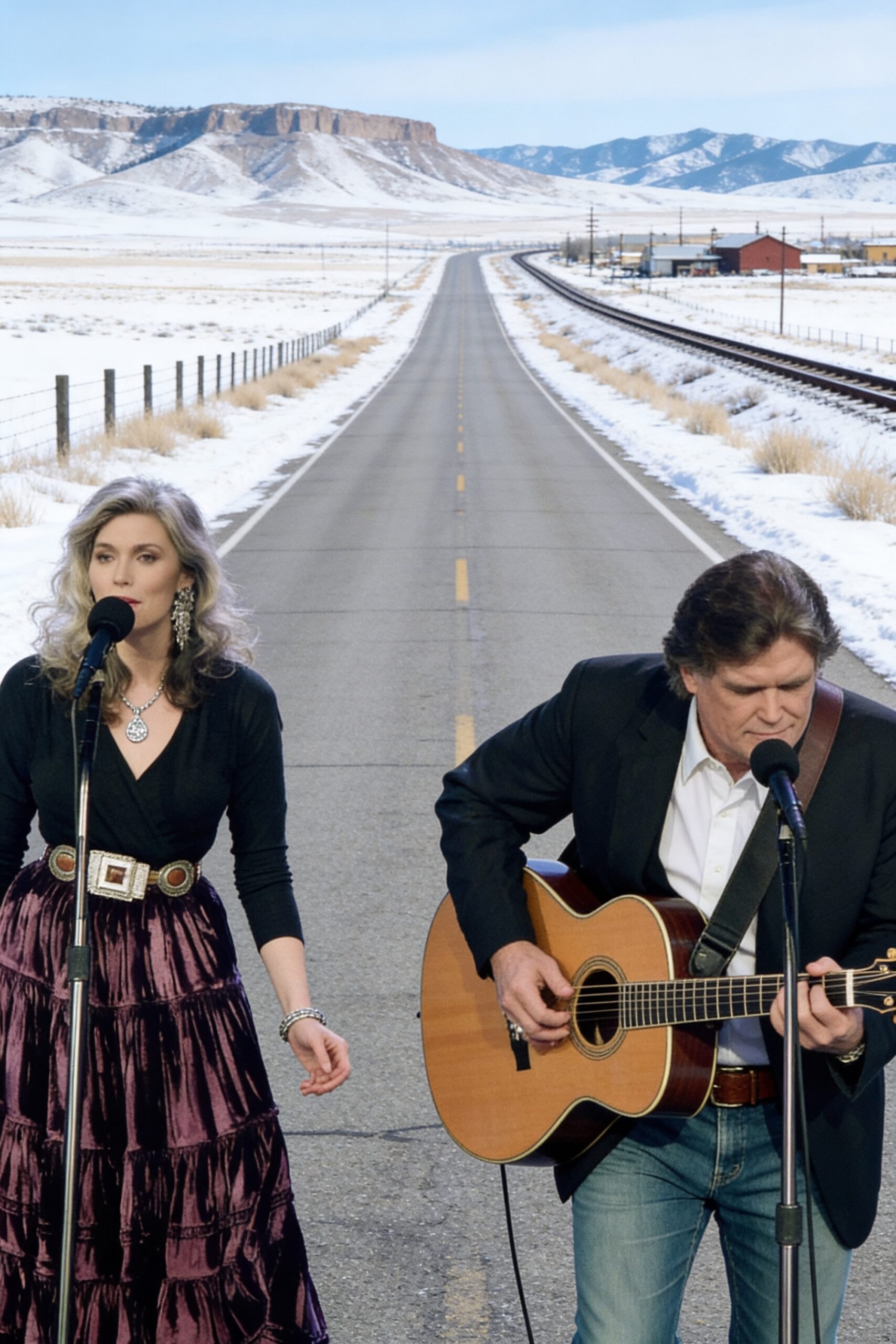
On Red Dirt Girl, My Antonia became a meeting place: Emmylou Harris writing from memory’s edge, and Dave Matthews answering like a voice carried in from another horizon.
Released in 2000 on Nonesuch, Red Dirt Girl marked a crucial creative turn for Emmylou Harris. After the atmospheric reinvention of Wrecking Ball, she moved even more decisively toward a sound where country memory, folk storytelling, and shadowed modern textures could live in the same room. The album placed Harris’s own songwriting at the center in a way that felt newly exposed, and within that setting, My Antonia stood apart as one of its most affecting collaborations. It was not simply a track with a famous guest. It was a self-penned narrative shaped as a duet with Dave Matthews, and the pairing gave the song a quiet tension that still feels unusual and deeply human.
For much of her career, Harris had been celebrated as one of American music’s great interpreters, a singer who could enter a song by Gram Parsons, Rodney Crowell, the Louvin Brothers, Townes Van Zandt, or the Carter Family and make it feel both preserved and newly awake. But Red Dirt Girl asked listeners to meet her not only as a vessel for other writers’ truths, but as a writer carrying her own landscapes. Produced by Malcolm Burn, the album did not polish those landscapes into easy country radio brightness. It gave them air, distance, and grain. The record later won the Grammy Award for Best Contemporary Folk Album, but its deeper achievement lies in how personal it sounded without ever becoming small.
That is where My Antonia finds its particular force. The title carries an unmistakable literary echo of Willa Cather’s prairie novel My Ántonia, and Harris’s song seems to understand the emotional weight a name can hold across years, miles, and memory. It does not unfold like a simple love song built for a neat chorus and a clean resolution. It feels closer to a letter found long after it was written, or a recollection spoken by someone who has learned that the past is never as still as it appears. Harris’s writing gives the narrative a broad, weathered feeling, as if the people inside it are shaped not only by desire, but by land, separation, and the slow ache of what cannot be reclaimed.
The arrival of Dave Matthews could have seemed surprising on paper. By 2000, Matthews was known to millions through the rise of the Dave Matthews Band, whose rhythmic drive, elastic arrangements, and arena-scale following placed him in a very different musical neighborhood from Harris’s country and folk lineage. Yet the success of My Antonia depends on how little the collaboration tries to announce itself. Matthews does not enter as a decorative guest brought in for contrast. He comes into the song as another presence inside the story, his voice rougher at the edges, more earthbound, carrying a tension that balances Harris’s clear, searching tone.
What makes the duet so compelling is its restraint. Harris has always known how to sing as if a feeling is being held carefully rather than displayed. On My Antonia, that gift is matched by Matthews’s willingness to serve the atmosphere instead of pushing against it. Their voices do not blend in the traditional country harmony sense, where two singers lock into one polished shape. Instead, they seem to circle the same memory from different sides. Harris brings luminosity and discipline; Matthews brings a grainy urgency that suggests distance, travel, and unfinished speech. The result is not smoothness, but conversation. The song breathes because the two voices leave room for silence between them.
Malcolm Burn’s production helps preserve that unsettled space. Much of Red Dirt Girl lives in the afterglow of the sonic world Harris had opened with Wrecking Ball, but the writing here gives the sound a different emotional center. On My Antonia, the arrangement does not crowd the narrative. It lets the voices stand close enough to reveal their differences, yet far enough apart to suggest the distance built into the story itself. The music feels less like a stage and more like weather around the characters: sparse, patient, and watchful.
In the larger arc of Emmylou Harris’s career, My Antonia matters because it shows how a collaboration can deepen a self-written song without taking it away from the writer. Harris did not need another voice to validate the narrative. She used another voice to widen it. With Dave Matthews, the song becomes less solitary, but not less intimate. It gains a second perspective, a second texture of longing, a second human temperature. That is a rare kind of duet: not a showcase, not a contest, not a sentimental exchange, but a shared act of listening.
More than two decades later, My Antonia still feels like one of the quiet portals on Red Dirt Girl. It reminds us that Harris’s greatest strength has never been only the beauty of her voice, but the moral patience inside it: the way she allows a story to remain partly unresolved, the way she trusts the listener to feel what the song does not explain. With Matthews beside her, she does not close the distance at the center of the song. She makes us hear it more clearly.
