
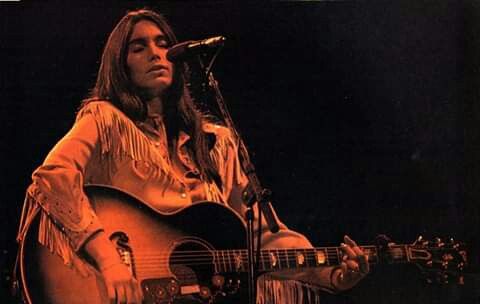
Slow Surprise shows how Emmylou Harris could make a quiet song feel unforgettable, turning a small emotional shift into something tender, lingering, and far deeper than its modest reputation suggests.
Not every great Emmylou Harris recording arrived with a rush of radio play or a high chart number. Some songs lived more privately than that. Slow Surprise belongs to that more intimate part of her catalog, the place where her artistry often feels most revealing. It was not one of her major hit singles, and it is generally remembered as an album deep cut rather than a Billboard country chart success. In strict chart terms, that means Slow Surprise does not carry the kind of standalone peak that songs like Together Again, Sweet Dreams, or Two More Bottles of Wine did. But sometimes a song’s true standing is measured by something older listeners know well: how long it stays with you after the record stops.
That is the first truth of Slow Surprise. It does not demand attention in a dramatic way. It earns it slowly, almost shyly. That was one of Harris’s rare gifts. She could sing with immaculate control, but she never sounded cold. She could make a song feel polished without sanding away its bruises. In Slow Surprise, she leans into hesitation, inwardness, and the kind of dawning feeling that arrives so gently you do not realize its force until it is already part of you.
The title itself is beautifully chosen. A surprise is usually imagined as sudden, loud, undeniable. But a slow surprise is something else entirely. It is the realization that takes its time. The love you did not see coming. The sorrow that does not hit all at once. The emotional truth that keeps unfolding after the conversation is over, after the night drive is finished, after the room has gone quiet. That is exactly the emotional territory Harris was so good at exploring. She was never merely singing about heartbreak or longing. She was singing about recognition, about the moment a feeling finally becomes clear.
Part of the story behind songs like Slow Surprise is really the story behind Emmylou Harris herself. From the beginning, she had the instincts of both a singer and a curator. She could find songs that did not scream for attention and reveal the life inside them. In an era when country music could still leave room for refinement, subtlety, and literary feeling, Harris became one of the great interpreters of her generation. She drew from country, folk, rock, and singer-songwriter writing without forcing those worlds together. She simply sang as if they had always belonged in the same room. Slow Surprise fits that tradition perfectly. It is not built like a showstopper. It breathes like a confidence shared after midnight.
That is also why the song’s meaning feels richer with time. In younger years, a listener may hear it simply as a tender, restrained song about love or emotional change. But the older the heart becomes, the more Slow Surprise begins to sound like a truth about life itself. So many of the deepest things do not arrive with fanfare. Regret does not. Gratitude does not. Memory certainly does not. They gather. They settle. They return when least expected. Harris sings as if she understands that fully, and as if she trusts the listener to understand it too.
Musically, the beauty lies in the restraint. Harris never overstates the song. She lets phrasing do the emotional work. A held note, a softened line ending, a slight ache in the tone: these are the details that make the performance feel human. Her voice had clarity, but it also had light and shadow. That balance is all over Slow Surprise. You hear composure on the surface, but beneath it there is vulnerability, and beneath that vulnerability there is wisdom. That layered quality is what made Harris such a singular presence in American music. She could sound graceful and wounded at the same time, dignified and exposed in the same breath.
It is also worth remembering that many of the finest songs in her catalog were never the ones most heavily advertised. Fans who stayed with the albums, who listened beyond the singles, found the real treasure there. That is where Slow Surprise lives: among the songs that do not try to overwhelm you, only to remain with you. In that sense, its lack of chart fame almost suits it. A song this inward might have been diminished by too much noise around it. Instead, it has been left to do what quiet songs do best: wait patiently for the right listener.
And perhaps that is why it still matters. Slow Surprise reminds us that Emmylou Harris was never only a hitmaker, never only a beautiful voice, never only a standard-bearer for country elegance. She was an emotional reader of songs, a singer who understood that some truths should not be shouted. They should be carried carefully. They should unfold in their own time. They should feel, as this song does, like something you suddenly understand years later.
So if the song never climbed the charts in the usual way, it still found another kind of place. It settled into memory. It became one of those recordings people return to not for spectacle, but for recognition. And that may be the most fitting legacy of all. Slow Surprise does not burst into your life. It enters quietly, and then, before long, you realize it has been telling you something important all along.
