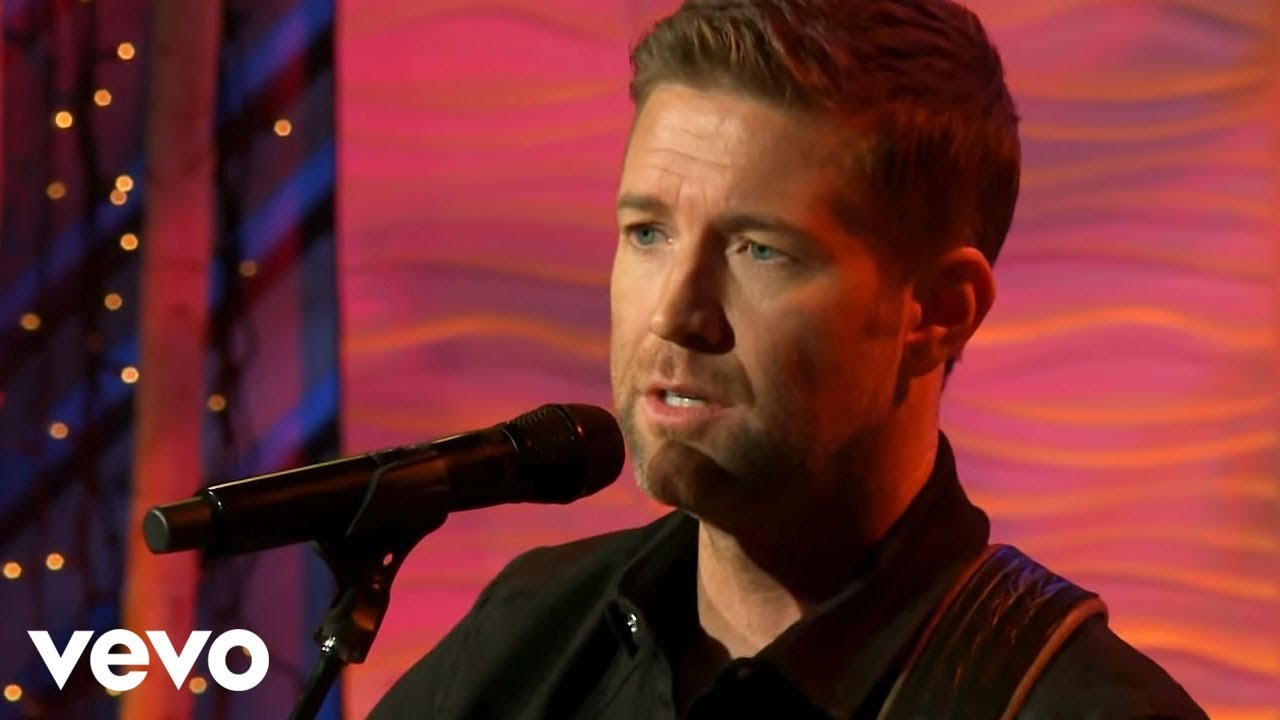
On I Serve a Savior, Josh Turner sings “Great Is Thy Faithfulness” with such plain conviction that the old hymn seems to stand up in the room all over again.
When Josh Turner released I Serve a Savior in 2018, he was not stepping into gospel as a novelty or a side trip. The album was his first full-length gospel project, and that matters when listening to his traditional reading of “Great Is Thy Faithfulness”. This was not a singer borrowing sacred material for atmosphere. It was a country artist, long associated with steadiness, gravity, and a voice built from low timber and patience, moving directly into music that had already shaped the emotional ground beneath his career.
That makes his version of “Great Is Thy Faithfulness” especially revealing. The hymn itself is one of the most enduring in American church music, with words by Thomas O. Chisholm and music by William M. Runyan, first published in 1923. It has been sung in sanctuaries, family gatherings, funerals, revivals, and ordinary Sunday mornings for generations. Because of that long history, every new recording faces a choice: turn the hymn into a showcase, or trust the strength that is already there. Turner chooses trust.
What he brings to the song is not reinvention but presence. His voice has always carried an unusual kind of authority, not because it pushes, but because it settles. On “Great Is Thy Faithfulness”, that quality becomes the whole point. He does not crowd the lyric or decorate it into sentiment. He lets each phrase arrive with room around it, and that space gives the words their old weight back. “Morning by morning new mercies I see” can become routine when heard too often, but in Turner’s hands it sounds less like a line being delivered and more like something remembered, slowly and sincerely.
The setting of I Serve a Savior deepens that feeling. This was a record built around songs of devotion, gratitude, and spiritual plainness rather than crossover gloss. In that context, “Great Is Thy Faithfulness” feels like more than a familiar hymn placed on a track list for recognition. It feels like one of the album’s emotional anchors. There is a difference between a song that is merely included and a song that quietly defines the atmosphere around it. Turner’s rendition belongs to the second kind. It helps explain the album’s inner character: reverent, unhurried, and more interested in testimony than display.
Part of the power also comes from how naturally Turner fits this material. For years, even outside explicitly gospel recordings, his singing has carried a kind of old-fashioned steadiness that links country music to church music, front-porch harmonies, and the simple seriousness of songs meant to last longer than a radio season. That overlap has always existed in American roots music, and I Serve a Savior makes it audible without needing to announce it. On “Great Is Thy Faithfulness”, the line between country interpreter and gospel singer almost disappears. What remains is a man standing inside a song that has outlived style.
That is why the performance lingers. It is not dramatic in the usual sense. There is no need for a large gesture when the emotional force comes from restraint. Turner understands that this hymn does not need to be rescued or modernized. It only needs to be sung with enough honesty that its certainty can be heard again. In an era when many recordings chase impact through volume or reinvention, there is something quietly radical in hearing a singer honor the architecture of a hymn and trust that listeners will meet him there.
And they do, because “Great Is Thy Faithfulness” speaks to a need deeper than novelty. It is a song about constancy, about daily mercy, about the reassurance that endurance itself can be sacred. Turner’s baritone, grounded and calm, is unusually well suited to that message. He sounds like someone who knows the value of not overplaying the truth. That makes the performance feel intimate even when it is formal, personal even when it belongs to a century-old tradition.
In the end, the beauty of Josh Turner’s recording lies in how little it strains for effect. On I Serve a Savior, “Great Is Thy Faithfulness” becomes a still point, a place where the album stops trying to move forward and simply stands firm. Some songs impress. Some songs comfort. A few do something quieter and harder to describe: they remind the listener that dignity, clarity, and faith can still travel in the same breath. Turner finds that narrow path here, and because he does, the hymn does what it has always done best. It endures, and it speaks again.
