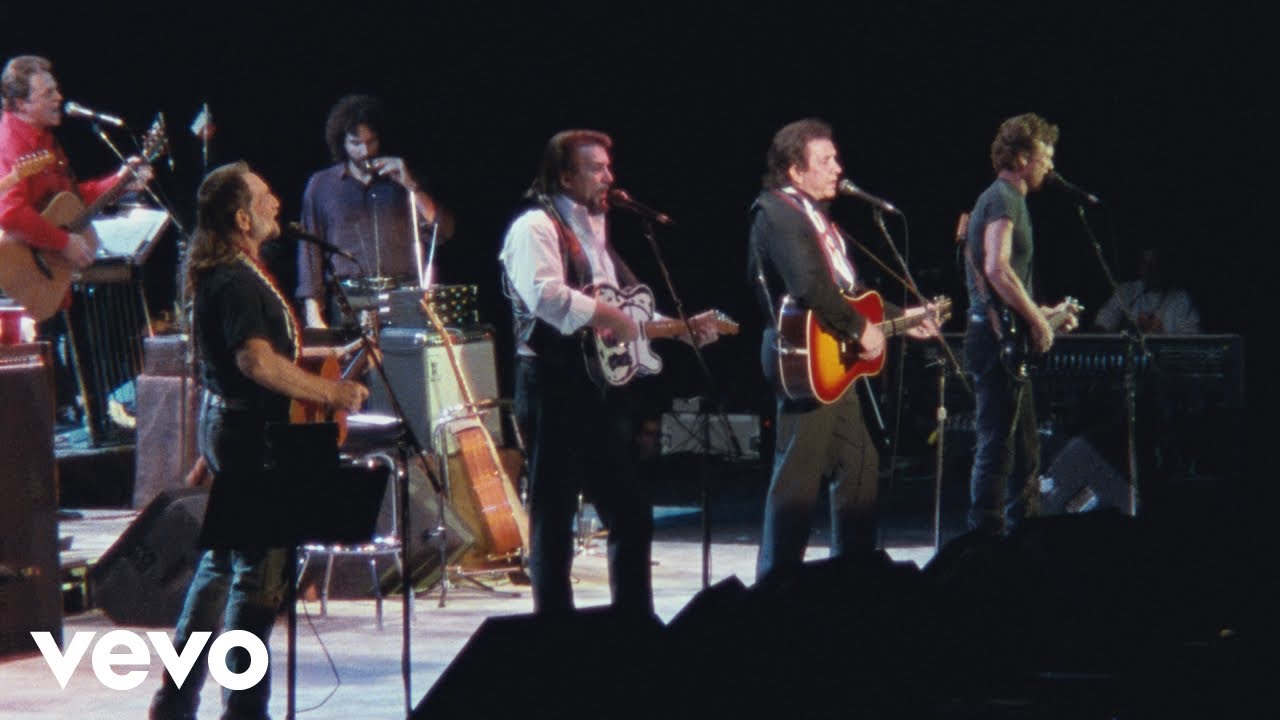
In “Highwayman,” four independent country voices became one restless American spirit.
In 1985, Johnny Cash, Waylon Jennings, Willie Nelson, and Kris Kristofferson joined forces on “Highwayman”, a song written by Jimmy Webb and released as the title single from the album Highwayman. The recording reached No. 1 on the country singles chart, but its importance is not only in that success. It gave four already unmistakable artists a shared name, a shared myth, and a structure strong enough to hold their differences without smoothing them away.
The song was an unusually fitting doorway for a country supergroup. “Highwayman” is built on recurrence: a soul moving through lives, trades, dangers, deaths, and returns. Its verses pass through a roadman, a sailor, a builder of dams, and a future traveler in space. In another singer’s hands, that idea might sound like narrative fantasy. In the hands of Cash, Jennings, Nelson, and Kristofferson, it becomes something earthier and stranger: not escapism, but a meditation on endurance, work, risk, and the stubborn persistence of identity.
The arrangement understands the value of separation. Willie Nelson opens with his light, elastic phrasing, letting the first character feel like a figure glimpsed moving across open country. Kris Kristofferson follows with a rougher, conversational gravity, grounding the song in human weather rather than theatrical polish. Waylon Jennings brings a darker drive to the dam-builder verse, his voice carrying the weight of machinery, labor, and fatal pressure. Then Johnny Cash enters for the final transformation, and the song suddenly widens. His bass-baritone does not need to push; it simply makes the futuristic image feel ancient, as though the next frontier belongs to the same old restless spirit.
That is the quiet genius of the record as a harmony-group moment. It is not memorable because four famous men sing in perfect blend throughout. It is memorable because they do not disappear into one another. Each voice remains distinct, with its own grain, history, and moral temperature. When the chorus arrives, the unity feels earned because the verses have respected the individuality of each singer. The song becomes a circle made from four straight lines, each one pointing in a different direction but returning to the same idea.
The timing also mattered. By the mid-1980s, country music was balancing polished radio production with the long afterglow of the outlaw movement that Jennings and Nelson had helped define in the previous decade. Cash carried an even deeper connection to American song, while Kristofferson stood as one of country’s most literary writers and interpreters. “Highwayman” did not ask them to chase a younger sound or reenact an older rebellion. Instead, it placed them inside a song about continuity, allowing their mature voices to become the point rather than a limitation.
Chips Moman’s production keeps the recording spacious and direct. The rhythm moves steadily, the instrumentation supports rather than crowds, and the vocal handoffs provide the drama. There is no need for excessive ornament because the casting is already doing profound musical work. The listener hears not just characters, but perspectives: Nelson’s sly lift, Kristofferson’s scarred plainness, Jennings’s force, Cash’s monumental calm. Together, they turn Jimmy Webb’s lyric into a kind of American mural, broad enough for myth but close enough to feel personal.
The single’s chart success confirmed that audiences were willing to meet these four artists as a collective, but the deeper achievement was artistic. The Highwaymen emerged not as a novelty of assembled reputations, but as a group whose identity was born from a song perfectly shaped for them. The title itself became a banner: one word that could hold roads, rebellion, mortality, survival, and movement. It allowed the singers to stand side by side without pretending they had traveled the same path.
What remains most powerful about “Highwayman” is its belief that return is not repetition. The song moves from past to future, from dust to ocean to concrete to stars, yet its emotional center stays human. Four voices, each marked by a different career and temperament, find common ground in the idea that a life can vanish from one form and continue in another. In that sense, the 1985 recording endures as a lesson in creative fellowship: harmony does not always mean sameness; sometimes it means letting every voice keep its weather while joining the road ahead.
