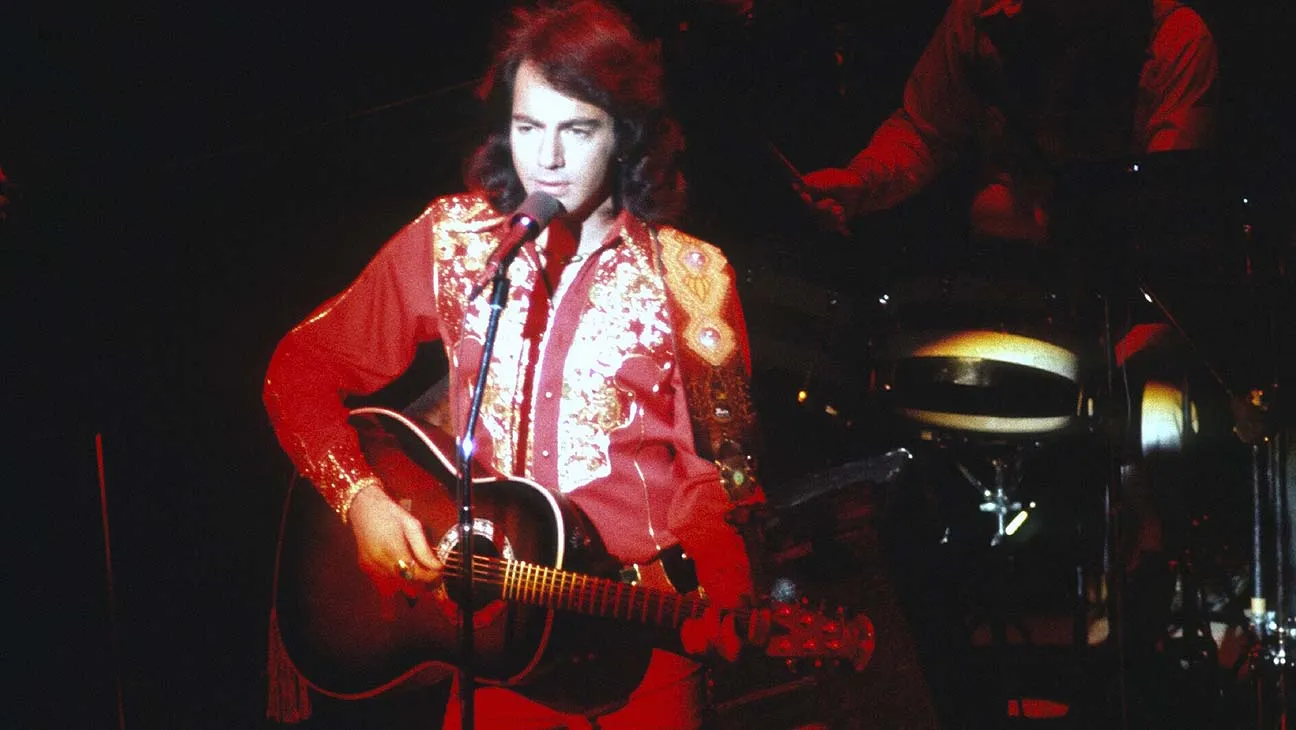
A grand, bruised piano ballad, Love on the Rocks turned Neil Diamond‘s 1980 soundtrack moment into one of pop’s most unforgettable portraits of grown-up heartbreak.
Released from the soundtrack of The Jazz Singer in 1980, Love on the Rocks did something rare: it escaped the orbit of its film and took on a life of its own. The single rose to No. 2 on the Billboard Hot 100, becoming one of Neil Diamond‘s biggest and most enduring hits. That chart peak matters, of course, but it only tells part of the story. What made the song last was not simply its success. It was the way it carried disappointment, pride, loneliness, and adult disillusionment in one sweep of piano and voice. Even now, it still sounds like a closing-hour confession delivered under too-bright lights.
Its connection to The Jazz Singer is essential, not incidental. Diamond was not merely supplying a song to a soundtrack; he was at the center of the film itself, starring in the 1980 remake and helping shape its musical identity. The movie drew mixed responses, but the soundtrack became a major commercial force, yielding memorable hits including America, Hello Again, and of course Love on the Rocks. In many ways, the soundtrack outlived the film in popular memory, and this song became one of the clearest reasons why. It had the scale of cinema, yet it felt painfully private.
There is a reason the opening lands so hard. From the first piano notes, the song feels older than the moment of its release, as if it belongs to some smoky tradition of late-night ballads and barroom truths. The writing credit shared by Neil Diamond and Gilbert Becaud gives the song part of that weight. Melodically, it has a continental fullness, but Diamond’s phrasing makes it unmistakably his. He does not sing it as a man stunned by heartbreak for the first time. He sings it as someone who has seen the pattern, who recognizes the wreckage, and who can no longer pretend surprise. That is the brilliance of the title line. Love on the Rocks is not melodrama. It is resignation dressed in a memorable hook.
Lyrically, the song cuts because it strips romance of illusion without losing feeling. When Diamond sings about love arriving broken, diluted, almost bitter, he captures the moment when hope has not disappeared entirely but has become difficult to trust. This is not a youthful lament. It is the ache of experience. So many pop songs beg, plead, or rage. Love on the Rocks does something more unsettling: it accepts. That acceptance is what gives the record its emotional authority. The hurt is obvious, but so is the hard-won knowledge behind it. In that sense, the song speaks to the kind of heartbreak that does not need explanation. One line, one look back, one piano phrase, and the whole room understands.
Musically, the arrangement deserves as much credit as the lyric. Neil Diamond had long understood how to marry intimacy with grandeur, and this recording is one of the finest examples of that gift. The piano carries the song like a weary companion, while the orchestral swell never overwhelms the central emotion. Instead, it enlarges it. The record moves with the confidence of a standard, almost as if it had always existed. Then Diamond’s vocal arrives and gives it human grain: a rough edge here, a small push of emphasis there, a sense that the singer is holding himself together as the melody rises. That is why the performance feels so lived-in. It is polished, yes, but never cold.
It is also one of the best examples of how a soundtrack song can become more than a scene-specific piece. In lesser hands, a number tied to a film can remain attached to plot and period. Love on the Rocks broke free because its emotional truth was larger than its setting. Listeners did not need to know a single detail about The Jazz Singer to feel the sting. Still, the movie context gave the song an added dramatic frame. On screen and on record, it carried the tension between performance and private pain, between the public face and the inner fracture. That duality has always suited Neil Diamond. Few singers of his era were as gifted at making a big, theatrical song feel strangely personal.
Looking back, the chart run to No. 2 now seems less like a commercial event than a cultural confirmation. By 1980, Diamond was already a major figure, but Love on the Rocks reminded listeners that he could still deliver a hit that felt substantial, not disposable. It was not built on fashionable tricks. It was built on songwriting craft, emotional clarity, and a voice that knew how to live inside a lyric. That is why the song never really faded into oldies comfort. It remains too sharp for that. Even in memory, it has an edge.
And perhaps that is the deepest meaning of Love on the Rocks. It tells the truth that not every great love song is about being saved. Some are about recognizing the bill after the dream is over, about standing in the silence and naming what happened without self-pity. For a soundtrack hit, it is remarkably unsentimental. For a pop smash, it is remarkably mature. And for Neil Diamond, it remains one of those rare recordings where star power, storytelling, and emotional honesty meet perfectly. The film may have introduced it, and the charts may have crowned it, but the song endured because it understood something people rarely forget: disappointment has its own music, and sometimes it arrives in the most unforgettable chorus of all.
