
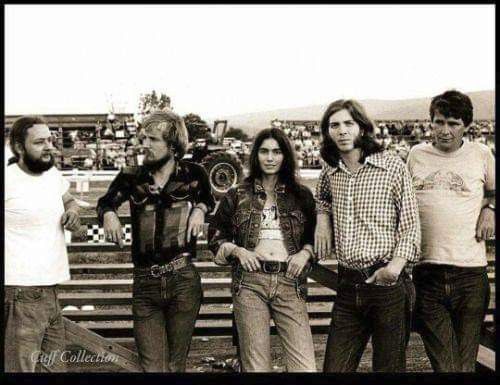
Boulder to Birmingham is Emmylou Harris at her most exposed: a song that turns distance into grief, and grief into a kind of faithful, trembling prayer.
There are songs that become hits, and there are songs that become part of an artist’s soul. Boulder to Birmingham belongs to the second group. First released on Emmylou Harris’s 1975 album Pieces of the Sky, the song rose to No. 22 on Billboard’s Hot Country Singles chart, a respectable placing but hardly a full measure of what it would come to mean. Over time, it grew far beyond its chart life. It became one of the defining performances of her career, not because it chased commercial polish, but because it carried something rarer: real sorrow, real love, and real spiritual longing. In the 2003 remaster, those qualities feel even more intimate. The recording opens up, the air around the instruments becomes clearer, and her voice seems to stand even closer to the listener, as if the years have only made the ache more audible.
The story behind the song is inseparable from Gram Parsons. Harris had sung with Parsons on GP and Grievous Angel, and their musical connection changed the course of her life. Parsons heard in her a voice that could move effortlessly between country, folk, gospel, and rock, and he helped bring that gift into the wider world. When he died in 1973, the loss hit her deeply. Boulder to Birmingham, written by Harris with Bill Danoff, was her way of answering that loss. It is often described as a tribute, and that is true, but the word tribute can sound too neat, too ceremonial. This song is less a formal remembrance than a conversation with absence. It sounds like someone trying to sing across a distance that cannot really be crossed.
That is why the title matters so much. Boulder to Birmingham is not just geography. It is emotional mileage. It suggests an impossible journey, the kind a grieving heart would make without hesitation if it believed one more glimpse, one more word, one more moment were waiting at the end of the road. The famous line about walking all the way from Boulder to Birmingham if she thought she could see his face again remains one of the most piercing lines in country-rock, precisely because it is so plainspoken. There is no elaborate poetry hiding in it. The power comes from its simplicity. It sounds like something a human being says when elegance no longer matters and only love does.
Musically, the recording is every bit as moving as the lyric. Produced by Brian Ahern, Pieces of the Sky introduced Harris not merely as a promising singer, but as an artist with extraordinary judgment. The arrangement on Boulder to Birmingham is restrained, tender, and beautifully paced. The country foundation is there, but so is the folk hush, the gospel reach, and the lonely glow of 1970s country-rock at its most graceful. Nothing is overplayed. Nothing distracts from the center. The instruments support her rather than compete with her, and that choice is crucial, because the emotional truth of the song lives in the way she sings it. Harris does not perform grief theatrically. She carries it with dignity. Her voice floats, then trembles, then steadies itself again, as though singing is the only way to keep going.
The 2003 remaster is especially valuable because it does not try to modernize the song or make it unnaturally bright. Instead, it lets listeners hear the original texture with greater clarity. The acoustic detail is more present, the vocal blend feels less veiled, and the emotional space inside the track becomes easier to notice. This matters with a song like this. A flashy remaster would have betrayed it. What this version does right is preserve the fragility. It reminds us that older recordings do not need to be renovated into something new; often they only need to be heard more clearly, with the dust gently lifted from the frame.
It is also worth remembering what this song meant in the arc of Harris’s career. Pieces of the Sky helped establish her as a major force in country music, and the album reached the country Top 10. Yet even on a record filled with beauty, Boulder to Birmingham stood apart. It told listeners that Harris was not simply a brilliant interpreter of other people’s material. She was also capable of writing from the deepest private places without sacrificing grace or musical discipline. That balance became one of her lifelong strengths.
Decades later, the song still carries an unusual weight. Many records from the era can transport us back to a style, a sound, or a radio memory. Boulder to Birmingham does something more difficult. It transports us to a feeling. It reminds us that some songs do not age because longing does not age. The details around us change, the years move on, but the need to reach for someone who is no longer there remains painfully familiar. That is why this performance still feels so alive. It is not frozen in 1975, and it is not trapped inside nostalgia. It continues to breathe.
In the end, Emmylou Harris did something extraordinary here. She took private grief and shaped it into a song spacious enough for others to enter. That is the quiet miracle of Boulder to Birmingham. It is personal, yet it never shuts the listener out. The road inside it is long, the distance inside it is real, and the love inside it never quite comes to rest.
