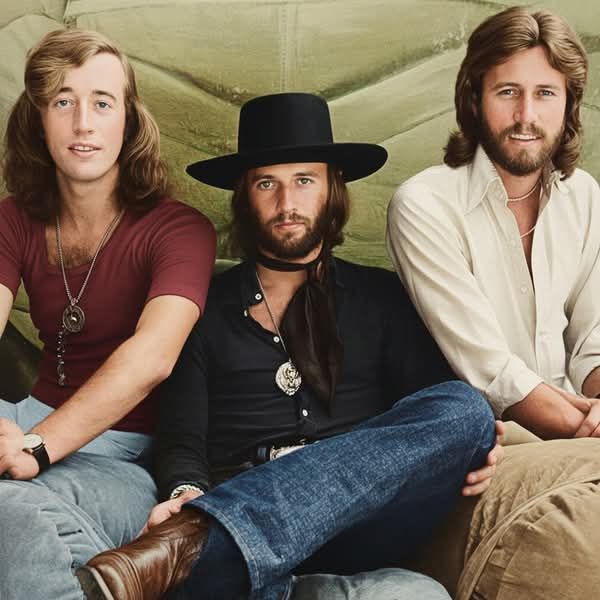
On the quieter side of a famous 1968 single, Bee Gees let Kilburn Towers become a small room of memory, restraint, and acoustic grace.
Kilburn Towers belongs to Idea, the 1968 album that found Bee Gees moving through one of the most inventive early periods of their career. It also carries a more modest but revealing place in their discography: it was released as the B-side to I Started a Joke, a song whose dramatic, almost dreamlike melancholy would become one of the group’s defining late-sixties recordings. That pairing matters. On one side was a single built for attention, with its strange emotional gravity and unmistakable melodic pull. On the other was a gentler acoustic track that seemed content to lower its voice and ask for a different kind of listening.
In the world of vinyl singles, the B-side often worked like a private afterword. It was not always meant to compete with the song on the front. Sometimes it offered contrast, sometimes experiment, sometimes a glimpse of an artist away from the pressure of the hit. Kilburn Towers feels especially suited to that role. It does not announce itself with the urgency of a grand statement. Instead, it moves with the patience of a remembered place, shaped by the softer textures and inward-looking imagination that made the early Bee Gees catalog so rich.
The song’s beauty lies in its refusal to overstate. Where I Started a Joke turns emotional confusion into something theatrical and almost cosmic, Kilburn Towers keeps its scale human. The acoustic feel gives it an intimate frame, as if the listener has stepped out of the bright room where the single is playing and into a quieter corner of the same house. The voices, the melody, and the gentle motion of the arrangement create a sense of distance without making the song feel cold. It is reflective rather than dramatic, tender without becoming fragile.
Idea arrived during a remarkable stretch for the group. The Bee Gees were still years away from the era that would make their name inseparable from the dance floor, but their songwriting identity was already unusually distinct. In 1968, they were exploring ornate pop, folk-like balladry, baroque touches, and lyrical scenes that often felt suspended between childhood memory and adult loneliness. Their songs could be oddly formal and deeply emotional at the same time. Kilburn Towers fits that world beautifully because it seems to understand that a small song can carry a large atmosphere.
The title itself gives the track a sense of place. Kilburn, a district in northwest London, suggests streets, buildings, and lived-in rooms rather than fantasy landscapes. Yet the song does not need to function as a literal travelogue to feel rooted. Its strength is more suggestive than descriptive. It evokes the feeling of looking back at somewhere that once mattered, whether that place was a neighborhood, a room, a relationship, or a version of the self that no longer exists in quite the same way. That kind of emotional geography was one of the Bee Gees’ quiet gifts: they could make a melody feel like a location.
As a B-side, Kilburn Towers also reminds us how much of music history lives outside the spotlight. The big song becomes the one everyone names first. It travels through radio, compilations, memory, and public recognition. The song on the reverse side often survives differently, passed among devoted listeners, album explorers, and those who still believe that turning the record over is part of the story. For them, a track like Kilburn Towers is not simply lesser because it was placed on the back. If anything, its quieter position sharpens its charm. It feels discovered rather than delivered.
There is a particular grace in hearing the young Bee Gees in this restrained mode. The group’s early work was full of ambition, but here the ambition is not about scale. It is about mood, tone, and the careful preservation of feeling. The acoustic texture allows space around the voices, and that space becomes part of the song’s meaning. Nothing feels rushed. Nothing pushes too hard. The track seems to trust that a listener will lean in.
That is why Kilburn Towers still deserves attention beyond its role as the companion piece to I Started a Joke. Its value is not only historical, though its place on the 1968 Idea album and on the single’s flip side gives it a clear place in the story. Its value is emotional. It captures the Bee Gees at a moment when their music could sound ornate one minute and quietly bare the next, when a B-side could hold a mood too delicate for the front of the record. The song does not try to overpower the hit it accompanied. It waits beside it, calm and open, like a window in a room many listeners forgot to enter.
Sometimes the lasting reward is not the song that first calls your name, but the one waiting patiently after the needle is lifted and placed down again. Kilburn Towers is that kind of record: modest in volume, careful in touch, and still capable of making the quieter side of Bee Gees feel unexpectedly close.
