On the far side of a 1968 single, Neil Diamond let a stranger, rougher voice peek out—one that makes Broad Old Woman (6 A.M. Insanity) feel less like a spare track than a clue.
Neil Diamond released Broad Old Woman (6 A.M. Insanity) in 1968 as the original B-side to his single Two-Bit Manchild, a detail that matters because this was not simply another early catalog track. It belonged to a moment when Diamond was moving through one of the most revealing turns of his career: away from the compact Brill Building sharpness and Bang Records punch that had helped define songs like Solitary Man, Cherry, Cherry, and Kentucky Woman, and toward the broader, more personal album-minded writing that would shape his late-1960s and early-1970s identity.
The A-side, Two-Bit Manchild, carried the public assignment. It was the side meant to introduce, sell, and compete. The B-side was different. In the 45-rpm era, a flip side could be a holding place, a bonus, a curiosity, or occasionally a small confession that slipped past the machinery of the hit. Broad Old Woman (6 A.M. Insanity) lives in that old vinyl space: not presented as the grand statement, not polished into the center of the room, but tucked behind the main attraction where serious listeners and stubborn collectors eventually find it.
That is part of its charm. The title alone feels unusually jagged for Diamond, especially to those who mostly remember him through the sweeping warmth of later concert favorites. Broad Old Woman (6 A.M. Insanity) sounds like a phrase found at the edge of wakefulness, when a city is neither asleep nor alive, when the mind starts rearranging ordinary faces into something stranger. It carries the vocabulary and restlessness of the late 1960s, a time when pop writers were testing how much unease, character, street language, and private disorder could fit inside a short record.
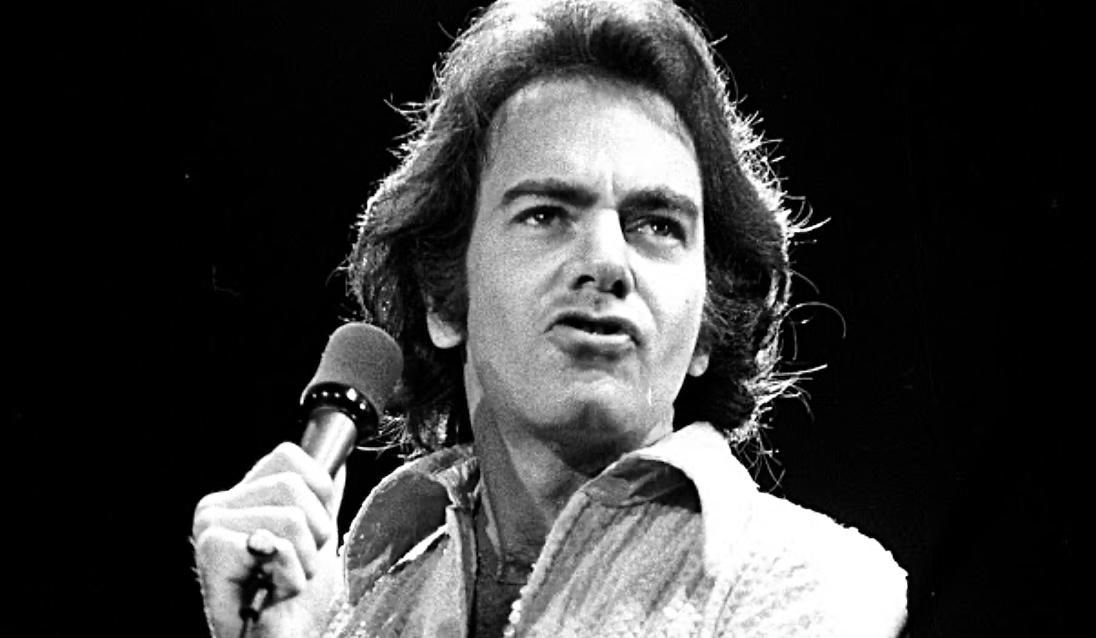
Diamond in 1968 was not yet the fully framed arena figure, not yet the sequined showman whose voice could make a vast room feel personal. He was still close to the songwriter’s workshop: urgent, rhythmic, hungry for a line that could snap open. His early work often had a forward-driving quality, as if the song had somewhere to be and little patience for delay. On a B-side like this, that energy feels less obligated to charm. The recording belongs to the more eccentric edge of his early catalog, the place where a young songwriter could chase an image because it bothered him, amused him, or refused to leave.
The period around Two-Bit Manchild and Velvet Gloves and Spit was important for that reason. Diamond was widening the frame. He was beginning to think not only in singles, but in mood, contrast, and self-definition. The old pop economy had taught him discipline: get to the hook, make the phrase count, leave a mark fast. But the late 1960s invited something roomier and less obedient. Broad Old Woman (6 A.M. Insanity) may not sit at the center of the Neil Diamond story, but it catches him during the act of becoming, when the edges were still visible and the final shape had not yet hardened.
There is also something wonderfully human about the survival of a B-side. Songs like this often travel through history by touch rather than ceremony: a paper sleeve pulled from a box, a label read under a lamp, a record turned over because someone wanted to know what else was there. They do not always arrive with the force of a famous chorus. Sometimes they wait, quietly, for the kind of listener who believes the reverse side can tell the better secret.
For fans who know Diamond only through the great, open-hearted sweep of Sweet Caroline, Cracklin’ Rosie, or I Am… I Said, this 1968 B-side offers a different doorway. It shows a writer less interested in monument than in motion, less concerned with comfort than with impulse. The song’s importance is not that it became a standard, because it did not. Its importance is that it preserves a corner of the workbench: the odd phrase, the early-morning tension, the young artist’s willingness to leave something slightly unruly on the record.
That is why Broad Old Woman (6 A.M. Insanity) still feels worth turning over for. It reminds us that a career is not made only of the songs everyone can sing from memory. It is also made of the smaller cuts, the flips, the restless fragments that reveal what an artist was risking before the whole world decided who he was supposed to be.
