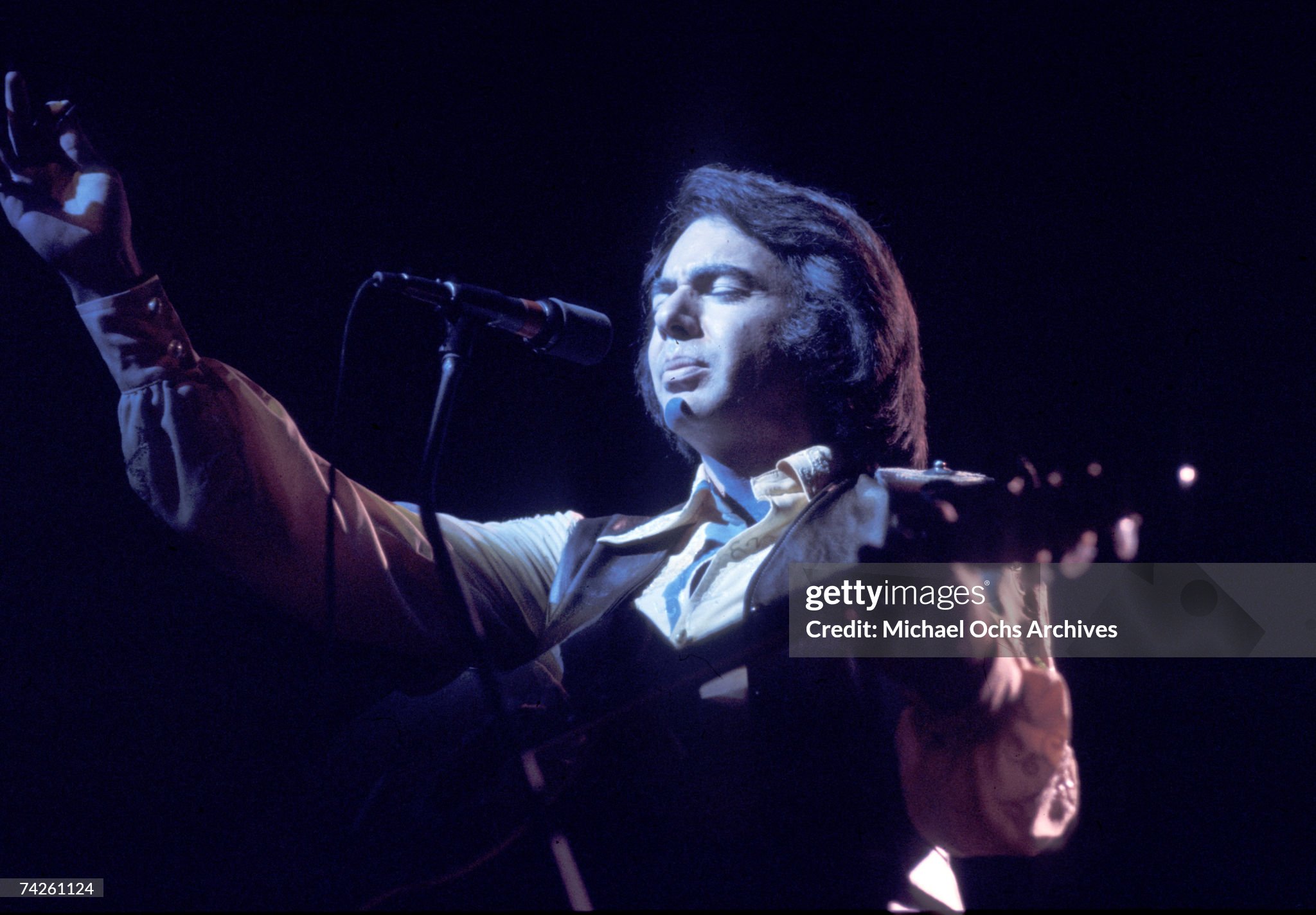
Neil Diamond’s La Bamba is not one of his defining hit singles, but it reveals something vital about him: his instinct for rhythm, showmanship, and his affection for the living roots of rock and roll.
When people think of Neil Diamond, they usually go first to the grand emotional sweep of “Sweet Caroline”, “Cracklin’ Rosie”, or “Song Sung Blue”. Those songs sit so firmly in the public memory that it can be easy to forget another side of him: the restless performer who understood that a concert, or even a single inspired recording choice, should breathe, move, and surprise. That is why “La Bamba” is such an intriguing title in the orbit of Neil Diamond. It is not a standard Diamond composition, nor was it one of his major chart-defining releases. In truth, his connection to the song is more revealing than commercial. It shows the artist not as a confessional songwriter first, but as a man of the stage and of deep musical memory.
That matters because “La Bamba” arrived in popular consciousness long before it crossed Diamond’s path. The song itself is a traditional folk tune from Veracruz, Mexico, with roots that run far deeper than the rock era. For millions of listeners in the English-speaking world, however, it became immortal through Ritchie Valens, whose electrifying 1958 version helped bring a Mexican folk melody into the center of early rock and roll. Valens’ recording, issued in the same period as “Donna”, became a cultural landmark. Even where chart details are debated or split by the old A-side/B-side system, the song’s true victory was never merely numerical. Its real triumph was permanence. “La Bamba” lived on because it carried joy, motion, and youthful daring in just a few unforgettable phrases.
So where does Neil Diamond fit into that story? He fits there as a performer who knew how to recognize a song with built-in voltage. His take on “La Bamba” is best understood not as an attempt to claim the song for himself, but as an embrace of its spirit. This was not the sort of material that was likely to sit beside his most autobiographical writing, and it was never a centerpiece of his chart history in the way his original hits were. There is no major standalone chart story to tell for Diamond’s “La Bamba”, and that is worth saying plainly. Its significance is not in rankings. Its significance is in the way it lets us see Diamond through another window.
And what a revealing window it is. Neil Diamond had a gift for making a room move with him. Even when a song did not originate in his own pen, he brought to it a sense of occasion. That is the heart of “La Bamba” in his hands. He leans into its pulse rather than dressing it up too heavily. The result is a reminder that Diamond’s artistry was never limited to solemn reflection or crowd singalongs with arms around shoulders. He also understood release. He understood what a familiar rhythm could do to an audience that only needed a few seconds to feel the floor change beneath them.
There is also something touching in the choice itself. “La Bamba” has always meant more than its brief running time suggests. On the surface, it is festive, immediate, and almost impossible to resist. But underneath that energy is a deeper story about cultural crossing, musical inheritance, and the way popular music keeps renewing itself by carrying old melodies into new rooms. For Neil Diamond to sing “La Bamba” is, in its own way, to acknowledge that rock and roll did not begin and end with one narrow tradition. The song had already traveled across borders, generations, and identities before it ever reached him. His performance becomes part of that long journey.
That may be why the song lingers in memory differently from a standard cover. It feels less like a reinvention and more like a salute. Neil Diamond was too individual a performer to disappear inside somebody else’s material, yet he was also too seasoned a musician to smother a song whose power lies in its directness. So he meets “La Bamba” on honest terms. He lets it be bright, physical, and communal. He trusts its history and adds his own sense of momentum.
In the end, Neil Diamond’s “La Bamba” matters because it reminds us that an artist’s legacy is not built only from the songs he wrote or the singles that climbed highest. Sometimes it is built from the moments when he steps into the broader river of music and shows what he loves. This song carries the sound of roots music turned into rock and then carried forward again by a performer who knew exactly how to honor a crowd’s memory while waking it up at the same time. It may not sit at the top of Diamond’s discography in fame, but it reveals a very real truth about him: behind the grand ballads and the signature choruses was a man who never lost his feel for the raw, joyful engine that made popular music come alive in the first place.
