
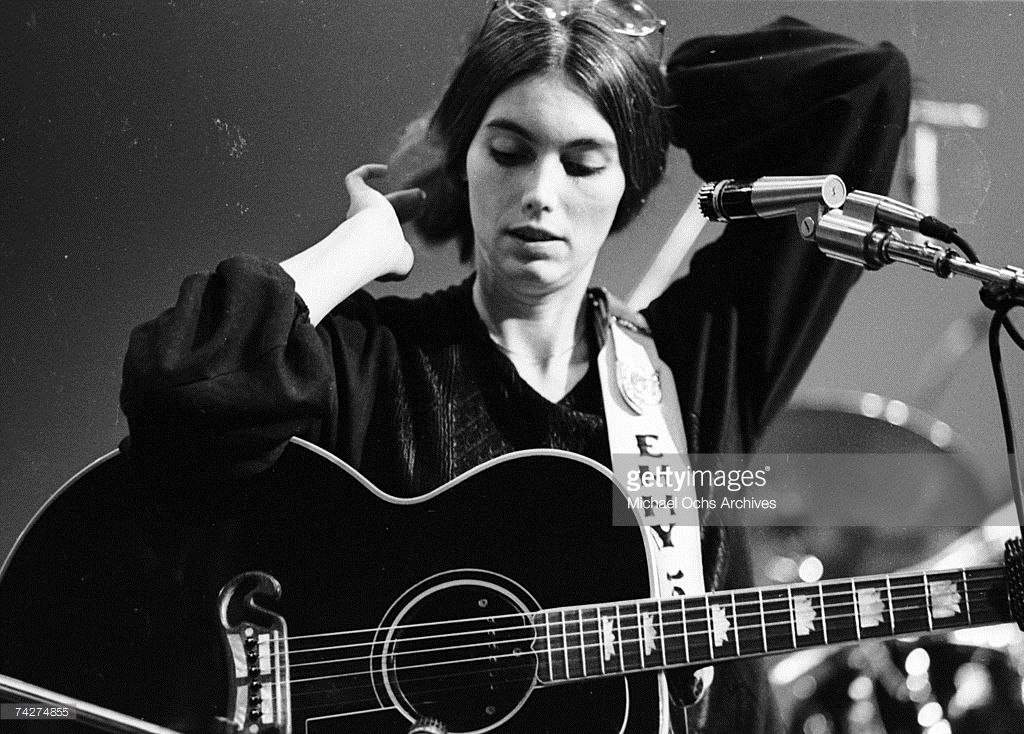
“Easy From Now On” turns heartache into motion, capturing that fragile moment when leaving hurts, but staying would hurt more.
There are songs that announce themselves with drama, and then there are songs like “Easy From Now On” by Emmylou Harris, which arrive with grace, wit, and a kind of smiling sorrow that only grows deeper with time. First released on her 1978 album Quarter Moon in a Ten Cent Town, the song became one of the record’s most beloved moments and later reached No. 12 on Billboard’s Hot Country Singles chart. Written by Carlene Carter and Susanna Clark, it carries the rare kind of emotional intelligence that country music has always done best: it sounds light on its feet, but it knows exactly how much pain it took to get there.
By the late 1970s, Emmylou Harris was already one of the most admired voices in American music. She had the purity of traditional country, the sensitivity of folk, and the instinct of a great bandleader who understood that emotional truth mattered more than ornament. On Quarter Moon in a Ten Cent Town, she was not merely preserving country traditions. She was expanding them—bringing together honky-tonk, country-rock, songwriter craft, and a distinctly feminine emotional perspective that felt wise without ever turning heavy-handed. “Easy From Now On” sits beautifully inside that world.
What makes the song so enduring is the tension at its center. Its title sounds almost carefree, almost breezy, as if the worst is over and the road ahead is clear. But listen closely, and the real beauty of the song begins to reveal itself. This is not the sound of someone untouched by disappointment. It is the sound of someone who has been through enough to know the difference between fantasy and freedom. The singer is not celebrating because love was simple. She is steadying herself because it was not.
That balance—between resilience and ache—is where Emmylou Harris was nearly unmatched. Her voice on “Easy From Now On” does not push. It glides. Yet inside that elegance is a firm emotional backbone. She sings as if she has already cried somewhere offstage, and what remains now is clarity. That is one reason the record continues to mean so much to listeners. It does not beg for sympathy. It offers recognition. It understands that sometimes the strongest words are the ones spoken after the storm, in a calm voice, with no need to prove anything.
The song’s backstory matters too. Carlene Carter and Susanna Clark were both gifted writers with deep roots in country music’s most literate and emotionally detailed traditions. Their writing on “Easy From Now On” gives the song its special flavor: conversational but poetic, wounded but never defeated. There is independence in it, but not the cold kind. It is independence born from experience, from finally knowing what can and cannot be fixed. That makes the song feel mature in the best sense of the word. It is not about bitterness. It is about reclaiming one’s balance.
Musically, the track is just as important as the lyric. The arrangement has movement, a lifted quality that keeps the song from sinking into self-pity. Like so much of Emmylou Harris’s finest work from that era, it is grounded in expert musicianship and restraint. The playing leaves room for the story. Nothing crowds the vocal. Nothing interrupts the emotional line. The result is a performance that feels effortless, though of course it is anything but. Great country records often hide their craft in plain sight, and this is one of them.
It is also one of those songs that reveals a larger truth about Emmylou Harris as an artist. She had a gift for choosing material that sounded classic the moment she touched it. Whether she was interpreting a heartbreak ballad, a folk standard, or a contemporary country song, she could locate the human center of it with astonishing precision. In “Easy From Now On”, she found not just a memorable melody, but a psychological moment many people know by heart: the instant when sadness gives way to self-respect.
That may be why the song still lingers so powerfully decades later. It speaks to anyone who has had to walk away with dignity, anyone who has smiled while carrying a bruise no one else could see. It does not promise a perfect tomorrow. It offers something more believable: a little lightness after heaviness, a little room to breathe after emotional confusion. In the hands of Emmylou Harris, that feeling becomes luminous.
And perhaps that is the deepest meaning of “Easy From Now On”. The title is not a boast. It is a prayer said with confidence. It is the hope that once the hardest truth has finally been faced, life might begin to open again. That hope is what Emmylou Harris sings so beautifully here—not with spectacle, but with poise, warmth, and the wisdom of someone who knows that moving on is rarely easy, even when it is right.
Nearly half a century later, the song remains one of the quiet triumphs of Quarter Moon in a Ten Cent Town, and one of the clearest reminders of why Emmylou Harris has always mattered so deeply. She never had to overstate a feeling to make it last. On “Easy From Now On”, she gave heartbreak a straighter spine, a gentler face, and a road leading forward.
