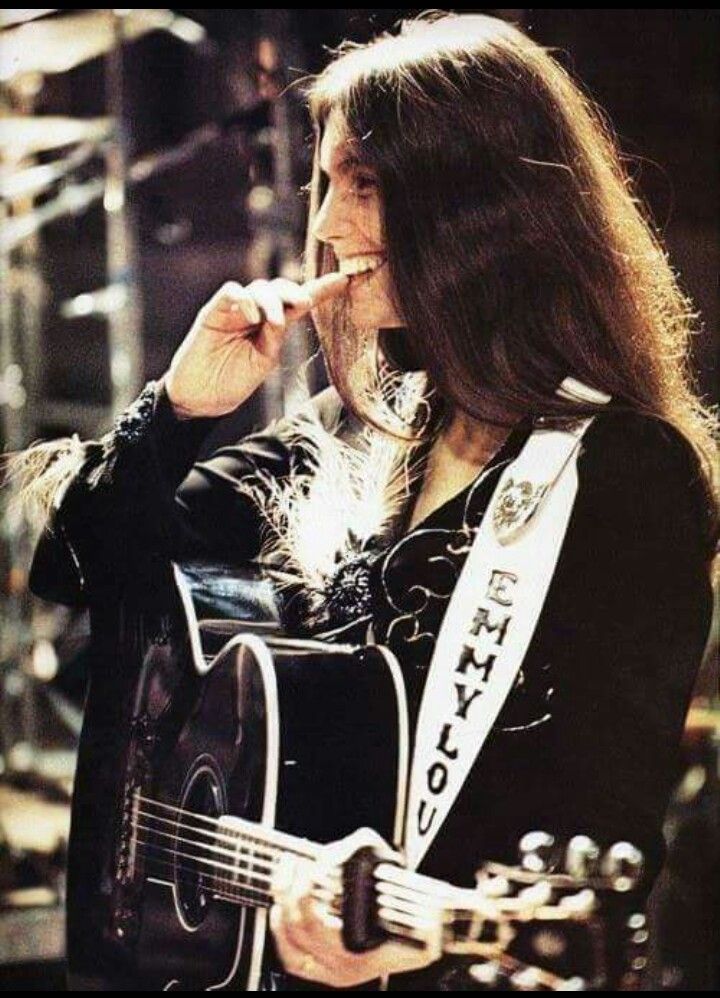
On All I Intended to Be, Emmylou Harris turns “Kern River” into a lesson in late-career grace, trusting silence, phrasing, and a weathered voice to uncover the full ache inside Merle Haggard’s song.
When Emmylou Harris recorded “Kern River” for her 2008 Nonesuch album All I Intended to Be, she chose a song that already carried deep country history. Merle Haggard had written and recorded it more than two decades earlier, releasing it in 1985 as the title track of an album that remains one of the most searching records in his catalog. Harris did not approach it as a novelty selection or a dutiful nod to a hero. On a record shaped by reflection, loyalty, and the feeling of looking back without losing forward motion, the song lands with unusual precision.
The timing matters. All I Intended to Be arrived after Harris had spent years moving further into her own writing, her own atmosphere, and a more interior kind of country music. It also came in the same year she was inducted into the Country Music Hall of Fame. That kind of moment can tempt an artist toward summary statements and grand gestures, toward the sort of performance that seems designed to prove permanence. Harris goes the other way. This album is measured, graceful, and almost stubbornly free of self-congratulation. Her version of “Kern River” may be one of the clearest examples of that artistic confidence.
Haggard’s original never needed embellishment. The Kern River was not some abstract symbol to him; it belonged to the same Central California world that shaped his imagination, his language, and the hard plainspoken weather of his music. In the song, place is not decoration. It is fate. The river feels physical, local, and dangerous, and Haggard’s writing lets the tragedy rise naturally out of the landscape rather than out of dramatic insistence. His performance is steady and conversational, which is exactly why it cuts so deeply. He sounds like a man telling the truth because the truth is all the song can bear.
What makes Harris’s reading so affecting is that she understands this from the inside. She does not try to out-Haggard Haggard, and she does not treat the song as a showcase for emotional display. Instead, she sings with the authority of someone who has spent decades learning that understatement is not the absence of feeling. It is one of the hardest forms feeling can take. By 2008, her voice had changed in the way great voices often do. The bright, airborne clarity of the early years had deepened into something more textured, more earthbound, and in some ways more revealing. There is more grain in the sound, more patience in the line, more knowledge of what can be left unsaid.
The arrangement on All I Intended to Be honors that maturity. It stays close to the ground, patient and unhurried, leaving air around the vocal and space around the story. Nothing in the track lunges forward asking to be admired first. The musicians support the song without crowding it, and that balance is essential. A composition like “Kern River” can easily tip into melodrama if the production leans too hard on its sadness. Harris and her band refuse that trap. They trust the writing. Just as importantly, they trust the listener to hear what is not being underlined.
That is where her late-career restraint becomes more than a stylistic choice; it becomes the interpretation itself. In Merle Haggard’s version, the pain feels close to the skin, as if the memory is still raw enough to alter the singer’s breathing. In Emmylou Harris’s version, the song feels touched by time. The loss has not diminished, but it has changed temperature. It arrives with the stillness of memory, which can sometimes be harder to carry than open grief because memory knows there will be no revision, no rescue, no different ending waiting somewhere beyond the next verse. Harris does not make the song colder. She makes it older, and in doing so she reveals another layer of its truth.
There is also something deeply moving about hearing Harris inhabit a Haggard song at this point in her life and career. Both artists built their best work on precision rather than fuss. Both understood that country music, at its most durable, depends less on decoration than on emotional exactness. By the time she reached All I Intended to Be, Harris had already traveled from the crystalline ache of the early Hot Band years through the atmospheric reinvention of Wrecking Ball and into a body of work that felt increasingly personal, searching, and reflective. So when “Kern River” appears on this album, it does not feel like a detour into somebody else’s catalog. It feels like part of her own long conversation with American song.
That may be the quiet achievement of the performance. It reminds us that maturity in music is not always a matter of larger statements. Sometimes it is the ability to remove emphasis, to leave a line plain, to sing as though the song does not need to be conquered. Harris finds the dignity in that approach. She lets the narrative stand. She lets the melody breathe. She lets the silence around the phrases carry part of the meaning. In a culture that often mistakes intensity for depth, her “Kern River” offers a different lesson.
It does not replace Haggard’s recording, and it does not need to. What it does is rarer. It opens the song again. On All I Intended to Be, Emmylou Harris sings “Kern River” as though time itself were part of the arrangement, and that choice gives the old story new resonance. The river is still there, the loss is still there, but the voice carrying it now knows something else as well: how to hold sorrow without pushing it, and how to make restraint sound like wisdom.
