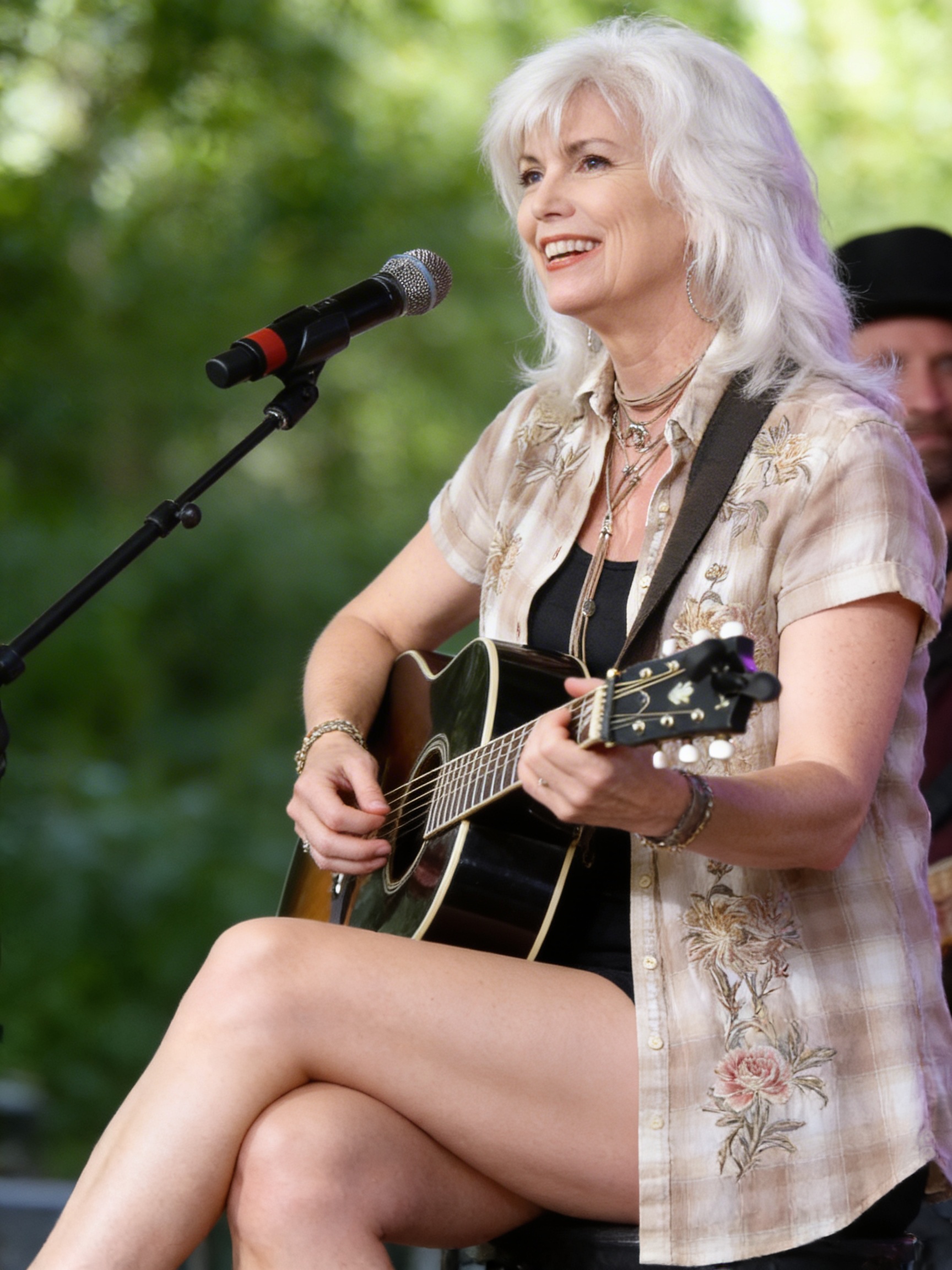
Before Cowgirl’s Prayer settles into its intimate country-folk light, Emmylou Harris begins with A Ways to Go, a small act of endurance that refuses to hurry its healing.
A Ways to Go is the opening track on Emmylou Harris’s 1993 album Cowgirl’s Prayer, and its placement matters. Rather than beginning the record with a sweeping statement or a radio-ready declaration, Harris opens with restraint: an acoustic-leaning song of movement, patience, and quiet resolve. Written by Lainie Marsh, the track gives the album its first emotional temperature. It does not arrive as a grand entrance. It steps in, steady and clear-eyed, as if the singer has already been traveling for some time and is only now letting us walk beside her.
That sense of an ongoing road is central to the way Cowgirl’s Prayer is heard. Released in 1993, the album came after Harris’s celebrated work with the Nash Ramblers and before the atmospheric reinvention of Wrecking Ball in 1995. In that space between roots revival and sonic transformation, Cowgirl’s Prayer feels like a record made close to the ground. Its surfaces are mostly warm, uncluttered, and human-scaled. The emphasis is not on spectacle but on touch: fingers on strings, breath in the phrasing, the measured confidence of a singer who understands that softness can carry its own authority.
As an album opener, A Ways to Go does something subtle and important. It tells the listener not to expect easy triumph. The title itself carries a plainspoken admission: the journey is not finished. There is distance left. There are things to be repaired, endured, or understood. Yet the song does not collapse under that knowledge. Harris’s performance has the calm of someone who has learned to keep moving without pretending the road is simple. Her voice does not push the emotion forward; it lets the emotion rise naturally through the melody, which is why the track can feel so strong without ever sounding forceful.
Harris had long been one of country music’s most sensitive interpreters, a singer capable of making another writer’s song feel lived-in without claiming it too heavily. On A Ways to Go, that gift is especially apparent. She does not overdramatize the lyric’s sense of distance. Instead, she gives it room. The vocal sits with the arrangement rather than above it, and the acoustic setting allows the song’s emotional grain to show. The result is a performance that feels less like a confession and more like a decision: not a dramatic vow, but a quiet continuation.
That is why the track works so beautifully at the front of Cowgirl’s Prayer. It prepares the listener for an album concerned with faith, fatigue, longing, memory, and the hard-earned grace of going on. Even the album title suggests a merging of earth and spirit: the cowgirl as traveler, worker, survivor; the prayer as private hope, spoken without ceremony. A Ways to Go brings those ideas into focus before the record has fully unfolded. It establishes motion, but not escape. It suggests belief, but not certainty. It carries the dignity of someone who knows that endurance is not always loud.
In 1993, country music was moving through a glossy and highly commercial era, but Harris was following a more inward path. She had already built a career on crossing boundaries between traditional country, folk, bluegrass, gospel, and singer-songwriter material, and Cowgirl’s Prayer continued that habit of choosing songs for their emotional truth rather than their market shape. The opening track reflects that instinct. It does not need to announce her relevance because it is too busy sounding honest. It trusts the listener to come closer.
Heard today, A Ways to Go can feel like one of those modest beginnings that reveals more with time. It does not demand to be remembered as a turning point, yet it stands at the doorway of an important moment in Harris’s catalog: a record poised between her roots-conscious early-1990s work and the more radical textures that would soon follow. The song’s power lies in its refusal to exaggerate. It simply opens the door, looks down the road, and begins again.
There is a particular kind of bravery in starting an album this way. No fanfare, no dramatic curtain rising, no attempt to conquer the room. Just a voice, a song, and the understanding that the most honest journeys often begin with an admission: there is still a ways to go.
