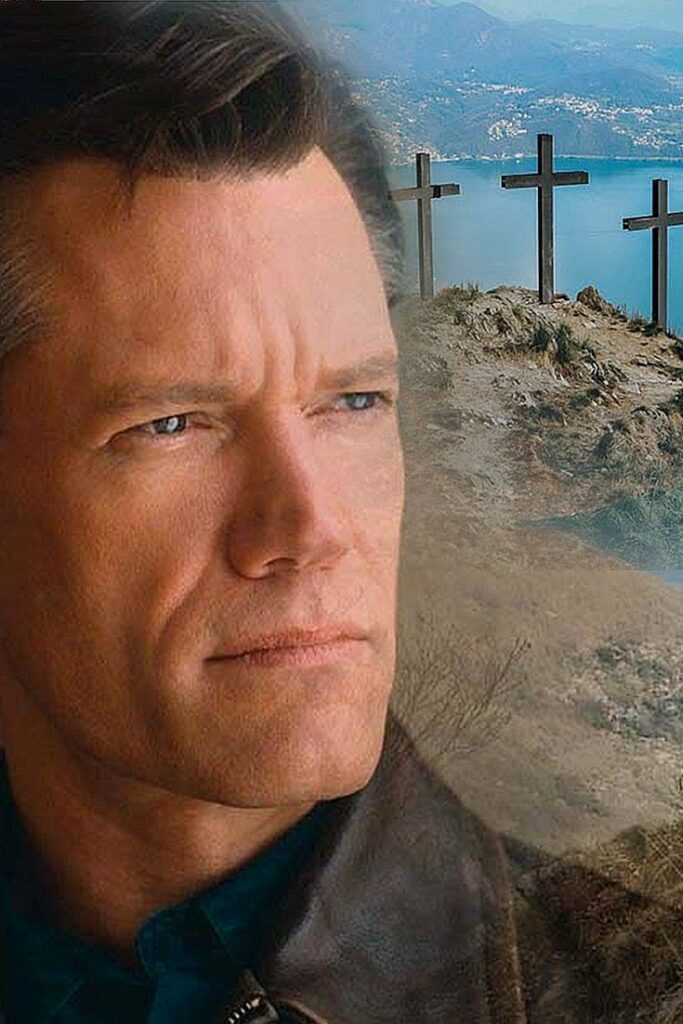
“Three Wooden Crosses” turns an ordinary highway tragedy into a meditation on grace, memory, and the quiet ways faith keeps traveling long after a journey ends.
When Randy Travis released “Three Wooden Crosses” in late 2002, country radio was already changing, but this song arrived like something timeless—plainspoken, deeply human, and unafraid to ask what really remains after lives seem to end in silence. It was the lead single from his album Rise and Shine, and it did more than reconnect him with listeners who had loved his steady, unmistakable voice for years. The song climbed to No. 1 on Billboard’s Hot Country Songs chart in 2003, becoming one of the most meaningful late-career triumphs in modern country music and the final chart-topping country single of his career. That fact alone gives the song an added kind of weight. It did not merely succeed; it endured.
Written by Kim Williams and Doug Johnson, “Three Wooden Crosses” is built on one of country music’s oldest strengths: storytelling that sounds simple at first and grows deeper each time it is heard. The opening lines place four passengers on a midnight bus bound for Mexico—a farmer, a teacher, a preacher, and a sex worker. A crash changes everything in an instant. By the side of the highway stand three wooden crosses, and the song asks the question that gives it its emotional center: why were there only three?
That question is what made the song so unforgettable. In lesser hands, it might have been only a clever twist. But in the voice of Randy Travis, it becomes something quieter and far more moving. He sings it without showmanship, without strain, as though he understands that a song like this does not need to push its meaning. It only needs to tell the truth carefully. His baritone gives the lyric a kind of moral gravity. Every verse feels measured, patient, and compassionate.
The power of the song lies in the way it refuses quick judgment. At first, listeners may assume they understand which lives mattered most and which story will be honored. Yet the final verse reveals that the surviving passenger was the woman many would have dismissed. She keeps the preacher’s Bible, raises a son, and that son later becomes a preacher who tells this very story from the pulpit. In that moment, “Three Wooden Crosses” becomes more than a narrative ballad. It becomes a song about mercy, redemption, and the mystery of influence. A life can seem broken to the world and still carry the seed of grace forward.
That is one reason the song struck such a deep chord with listeners. It speaks in the language of faith, but its emotional truth reaches beyond any single tradition. It is about the unexpected ways goodness survives. It is about what one person leaves in the hands of another. It is about the possibility that the most important chapter of a life may be the one no one sees coming. Country music has always been at its best when it honors ordinary people without sentimentalizing them, and this song does exactly that.
There is also something unmistakably old-fashioned about the craftsmanship here, and that is meant as praise. The writing is disciplined. The details are clean. The melody never overreaches. The arrangement allows the story to breathe. Instead of crowding the lyric with modern production tricks, the recording leans into clarity and emotional space. That restraint is part of why the song still feels so strong. It trusts the listener. It trusts the words. And it trusts Randy Travis to carry the burden of the story with dignity.
For longtime admirers of Randy Travis, the success of “Three Wooden Crosses” felt especially meaningful because it reminded everyone what made him so important in the first place. He never had to oversing to break your heart. He never had to decorate a line that was already true. From the beginning of his career, he brought a spiritual stillness to country music, even when the songs were not explicitly religious. Here, that quality finds one of its purest expressions.
The song’s legacy was confirmed when it won Song of the Year at the CMA Awards in 2003, an honor that recognized not just its popularity but its craftsmanship and emotional reach. And years later, it remains one of those rare modern country songs that listeners talk about almost like an old hymn or a family story. People remember where they were when they first heard that last verse land. They remember the silence after it. They remember the feeling of having been led somewhere familiar and then shown something they had missed all along.
In the end, “Three Wooden Crosses” lasts because it understands a truth many great songs know: what we leave behind is not always visible at first. A Bible in a blood-stained hand. A child listening. A sermon years later. A chorus carried by a voice that knows how to sound both wounded and steady. Randy Travis did not just record a hit with “Three Wooden Crosses”; he gave country music one of its most quietly profound meditations on fate, faith, and the way grace keeps moving down the road.
