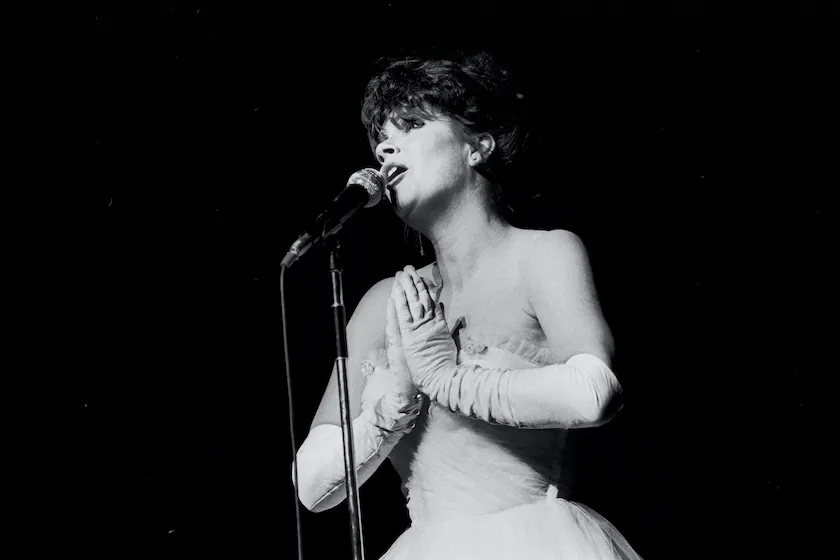
“Love Has No Pride” is a song about the moment dignity loses its grip—when the heart, unwilling to be cured, keeps reaching for someone who no longer reaches back.
In the early years of her superstardom—before the arena-sized triumphs hardened into legend—Linda Ronstadt recorded a performance that still feels like a private confession spoken into a half-lit room. Her version of “Love Has No Pride” arrived as the lead single from her album Don’t Cry Now, released October 1, 1973 on Asylum Records. And crucially, it wasn’t just an album track waiting in the shadows: Asylum issued “Love Has No Pride” as a single in October 1973, and it climbed to No. 51 on the Billboard Hot 100 (with Billboard’s chart listings showing it reaching that peak in January 1974). It also reached No. 59 in Canada, another sign that this bruised ballad traveled farther than “deep cut” status would suggest.
The song’s backstory is a quiet piece of songwriter lore. “Love Has No Pride” was written by Eric Kaz and Libby Titus—two writers who understood that the most devastating lines often sound the simplest when spoken aloud. The first widely recognized recording came from Bonnie Raitt, who included it on her 1972 album Give It Up (with the writers credited right there in the official album notes). Ronstadt’s choice to sing it a year later—on Don’t Cry Now—wasn’t a casual cover. It was a declaration of taste and emotional courage: she was aligning herself with a kind of songwriting that refuses to flatter the narrator.
Because the central idea is almost unbearable in its honesty. The title itself—“Love Has No Pride”—isn’t romantic in the greeting-card sense. It’s the opposite: a small, bitter truth you learn only after you’ve tried to be “strong” and failed. Pride says, don’t call. Pride says, walk away. Pride says, if they wanted you, they would. But love—real love, the kind that clings even when it shouldn’t—often shows up without pride, without strategy, without clean edges. It returns to the door you promised yourself you’d never knock on again.
Ronstadt sings that truth with a particular kind of gravity: not theatrical misery, not self-pity, but a steady emotional exposure that makes the listener feel like they’re overhearing something they weren’t meant to hear. Don’t Cry Now was produced by John David Souther, John Boylan, and Peter Asher—a trio who helped shape Ronstadt’s early-’70s identity into something more refined and emotionally direct. Within that world, “Love Has No Pride” sits like a candle in a dark hallway: warm, trembling, and impossible to ignore once you’ve noticed it.
And perhaps that is why the song’s meaning lasts. It isn’t simply about heartbreak; it’s about the humiliation that sometimes comes with devotion—the moment you realize you’re still willing to take less than you deserve, just to keep the connection alive. The melody doesn’t “solve” that pain; it dignifies it. It says: this happens. To good people. To careful people. To people who know better.
There’s also something quietly nostalgic in remembering that Ronstadt released this as a single at all—back when radio could still carry an intimate, adult ache into the everyday world. The charts tell us it didn’t become a Top 10 coronation, but No. 51 is still a kind of public witness: enough listeners heard it, felt it, and kept it close.
In the end, Linda Ronstadt doesn’t sing “Love Has No Pride” like a lesson. She sings it like a night you live through. And when the last note fades, what remains is not just sadness—but recognition: that love, at its most human, doesn’t always arrive with dignity. Sometimes it arrives on its knees, still hoping.
