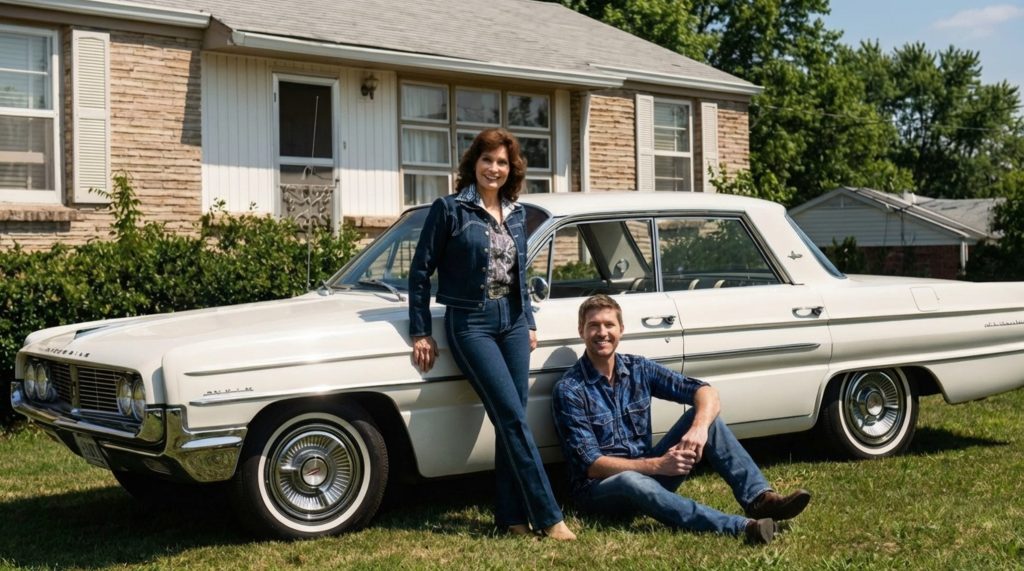
“Loretta Lynn’s Lincoln” is a daydream set to a country shuffle—Josh Turner reminds us that sometimes the sweetest escape isn’t leaving home, but slipping into a story where your heroes ride shotgun.
The moment you press play on “Loretta Lynn’s Lincoln”, you can feel its place in time and in Turner’s career: it’s track 5 on Josh Turner’s breakthrough album Your Man, released January 24, 2006. This wasn’t a minor chapter for him—Your Man debuted at No. 2 on the Billboard 200 and No. 1 on Top Country Albums, meaning Turner was suddenly singing to a much bigger room than before. And right there, early in the tracklist—between the flirtation and the slow burns—he places this playful, affection-soaked tribute written by Shawn Camp and Mark D. Sanders, produced by Frank Rogers.
Because “Loretta Lynn’s Lincoln” was never pushed as a radio single, it doesn’t come with a tidy “debut chart position.” Its fame is the quieter kind: the kind you discover while letting the album roll, then you find yourself replaying it with a grin, as if it’s an old joke told perfectly.
The “story behind it” is where the charm lives. The song is built like a mini-movie—an only-in-Nashville fantasy where the narrator believes he’s cruising around town in Loretta Lynn’s famous Lincoln, with the radio on and everybody lip-synching like the night has been blessed. The lyric even turns wonderfully absurd, with a police officer basically calling him back to reality, and then the punchline lands: he wakes up in his pickup, the dream sinking “like them ol’ springs.” It’s comedy, sure—but it’s also something more tender: the sound of a working imagination trying to make the ordinary world feel magical for a few minutes.
What makes this song quietly meaningful is the way it treats fandom—not as obsession, but as gratitude. Loretta Lynn isn’t used as a punchline; she’s used as a symbol of country music’s living history, the kind of legend whose very name can turn a used car into a sacred relic. Turner doesn’t sing it like a man trying to impress you with references. He sings it like someone who still remembers the first time a country record made him feel seen, and he’s smiling at the memory.
And there’s a deeper, bittersweet truth hiding in the joke: the dream is so vivid because real life can be so plain. That’s why the details hit—the “two big headlights blinkin’,” the goofy certainty of the narrator insisting, Yes, it’s really hers, the way fantasy keeps escalating until it can’t. It’s the same human impulse that built country music in the first place: if you can’t change the day, you can at least tell it as a better story at night.
Placed within Your Man, the track works like a palate cleanser, but not an empty one. It’s Turner showing he understands that country music is allowed to be witty without being shallow. In fact, the wit is part of the respect: it says, “We love this world enough to laugh inside it.” Critics and long-time listeners often point to the song’s pure likability—how it sounds like Turner is genuinely enjoying himself, not merely performing a mood.
So “Loretta Lynn’s Lincoln” endures as a small, bright gem: a love letter to Nashville mythology, to hero worship that stays gentle, and to the private power of songs that let you escape without leaving your chair. It’s a reminder that the “greatest hits” aren’t always the loudest ones—sometimes they’re the ones that make you chuckle, then pause, because you recognize the soft truth underneath: we all keep a little garage of dreams, and once in a while, we get to take the keys.
