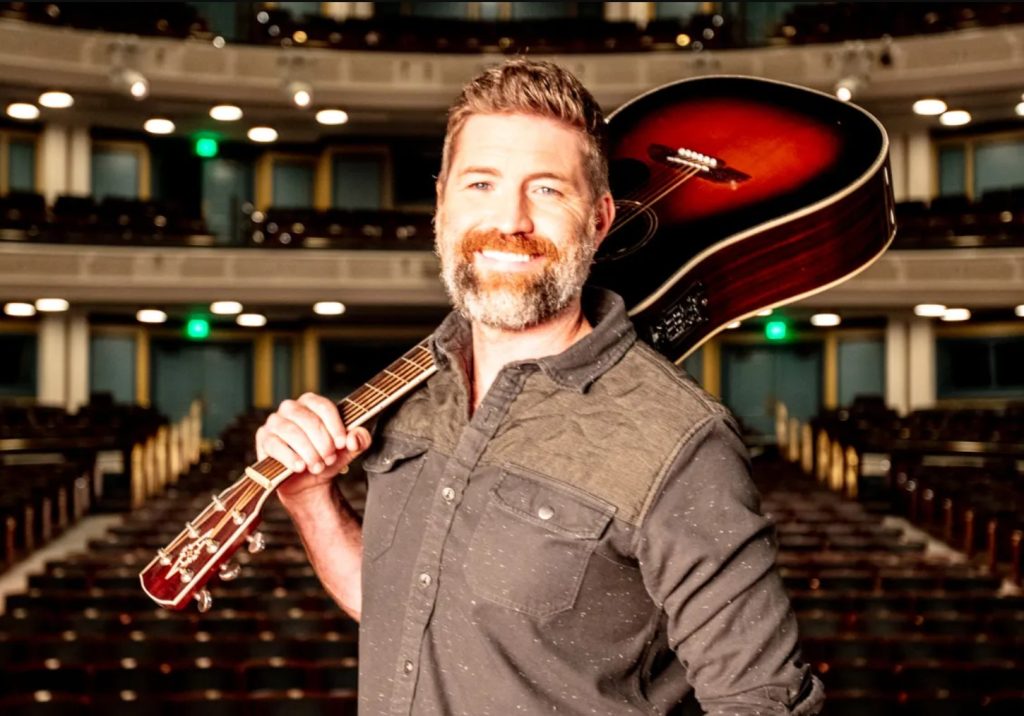
When Josh Turner steps into “Long Black Train,” he does so not merely as a vocalist but as a custodian of a particular strain of American country music, one rooted in moral gravity, baritone authority, and an almost hymnal sense of warning. Released originally in 2003 as Turner’s breakthrough single, the song had already cemented his image as a revivalist figure when it reached this 2006 duet performance. By then, Turner’s voice carried the weight of a singer who understood restraint as power. His delivery is measured, unhurried, and deliberate, allowing the lyrics to unfold with the calm certainty of a sermon rather than the urgency of a confession. In this performance, Turner anchors the song, maintaining its structural discipline and narrative clarity, reminding listeners that “Long Black Train” was never about spectacle but about inevitability.
That inevitability gains deeper resonance with the presence of Randy Travis, whose influence on Turner is neither subtle nor overstated. Travis enters the performance not as a co star seeking balance, but as a voice from an earlier chapter of modern country music, one that Turner openly reveres. By 2006, Travis had long been established as a defining force of the neotraditional movement, and his vocal timbre carries with it decades of moral storytelling and spiritual reflection. When Travis joins in, his phrasing is spare and unadorned, allowing the lines to breathe. He does not compete with Turner’s baritone but complements it, offering contrast through age, texture, and lived experience. His contribution feels less like a feature and more like a quiet endorsement, as though the elder statesman is affirming that the song’s warning remains relevant.
The true power of this performance, however, lies in the interaction between the two voices, which transforms “Long Black Train” from a singular moral parable into a generational dialogue. Turner sings as the watchman calling out from the tracks ahead, while Travis answers as one who has already seen the consequences described. Their harmonies are understated, almost austere, yet they carry emotional density precisely because neither singer reaches for excess. The duet format reframes the song as a shared testimony, reinforcing its central theme that temptation and consequence are not bound to any single age or era. In this context, the performance becomes less about vocal display and more about continuity within country music’s moral storytelling tradition.
At its core, “Long Black Train” remains a song defined by symbolism rather than plot. The train itself functions as a recurring metaphor for temptation, spiritual loss, and the ease with which one can drift toward irreversible choices. The lyrics avoid specificity, allowing listeners to project their own fears and experiences onto the imagery. In this 2006 duet, the song’s gospel undercurrent becomes more pronounced, not through arrangement changes but through the gravity both singers bring to the words. The sparse instrumentation and subdued staging reinforce the sense that the song is meant to be listened to rather than consumed, contemplated rather than applauded.
Viewed through the lens of this performance, “Long Black Train” stands as more than a hit single revisited. It becomes a moment of lineage, where a younger artist and his formative influence meet on equal footing, unified by a shared belief in the enduring power of restraint, clarity, and moral narrative. The duet does not attempt to modernize or reinterpret the song. Instead, it affirms its original purpose, allowing the warning to roll forward unchanged, much like the train it describes.
