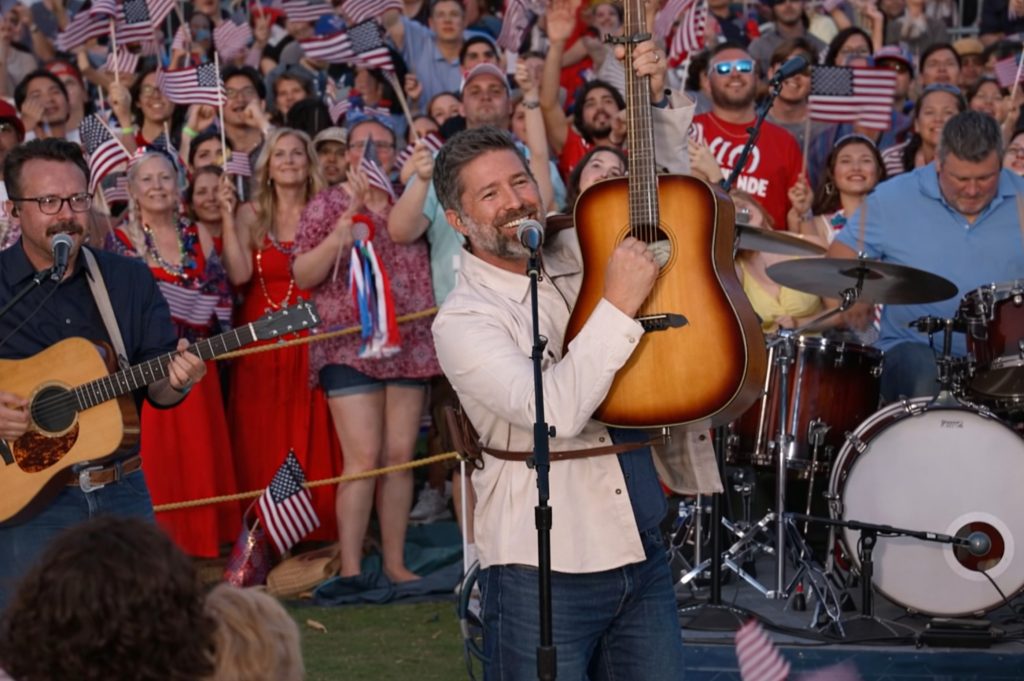
Firecracker is pure summer country charm—playful, bright, and full of that easy spark that feels even more alive when Josh Turner brings it to a holiday stage.
There are some country songs that arrive with a grin, a backbeat, and just enough swagger to make the whole room feel lighter. “Firecracker” is one of those songs. When Josh Turner sings it in a setting like A Capitol Fourth, the song seems to find a second home. It already carried the heat and flirtation of midsummer when it was released in 2007, but in a live Independence Day atmosphere, it takes on something extra—a sense of open air, celebration, and American summer tradition that suits Turner’s voice beautifully.
Originally released as the lead single from Josh Turner’s 2007 album Everything Is Fine, “Firecracker” quickly became one of the most recognizable songs of that chapter of his career. Written by Rivers Rutherford and Mike Dekle, the song climbed to No. 2 on the Billboard Hot Country Songs chart, proving that Turner could do far more than deliver slow-burning baritone ballads. Many listeners first fell for him through the deep, unmistakable gravity of songs like “Long Black Train” and “Your Man”, but “Firecracker” showed another side: teasing, upbeat, and full of country mischief.
That is part of the song’s appeal even now. It is flirtatious without sounding forced, lively without becoming loud, and catchy without losing its country backbone. The title itself gives away the song’s central image. The woman at the heart of “Firecracker” is not simply admired—she is described as something explosive, dazzling, and impossible to ignore. In lesser hands, that kind of lyric might feel like a gimmick. But Turner’s delivery grounds it. His voice has such natural weight that even a playful song comes across with conviction. He sounds amused, impressed, and fully in on the fun.
Musically, the record leans into a crisp, energetic country arrangement with enough snap to keep the lyric moving. It has the rhythm of a summer drive, the charm of a county fair, and the easy confidence of radio country at its most accessible. Yet what makes it memorable is the balance. Turner never oversings it. He lets the groove work, lets the phrasing breathe, and trusts the song’s simple imagery to do its job. That restraint is one reason “Firecracker” aged so well. It does not beg for attention. It earns it.
In the context of A Capitol Fourth, the song lands with special warmth. That annual concert, long associated with patriotic music, televised celebration, and the broad glow of a July evening in Washington, has always made room for songs that feel distinctly American in mood, not only in message. “Firecracker” fits naturally into that tradition. It is not a patriotic anthem in the direct sense, but it captures something just as familiar: summertime, flirtation, outdoor festivity, and the sense that music can turn a public event into a personal memory. On a holiday stage, the title itself suddenly feels larger. The song becomes part romance, part celebration, part seasonal snapshot.
That is where Josh Turner excels. He has always understood that country music is often strongest when it makes room for recognizable life. Not grand speeches. Not overworked symbolism. Just images people know by heart: heat in the air, a spark in the crowd, a woman who changes the atmosphere the moment she appears. “Firecracker” thrives on that kind of immediacy. It is built from ordinary language, but it leaves behind a vivid impression.
There is also a deeper reason the song has endured in Turner’s catalog. It represents a moment when his career broadened without losing its identity. By the time Everything Is Fine arrived, Turner was no longer simply the singer with the unforgettable low voice—he was becoming a durable mainstream country presence. “Firecracker” helped prove that he could carry a modern country radio hit while still sounding unmistakably like himself. That is not a small achievement. So many artists can chase tempo, charm, or commercial polish. Far fewer can do it without sanding away the very thing that made them distinctive in the first place.
And perhaps that is why a live performance of “Firecracker” still feels so enjoyable. The song does not rely on studio trickery or a passing trend. It relies on personality, timing, and a singer who knows exactly how to let a crowd lean in. In a setting like A Capitol Fourth, with all the associations of summer and celebration surrounding it, the song feels renewed. Not rewritten, not reinvented—simply brought back into the season where it belongs.
In the end, “Firecracker” remains one of those bright country records that never loses its color. It reminds us that not every lasting song has to be solemn to be meaningful. Some endure because they capture a moment, a mood, and a kind of joy that returns every year like warm weather itself. And when Josh Turner steps onto a stage and sings it live, that spark catches all over again.
