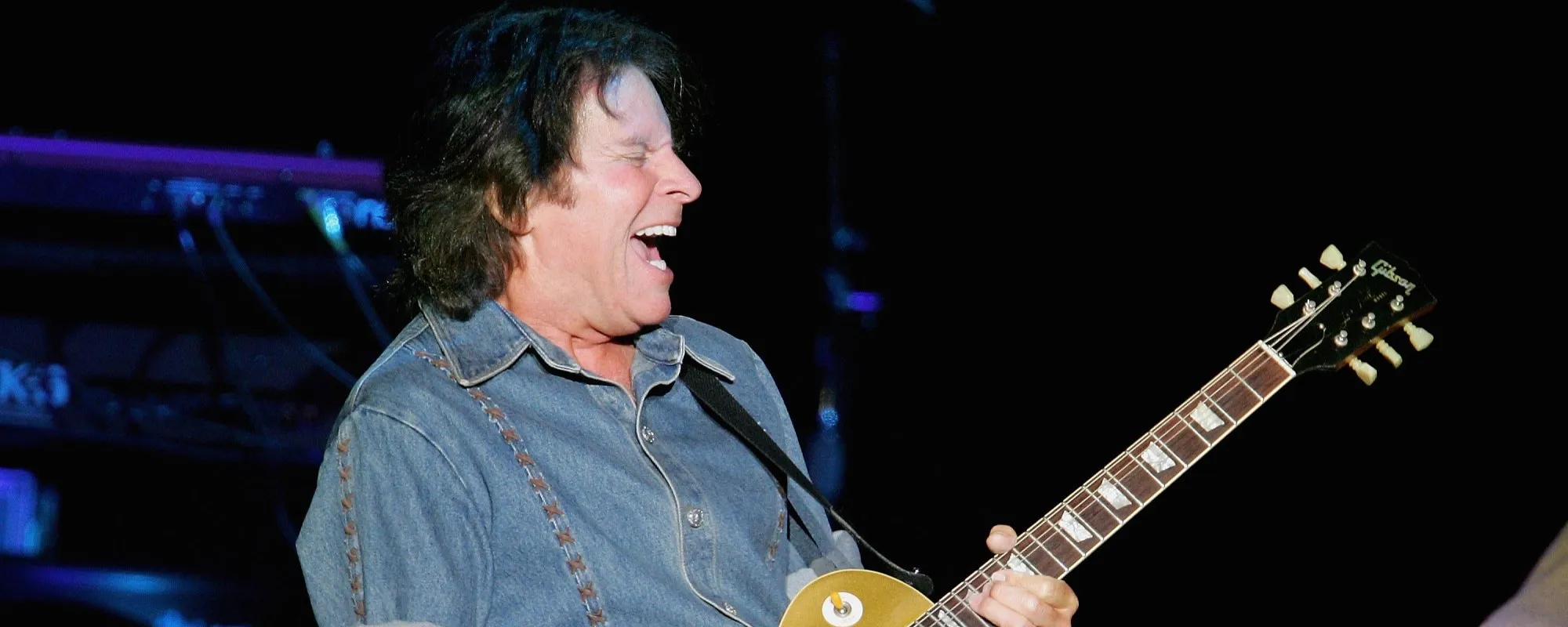
In 2004, John Fogerty made protest sound less like thunder than a memory refusing to stay buried.
John Fogerty released Deja Vu All Over Again in 2004, and its acoustic title track, commonly listed as Deja Vu (All Over Again), addressed the Iraq War with unusual directness. The song did not hide its subject behind abstraction. It looked at a new American conflict and heard an older echo: Vietnam, public doubt, political repetition, and the cost paid by young lives far from home.
That echo mattered because Fogerty’s voice already carried history. During his years with Creedence Clearwater Revival, he had written songs such as Fortunate Son and Who’ll Stop the Rain, records that became inseparable from the sound and unease of the Vietnam era. By 2004, he was no longer the young bandleader singing from inside that storm. He was an older songwriter watching another war unfold and choosing to speak in a language that was plain, compact, and difficult to mistake.
The title itself is part of the song’s power. The phrase deja vu all over again, long associated with baseball’s Yogi Berra, usually carries a comic circularity, a wink at repetition. Fogerty removes the comfort from it. In his hands, the phrase becomes a civic warning. The joke collapses into recognition. What returns is not nostalgia, but a pattern: familiar arguments, familiar losses, familiar assurances, and the uneasy feeling that a country has heard this music before.
Musically, the track resists the obvious route. Fogerty could have built his protest around the full electric bite many listeners associate with his most forceful rock writing. Instead, Deja Vu (All Over Again) is driven by acoustic restraint. The guitar does not soften the statement so much as expose it. Without a wall of sound to hide behind, the words sit close to the listener. The performance has the urgency of someone speaking across a table, not from a podium.
That intimacy gives the song its protest energy. It is not a chant. It is not a grand denunciation. It moves by accumulation: a public conversation overheard, a warning sign sensed, old ghosts rising in the national imagination, families left to carry grief. Fogerty’s phrasing keeps the song grounded. He does not over-sing the outrage. His voice carries a weathered edge, but the feeling is controlled, which makes the political charge more durable. Anger is present, yet it has been shaped into witness.
The acoustic setting also changes how the listener hears Fogerty’s history. The song does not simply repeat the stance of Fortunate Son. That earlier song burned with class anger and generational friction; its electric snap made privilege sound like an accusation. Deja Vu (All Over Again) works differently. It is less about the first shock of injustice than about the exhaustion of seeing injustice return. The tempo, the economy of the arrangement, and the directness of the lyric all point toward a mature form of protest: not less fierce, but more deliberate.
As the title track of the 2004 album, the song also frames Fogerty’s career at a revealing moment. He was not trying to enter a fashionable argument as a newcomer. He was drawing on a role he had occupied before, while understanding that the world around the song had changed. The early 2000s were filled with patriotic rhetoric, televised war, and a divided public conversation. In that atmosphere, a concise acoustic song could cut through precisely because it did not sound theatrical. It sounded like a citizen remembering.
There is courage in that kind of simplicity. Protest songs can fail when they become too broad, too certain of their own righteousness, or too attached to the moment that produced them. Fogerty’s title track avoids much of that by keeping the human cost near the center. The song’s argument is not complicated: when leaders repeat the errors of the past, ordinary families bear the consequences. Yet the plainness is not a weakness. It is the point. Some warnings should not need elaborate language.
What remains striking is how small the recording feels compared with the subject it confronts. War is vast, bureaucratic, televised, argued over in rooms far from battlefields. Fogerty answers with wood, strings, voice, and memory. That contrast gives Deja Vu (All Over Again) its lasting force. It suggests that protest does not always arrive as volume. Sometimes it arrives as recognition, quietly insistent, asking listeners whether the past is really past if its lessons are ignored.
For Fogerty, the song stands as a late-career act of continuity and conscience. It does not borrow significance only from his earlier work, though those echoes are impossible to miss. It earns its place through discipline: a clear subject, an uncluttered arrangement, and a voice willing to name the recurrence. In a time of noise, he chose a lean acoustic warning. The result is a song that understands protest not merely as opposition, but as memory doing its hardest work.
