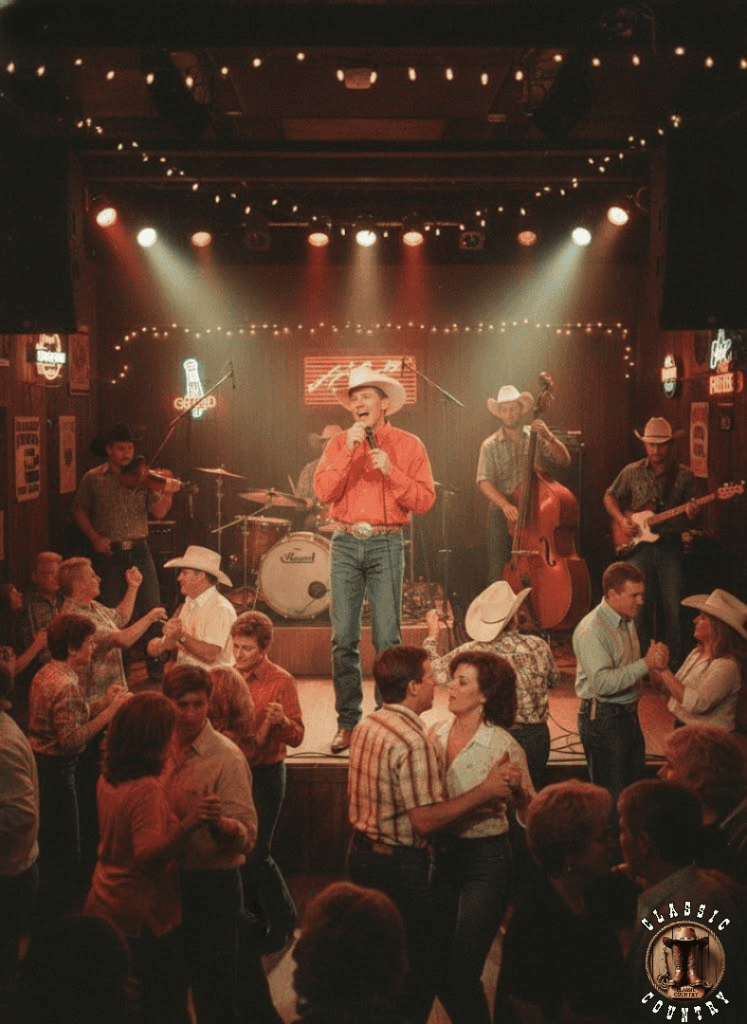
In the Hum of Neon Lights, A Feverish Heart Finds Its Rhythm
When George Strait released Friday Night Fever as part of his 1981 debut album, Strait Country, the country music scene was on the brink of transformation. Though the song itself did not chart as a single, it was nestled within an album that would go on to reshape the genre’s landscape. In an era teetering between the bombast of urban cowboy trends and the timeless allure of traditionalism, Strait emerged as a torchbearer for authenticity, a role he would continue to embrace throughout his illustrious career.
The early ’80s were a dynamic period for country music, caught in a tug-of-war between pop-infused sounds and the twangy roots of its heritage. Enter George Strait, a fresh voice steeped in the Texas honky-tonk tradition. His debut album, Strait Country, produced by Blake Mevis, offered a collection of tracks that signaled both a return to and a revitalization of classic country values. The album’s influence was profound, laying the groundwork for what critics would later dub the “neotraditionalist” movement, characterized by a revival of the genre’s core elements—steel guitars, fiddles, and heartfelt storytelling.
Friday Night Fever encapsulates this transition. With its lively tempo and spirited lyrics, it tells a familiar story of longing and escape within the vibrant world of dance halls and neon lights. The song captures the restless energy that fills these spaces on a Friday night—a haven where the week’s burdens dissolve into rhythm and movement. This narrative strikes a universal chord: the anticipation of release and connection after days spent under life’s weight.
Strait’s performance in Friday Night Fever is both earnest and electrifying, delivering a vocal style that marries warmth with an undeniable sense of ease. His voice, often described as smooth yet robust, reflects an understanding of the human condition that belies his years. Even in this early stage of his career, Strait’s ability to convey complex emotions with simplicity is evident—a trait that would come to define his enduring appeal.
The song’s musical composition complements its lyrical themes impeccably. Traditional country instruments converge to create a soundscape that evokes dusty dance floors and swirling skirts. The guitar twangs with vitality while the fiddle wails in harmonious accompaniment, crafting an atmosphere that is simultaneously nostalgic and exhilarating.
While Strait Country produced more commercially successful hits like “Unwound”, it is songs like Friday Night Fever that contribute to its lasting legacy. The track’s inclusion in this pivotal album underscores Strait’s commitment to authenticity—a commitment that resonated deeply with audiences yearning for genuineness amidst changing musical tides.
Reflecting on Friday Night Fever, one cannot ignore its cultural significance within George Strait’s oeuvre and country music history at large. It serves as an emblematic piece within his vast catalog—a testament to Strait’s influence in shaping the genre’s trajectory. More than four decades later, Strait remains an icon whose artistry continues to inspire new generations of musicians seeking to balance innovation with tradition.
Ultimately, Friday Night Fever offers more than just a glimpse into George Strait’s formative years; it provides listeners with an experience that transcends time and place. Its echoes linger not only in honky-tonks but also in any soul seeking solace through song and dance. This feverish pursuit of joy and connection remains ever-relevant—a testament to Strait’s enduring impact on country music’s heartstrings.
