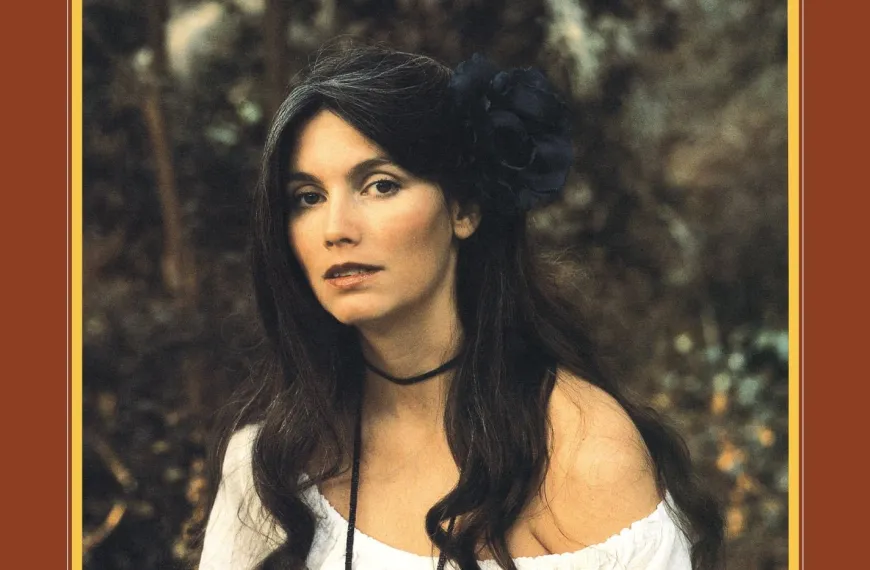
“Amarillo” is Emmylou Harris opening a door and letting the wind tell the truth—love slipping away not to another woman, but to the road, the bottle, and the restless pull of country music.
Before the hits arrive, before the classic covers start stacking up like postcards from every corner of her taste, Emmylou Harris begins Elite Hotel with a song that is unmistakably her own: “Amarillo.” It’s the first track on an album released December 29, 1975, recorded in June 1975 in Los Angeles, and produced by Brian Ahern—an album that would become her first No. 1 on Billboard’s Top Country Albums chart and peak at No. 25 on the Billboard 200.
Those are the big, public facts, and they matter—because they frame the intimacy of what “Amarillo” really is: an opening confession placed at the front of a record that was, commercially and artistically, the moment Harris stepped into true stardom. Elite Hotel didn’t just perform well; it announced a new kind of country voice—elegant, literate, rooted, and emotionally exact. And fittingly, she chose to introduce that world with the only song on the original album track list that she co-wrote: “Amarillo,” credited to Emmylou Harris and Rodney Crowell.
The song’s “chart debut” story is honest in a way older listeners tend to appreciate: “Amarillo” wasn’t pushed as a headline single and doesn’t have a neat Hot 100 or country-singles debut position to brag about. It lived where many of the most enduring songs live—as an album opener, a mood-setter, a piece of narrative architecture. Still, it did find its way onto vinyl in the era’s practical, two-sided way: it appeared as the B-side to Harris’ hit “Sweet Dreams” on a Reprise 45. That’s a small detail with a big emotional resonance—because it means some people first met “Amarillo” the old-fashioned way: flipping the record over after the “main event,” and discovering the deeper ache hiding underneath.
And what an ache it is. “Amarillo” doesn’t dramatize betrayal with soap-opera heat. In fact, it quietly undercuts the most common heartbreak cliché: the man in the song isn’t undone by chasing women—he’s undone by something harder to compete with. The song’s world is honky-tonks and highways, a lover being slowly replaced by habit: gambling, drinking, the seduction of music itself, that cruel, glittering promise that the next night might finally feel like relief. You can hear it in Harris’ delivery—how she sings like someone trying to stay reasonable while the heart keeps slipping its leash.
That’s what makes “Amarillo” feel so grown-up. It isn’t only about losing someone; it’s about losing them to a life—a life that doesn’t come home at a dependable hour, a life that keeps choosing the bright noise over the quiet room where love waits. Harris doesn’t spit venom. She sounds saddened, yes, but also strangely clear-eyed, as if she’s already begun the hard work of acceptance. The melody has that forward motion that country does so well: even while the lyric hurts, the song keeps moving, like wheels turning when you’d rather stay parked and pretend nothing is changing.
Placed at the front of Elite Hotel, “Amarillo” also serves as a kind of thesis. This album would go on to yield major chart successes—“Together Again” and “Sweet Dreams” became No. 1 country singles, “One of These Days” reached No. 3, and even “Here, There and Everywhere” crossed to the pop chart at No. 65. Yet it’s telling that the record opens not with a safe cover, but with a new song written from inside Harris’ own emotional weather—then sung with the restraint of someone who doesn’t need to shout to be believed.
In the end, “Amarillo” is less a place name than a feeling: the long, flat distance between two people when one of them has begun to live elsewhere—inside the night, inside the noise, inside the need to keep rolling. And Harris, with that clear, luminous voice, makes the saddest truth sound almost gentle: sometimes love doesn’t end in one moment. Sometimes it ends mile by mile, bar by bar, song by song—until all you can do is name the town you’ve been left in, and keep breathing there.
