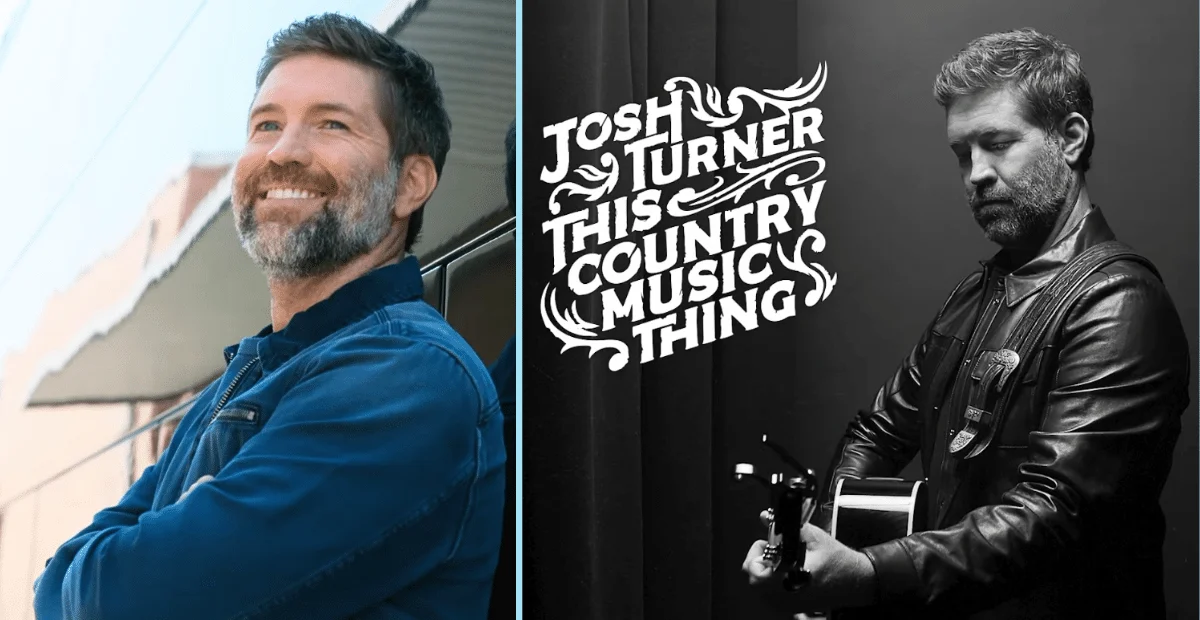
Before the big radio moments fully arrived, Josh Turner was already singing like every promise, doubt, and small-town decision carried real weight.
“There’s a Lot Riding on That” belongs to a revealing corner of Josh Turner’s early catalog: the 2004 Lost Tracks EP, a release that arrived during the important first stretch of his career, after “Long Black Train” had introduced his unmistakable baritone to country radio and before later hits would make him a household name among modern traditional-country fans. It is not the song casual listeners usually name first. It does not occupy the same public space as “Your Man”, “Would You Go with Me”, or the title track that gave his debut album its spiritual gravity. But deep cuts often tell a different kind of truth. They let us hear an artist before the larger story has hardened into memory.
Turner’s early-career appeal was never built on flash. From the beginning, he sounded older than the moment around him, not because he was imitating the past, but because his voice seemed naturally drawn to patience, consequence, and plainspoken conviction. When Long Black Train, his major-label debut album, appeared in 2003, mainstream country was carrying many different currents at once: polished radio ballads, arena-ready choruses, roots-minded revival, and songs that leaned toward pop brightness. Turner entered that atmosphere with a bass-baritone that felt almost startling in its steadiness. He did not have to press hard to command attention. He could simply settle into a line and make the room feel quieter.
That quality is what makes “There’s a Lot Riding on That” worth revisiting. The title itself suggests pressure without spectacle. It is country language at its most useful: direct, conversational, and carrying more than it announces. There is no need for grand scenery when a phrase like that can point toward love, responsibility, reputation, faith, family, or the fragile hope of getting one important thing right. In Turner’s hands, a song built around that idea naturally fits the emotional vocabulary he was shaping in those first years. He was already drawn to material where choices mattered, where a man’s voice was not merely decorative but accountable.
The Lost Tracks EP context matters because it frames the recording not as a centerpiece of a blockbuster era, but as part of the material orbiting Turner’s arrival. Early EPs, bonus releases, and tucked-away tracks can feel like side roads, yet they often preserve the atmosphere around an artist’s formation. They catch the singer before the audience has decided exactly what box to place him in. For Turner, that means hearing the low end of his voice not as a signature already familiar from years of hits, but as an unfolding promise. The deep resonance is there, but so is the sense of a young artist still laying claim to the kind of country music he wanted to stand for.
Musically, a song like “There’s a Lot Riding on That” sits comfortably beside Turner’s early traditional leanings. His best performances from this period tend to value shape over excess. The drama comes not from vocal gymnastics, but from restraint: the way he lets a phrase fall, the way the bass in his voice gives ordinary words a moral weight, the way the arrangement leaves enough room for the lyric to breathe. That restraint was one of his quiet strengths. At a time when many singers were chasing bigger choruses and brighter production, Turner’s presence suggested that country music could still find force in lowered volume and settled conviction.
There is also a particular kind of youth in this recording, though not the restless kind. Turner was in the early phase of a career that would soon expand dramatically, but his singing already carried the sound of someone measuring the road ahead. That is why the song’s title feels almost autobiographical when heard through the lens of 2004. There really was a lot riding on that season for him: the follow-up choices after a remarkable introduction, the question of whether traditional country instincts could still find a wide audience, and the challenge of turning a striking voice into a lasting body of work. The song did not need to become a radio standard to belong to that story. Its importance lies in the way it shows the foundation being built.
Deep cuts can be generous to listeners because they ask for a slower kind of attention. They are not surrounded by the same public memories, so they have to speak from the recording itself. “There’s a Lot Riding on That” does exactly that. It draws the ear back to a period when Josh Turner was still being discovered by many fans, when his voice felt like a fresh return to something sturdy, and when even a lesser-known track could reveal the seriousness behind the calm. Heard now, the song feels less like a leftover and more like a small document of direction: a young singer choosing weight over glitter, steadiness over show, and consequence over easy charm.
That may be why the recording continues to hold quiet interest for those who dig beneath the obvious landmarks in Turner’s catalog. It reminds us that careers are not made only from the famous singles. They are also made from the songs that surround them, the ones that test tone, identity, and trust. In “There’s a Lot Riding on That”, the voice that would later fill bigger spaces is already present, grounded and sure, carrying the title’s burden as if it were not a slogan but a way of singing. Sometimes the early tracks do not announce the future loudly. They simply let you hear it taking shape.
