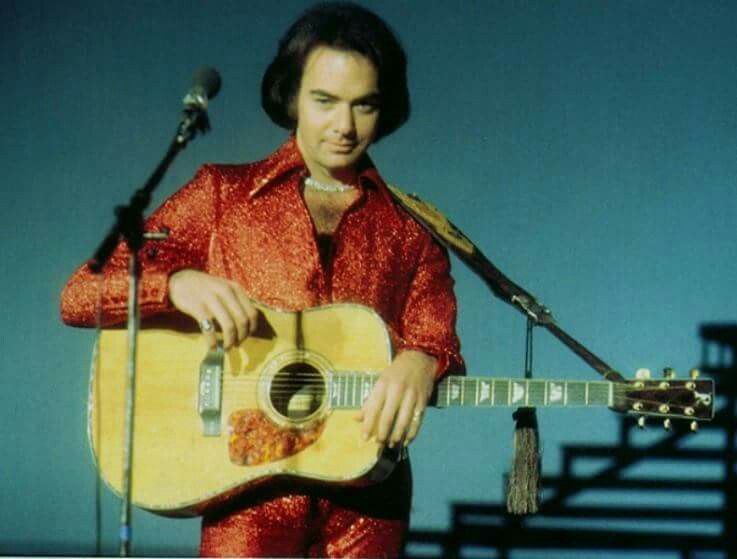
In Dig In, Neil Diamond sounds like an artist still close enough to the street to feel every push, but already reaching for the larger stage ahead.
Dig In appears as a 1969 album track on Neil Diamond’s Brother Love’s Travelling Salvation Show, a record from the early Uni Records period when Diamond was moving beyond the compact urgency of his Bang Records hits and toward a broader, more dramatic musical identity. By then, he was no longer simply the sharp young songwriter behind songs like Solitary Man, Cherry, Cherry, and Kentucky Woman. He was becoming something harder to classify: part pop craftsman, part folk-rock believer, part street-corner preacher, part solitary romantic with a rhythm section behind him.
That makes Dig In a valuable piece of the story. It is not the song most casual listeners name first when they think of Diamond’s 1969 breakthrough season. The title track, Brother Love’s Travelling Salvation Show, carries the album’s theatrical charge, while Sweet Caroline, released the same year, would eventually become one of the most widely recognized songs in American popular music. But an album track like Dig In lets the listener stand closer to the machinery of Diamond’s early evolution. There is less monument around it, less public ritual, and because of that, the song can feel more immediate.
The title itself is a command, plain and physical. Dig In does not ask politely for attention. It suggests effort, appetite, grit, and the refusal to stay on the surface. In the context of Brother Love’s Travelling Salvation Show, that matters. The album often finds Diamond exploring the line between personal conviction and public performance, between the private songwriter and the man learning how to fill a room with authority. On Dig In, the force is leaner. The performance does not need the full revival-tent sweep of the title song. It works more like a clenched hand on a tabletop: direct, rhythmic, and restless.
Listening to this track through the lens of Diamond’s early era, one can hear a singer still shaping the voice that later became so familiar. The deepened authority was already there, but it had not yet settled into the polished certainty associated with the arena years and the grander live recordings of the 1970s. There is a hunger in this period, a sense that Diamond was testing how much pressure his voice could carry without losing its plainspoken edge. He had a gift for writing songs that sounded simple on first contact, then revealed a more complicated emotional structure beneath the surface. Dig In belongs to that world: compact, forceful, and more revealing than its reputation might suggest.
The late 1960s were full of artists trying to stretch beyond the strict boundaries of the pop single. Albums were becoming statements, not just containers for hits, and Diamond was participating in that change in his own way. He did not abandon melody or accessibility; those remained central to his appeal. But on Brother Love’s Travelling Salvation Show, he allowed more room for theatricality, moral urgency, and rougher textures. Dig In fits that atmosphere because it sounds less concerned with charm than with momentum. It catches Diamond before his public image hardened into the larger-than-life figure many later came to know.
That is the pleasure of returning to an early album cut. It does not arrive burdened by stadium singalongs, sports-crowd memory, or decades of repetition. It still has room to surprise. In Dig In, Neil Diamond is not yet standing fully inside the mythology of his own career. He is still pushing, still claiming space, still turning urgency into song. For listeners who know only the grand choruses and familiar anthems, this 1969 track offers a sharper portrait: a young artist in motion, already confident, but not yet settled; already recognizable, but still becoming.
He would go on to make bigger records, more famous records, and performances that entered the public memory in ways few songwriters ever experience. But Dig In holds a different kind of value. It preserves the sound of ambition before it becomes ceremony. It reminds us that even the most familiar voices had early rooms to fight through, early grooves to lean into, early album tracks where the future was not yet guaranteed but was beginning to announce itself.
