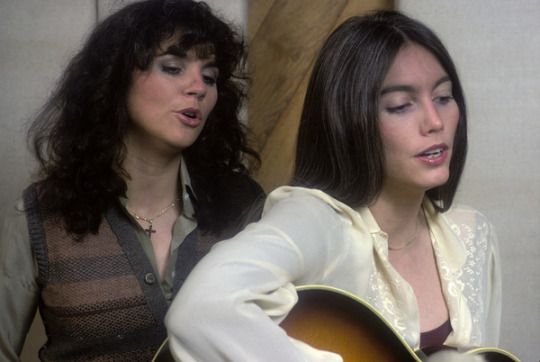

A young Rodney Crowell wrote a song about drift, weakness, and the hope of being held steady. In 1975, Emmylou Harris turned it into one of the quiet emotional centers of Elite Hotel.
When Emmylou Harris recorded ‘Til I Gain Control Again for her 1975 album Elite Hotel, she did something she would do better than almost anyone of her generation: she took a songwriter’s private truth and carried it into the bloodstream of country music. The song came from Rodney Crowell, still a young writer finding his place, and Harris heard in it something lasting. Though ‘Til I Gain Control Again was not pushed as a charting single of its own, the album that housed it mattered enormously. Elite Hotel reached No. 1 on Billboard’s Top Country Albums chart, and its run also produced major country hits, including Together Again at No. 1, Sweet Dreams at No. 1, and One of These Days at No. 3. That means this recording arrived inside a record the country audience truly lived with.
There is an important lineage here. Before Rodney Crowell became a major artist and one of Nashville’s most admired writers, Emmylou Harris was one of the first major voices to champion his songs. She had already recorded Bluebird Wine on Pieces of the Sky, and with ‘Til I Gain Control Again she went even deeper into Crowell’s world: grown-up, unsettled, tender, and quietly bruised. Crowell came out of that rich songwriter current that ran through Texas and Nashville in the 1970s, the same atmosphere that prized truth over ornament and detail over grandstanding. Harris, especially in the early Hot Band years, became a remarkable bridge between that writing culture and a wider listening public.
What makes ‘Til I Gain Control Again so powerful is that it is not a simple love song and not quite a breakup song either. It is a confession from someone who knows he is unstable, knows he drifts, knows the road ahead may send him spinning, and still asks for grace. The title itself tells the whole emotional story. This is a song about trying to come back to oneself. It is about needing another person’s steadiness while your own inner weather is still changing. In lesser hands, that idea could sound self-pitying. In Crowell’s writing, it sounds honest. In Harris’s voice, it sounds almost sacred.
That is one reason her 1975 recording remains such a touchstone. Emmylou Harris never attacks the lyric. She does not force the pain or oversell the devotion. Instead, she sings it with the calm ache that became one of her signatures. The early Hot Band sound surrounds her with just enough motion to suggest life on the move, but never so much that the words disappear. You can hear the country tradition in the steel and the careful rhythm, but you can also hear the widened horizon Harris brought to the genre after folk, rock, and cosmic country had all started leaning into one another. The track feels polished, but never slick; intimate, but never fragile.
There is also a biographical shadow that makes the performance even more resonant. By the time of Elite Hotel, Harris was shaping her own identity after the upheaval that followed her work with Gram Parsons. She was no longer simply being introduced to the public; she was building a canon. And part of that canon came from her extraordinary instinct for material. She knew how to honor older country songs, but she also knew when a newer writer was carrying forward the same emotional truth in a different language. With ‘Til I Gain Control Again, she was not merely covering Rodney Crowell. She was helping establish him.
That may be the most beautiful part of the story. Some singers deliver songs. Harris has always seemed to adopt them, protect them, and reveal their best light. Her version gave ‘Til I Gain Control Again an early permanence. Later, many listeners came to understand just how central Crowell would become to modern country and Americana songwriting, but in 1975 Harris was already hearing that future. The song’s place on Elite Hotel now feels almost prophetic, one quiet sign that the next generation of writers had arrived.
And still, for all the historical importance, the recording survives because of feeling. The lyric does not offer neat resolution. It does not promise that love will fix everything. It only asks for patience, for shelter, for a little faith while the singer tries to stop spinning. That is a deeply adult emotion, and Harris understood how to leave it unadorned. Her phrasing gives the song room to breathe, and because of that, the vulnerability lands harder. It sounds like someone who has stopped making speeches and finally chosen honesty.
So when people speak of the early Hot Band era as a golden period, this recording is part of the reason why. It captures Emmylou Harris at the point where taste, timing, voice, and repertory all met. It also captures Rodney Crowell before the full fame, already writing with the wisdom and weathered clarity that would define his career. On paper, ‘Til I Gain Control Again may look like an album cut on a chart-topping 1975 record. In memory, it feels larger than that: a handoff between songwriter and interpreter, between promise and recognition, between private unease and lasting art.
