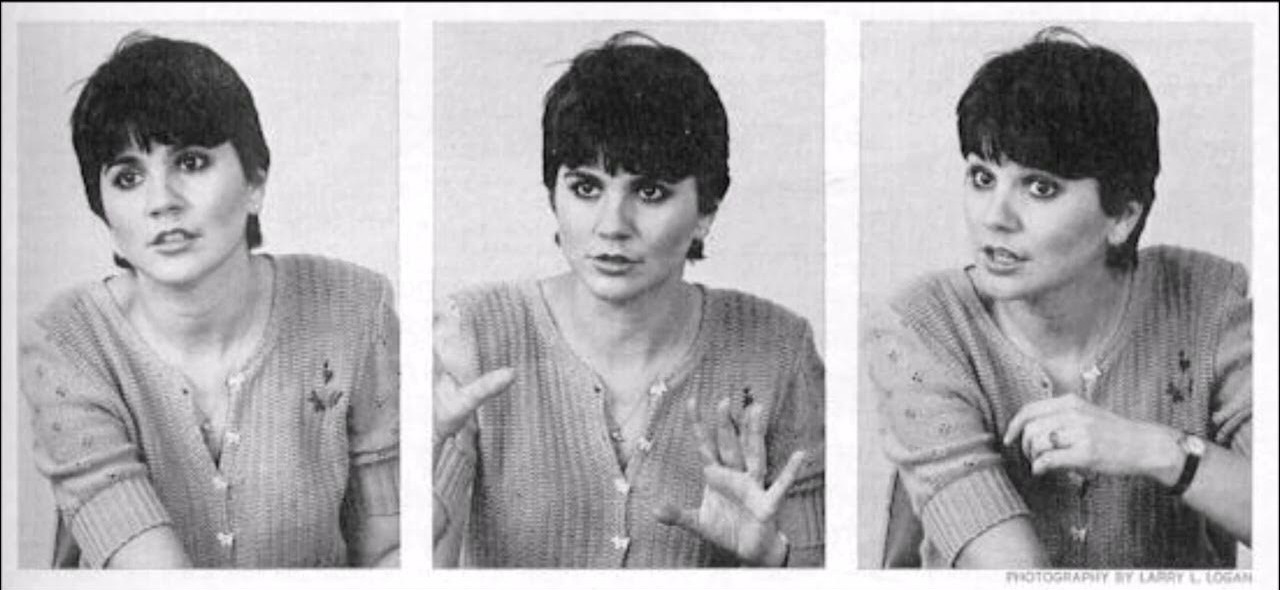
On I Knew You When, Linda Ronstadt turned a mid-1960s memory song into one of the brightest, sharpest flashes on Get Closer, the 1982 album that now feels like a last electric shimmer before her next great artistic turn.
There is something especially revealing about Linda Ronstadt‘s version of I Knew You When on Get Closer. It is not just a cover, and it is not just another strong vocal on a strong album. It is one of those performances that quietly tells you where an artist has been, what she still does better than almost anyone, and how close she is to changing direction. Released in 1982, Get Closer reached No. 31 on the Billboard 200, a respectable showing, though not on the towering commercial level of some of her mid-to-late 1970s triumphs. Even so, the record has aged beautifully, and songs like I Knew You When are a big reason why.
The song itself already had history. I Knew You When was written by Joe South, one of the great Southern songwriters of his era, and it first became widely known through Billy Joe Royal‘s 1965 hit version, which climbed to No. 14 on the Billboard Hot 100. In its original life, the song carried that unmistakable 1960s mixture of youthful ache and radio-ready polish. Joe South had a gift for writing melodies that felt open-hearted and a little wounded at the same time, and this song sits squarely in that tradition. It is a song about recognition, but not comfort; about seeing someone again, but realizing the old closeness no longer means what it once did.
What Linda Ronstadt did with it in 1982 was subtle in concept but powerful in effect. Her reading is often described as power-pop infused, and that phrase fits. The arrangement has more forward motion, more crispness, and more snap than the earlier hit version. There is a bright, urgent pulse running through it, the kind of early-1980s pop-rock energy that gives the performance lift without sanding away its emotional undercurrent. Ronstadt had always been extraordinary at taking songs rooted in country, rock, folk, or pop and finding the exact point where clarity and feeling met. On I Knew You When, she does not oversing the regret. She rides it.
That is part of what makes the performance so memorable. The lyric is built on a simple but quietly devastating idea: time has moved on, and the person in front of you is both familiar and gone. The title phrase itself, I Knew You When, contains a whole world of distance. It is not the same as saying, “I know you.” It is an acknowledgment that memory is now doing most of the work. In Ronstadt’s hands, the song feels less like a teenage sigh and more like an adult reckoning with how swiftly the emotional weather can change. The bright attack of the arrangement almost disguises that ache at first. Then her voice comes through, and suddenly the song is no longer just catchy. It is bittersweet in the deepest sense.
Heard within the full context of Get Closer, the track becomes even more interesting. This was a transitional period for Linda Ronstadt. She was still very much a major pop presence, still capable of cutting lively, radio-friendly performances, and still moving with ease across styles. But from the distance of time, Get Closer also sounds like a bridge between chapters. It arrived after the leaner, more contemporary edge of Mad Love and just before the dramatic left turn of What’s New in 1983, the album that introduced her celebrated collaboration with Nelson Riddle and opened an entirely different artistic path. That is why I Knew You When now lands with special force. It carries the confidence of Ronstadt’s rock-pop years, but it also carries a maturity that points ahead.
There is another reason the song endures: Linda Ronstadt understood how to sing from inside a lyric without making a performance feel heavy. Her phrasing here is clean, conversational, and emotionally exact. She sounds neither theatrical nor detached. Instead, she sounds like someone who has lived long enough to know that some reunions are really encounters with memory, and some familiar faces only remind us how much has slipped away. That balance between energy and reflection is the heart of the track. It is what gives the performance its glow.
Commercially, I Knew You When was not the centerpiece of the album’s chart story. It was not one of the major singles that defined the release campaign. But album tracks often tell the fuller truth about an artist, and this one certainly does. If the charts tell us where a record stood in the marketplace, songs like this tell us where the artist stood in spirit. On Get Closer, Ronstadt still sounded alert, adventurous, and deeply committed to the craft of interpretation. She could take a song from 1965 and make it feel immediate without breaking its emotional spine.
That may be the lasting beauty of this recording. It honors the Joe South original, nods to the hit made famous by Billy Joe Royal, and still belongs unmistakably to Linda Ronstadt. In just a few minutes, it captures the tension that made her such a singular artist: elegance and force, accessibility and depth, polish and feeling. For listeners returning to Get Closer, I Knew You When is more than a fine cover. It is one of those album-era gems that reveals an artist in motion, standing between one celebrated identity and the next, singing with enough spark to make both the past and the present feel alive at once.
