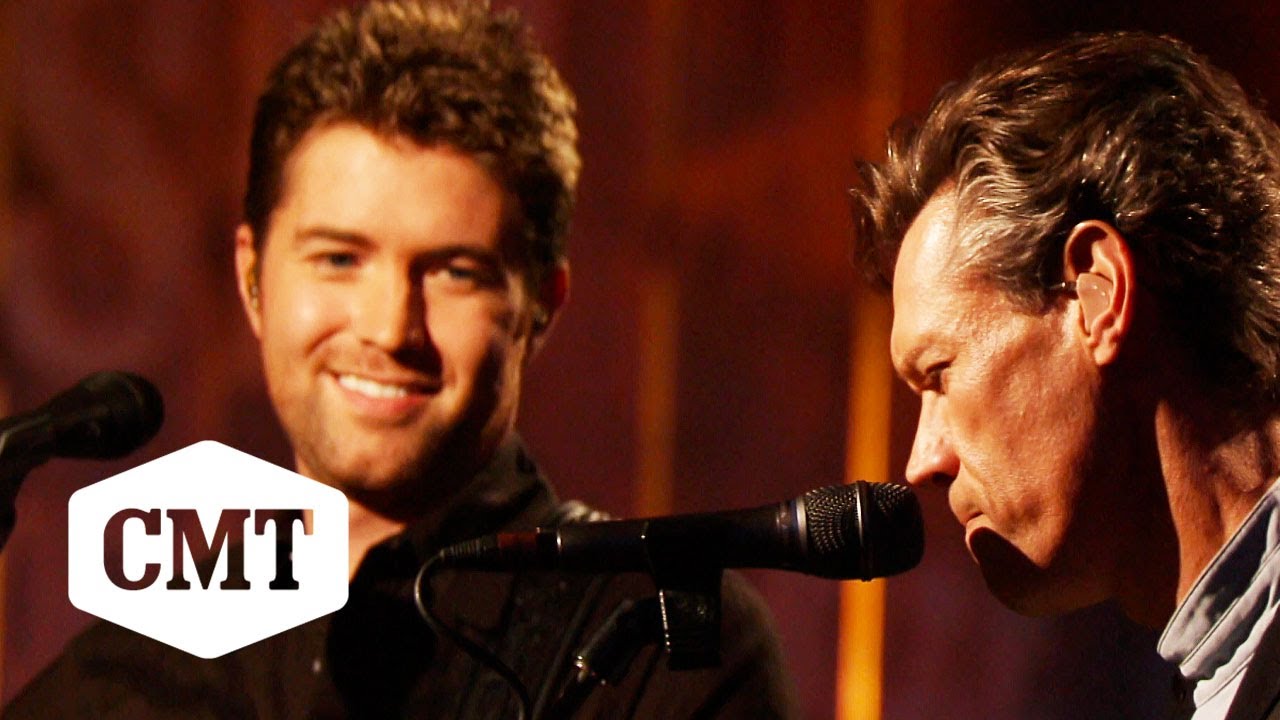
At the Ryman, Josh Turner let Backwoods Boy become less of a country character sketch and more of a proud statement of place, voice, and belonging.
Josh Turner’s live performance of Backwoods Boy on the 2007 Cracker Barrel exclusive album Live at the Ryman captures a very specific kind of country music moment: not flashy, not overexplained, but rooted so deeply in identity that the room itself seems to understand it. The setting matters. The Ryman Auditorium in Nashville is not just another venue with good acoustics; it is a room where country songs carry the weight of memory before a singer even opens his mouth. For Turner, whose baritone had already made him one of modern country’s most recognizable traditional voices, that room gave Backwoods Boy a different kind of authority.
The song had first found its place in Turner’s early catalog around the Long Black Train era, when he was still being introduced to a broad country audience as a singer with an unusually deep voice and an old-soul sense of restraint. Backwoods Boy is not built like a polished pop-country confession. It is built from plainspoken rural detail, the kind of lyric that sounds less like performance and more like someone describing the ground beneath his boots. In the studio, that directness gave the song its character. At the Ryman, on Live at the Ryman, it becomes something more public and more communal.
That 2007 release is important because it arrived at a moment when Turner’s career had already widened beyond first impressions. By then, listeners knew the gravity of Long Black Train, the warmth of Your Man, and the easy swing of Would You Go with Me. He was not simply a newcomer with a remarkable low register anymore. He had become a bridge between contemporary country radio and a deeper tradition of gospel-shaped phrasing, Southern storytelling, and masculine understatement. A Cracker Barrel exclusive live album may sound like a modest piece of discography, but in country music terms, it makes a certain sense: music traveling through a familiar American roadside space, finding listeners not only through charts and videos, but through everyday life.
On Backwoods Boy, Turner’s voice does what it has always done best: it refuses to hurry. He does not need to push the song into drama, because the drama is in the contrast between simplicity and conviction. The lyric’s rural imagery could have become a costume in the hands of a less grounded singer. Turner gives it steadiness. His delivery suggests a man who is not trying to sell a lifestyle as much as name one honestly. The live setting sharpens that distinction. You can imagine the song moving through the wooden bones of the Ryman, where every syllable has to stand on its own and every easy gesture risks sounding too big for the room.
What makes this version compelling is the way the audience becomes part of the song’s meaning without taking it over. Backwoods Boy is a proud song, but not a loud one in spirit. It carries the confidence of someone who knows where he comes from, yet it also has a hint of defense in it, as if the singer understands that rural identity is often simplified from the outside. In a live performance, especially in a place so tied to country history, that pride feels less like a slogan and more like a quiet correction. The song says: this is not a pose, this is a place; this is not nostalgia, this is memory with mud still on it.
The Ryman also changes the way Turner’s band can be heard. A song like this depends on pulse and clarity more than ornament. The groove needs to feel lived-in, not decorated. In the live version, the arrangement serves the vocal and the story, letting the rhythm carry the forward motion while Turner’s baritone anchors everything. There is a satisfying lack of excess in that approach. Nothing about it asks the listener to admire the machinery. Instead, the performance keeps returning attention to the central fact of the song: a man standing in front of a crowd and making his background sound not quaint, but dignified.
That dignity is the real emotional center of Backwoods Boy on Live at the Ryman. The performance does not ask to be treated as a grand turning point, and that restraint is part of its appeal. It belongs to a quieter tradition of country music where a singer’s credibility is measured not by how much he reveals, but by how naturally the song seems to fit his voice. Turner’s live reading allows the track to breathe inside a historic room, and in doing so, it brings forward something that can be missed in a casual listen: the song is not only about where a man lives or hunts or works. It is about the deep human need to be recognized without being polished into something else.
Years later, this 2007 Live at the Ryman performance still works because it catches Turner at a meaningful intersection: young enough in his career to sound freshly certain, established enough to command the stage without strain, and traditional enough to make the Ryman feel like a natural home rather than a borrowed backdrop. Backwoods Boy may not be the first title people name when discussing his catalog, but in this setting it becomes a revealing piece of the larger Josh Turner story. It shows a singer using a live stage not to reinvent himself, but to stand more fully inside the identity his music had been carrying all along.
