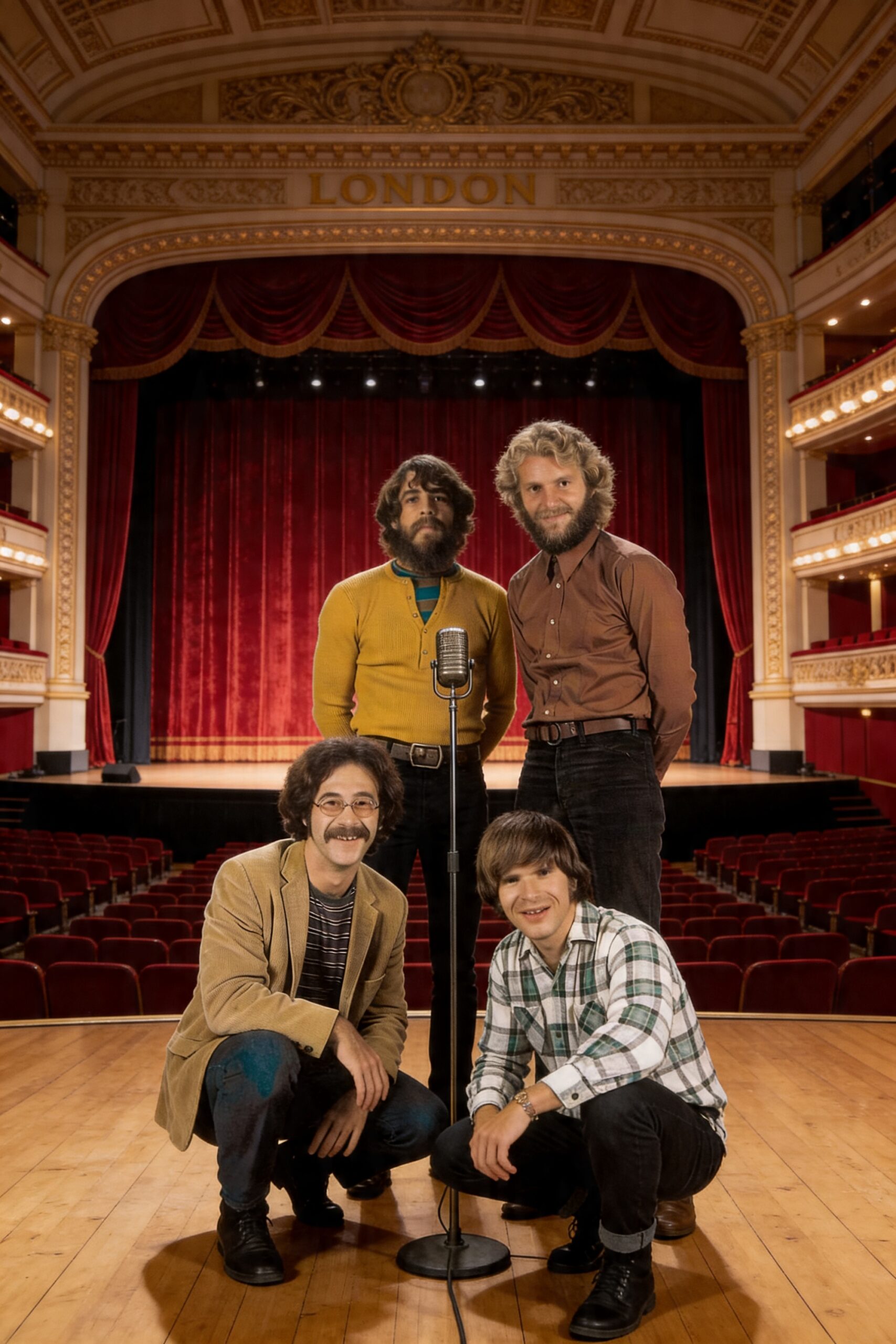
A brief instrumental tucked inside a famous 1969 album, Poorboy Shuffle lets Creedence Clearwater Revival sound less like hitmakers and more like a street-corner band chasing a groove.
On Willy and the Poor Boys, released in 1969 on Fantasy Records, Creedence Clearwater Revival built one of the most enduring albums of their astonishingly busy late-sixties run. It is the record that holds Down on the Corner, Fortunate Son, The Midnight Special, and Effigy—songs with very different moods, yet all carrying the unmistakable stamp of a band that could make American roots music feel urgent without dressing it up. But buried on side one is a smaller, stranger, and more revealing moment: Poorboy Shuffle, a rare instrumental deep cut featuring John Fogerty on harmonica.
That detail matters because Creedence was usually driven by Fogerty’s voice: blunt, weathered, sharp-edged, and instantly recognizable. His singing could sound like it came from a roadside bar, a riverbank, a news bulletin, and an old folk memory all at once. On Poorboy Shuffle, however, that voice steps aside. The words disappear. In their place comes a loose, rootsy instrumental that feels like it belongs to the fictional street band introduced by the album’s title idea. If Down on the Corner imagines Willy and the Poor Boys playing for coins on a corner, Poorboy Shuffle briefly lets that imaginary band breathe without explanation.
The track is not designed to overwhelm. It does not announce itself with the force of a single, and it does not carry the political bite that makes Fortunate Son such a defining recording of 1969. Instead, it works like a scene change. The harmonica pulls the listener toward country blues, folk performance, and the informal language of players gathered close enough to hear each other’s smallest turns. In a catalog often remembered for tight radio structures and hard-driving swamp-rock momentum, Poorboy Shuffle feels deliberately modest. Its charm lies in how little it tries to prove.
That modesty is part of the album’s larger intelligence. Willy and the Poor Boys arrived the same year as Bayou Country and Green River, a remarkable stretch for a band that seemed to be moving faster than the era around it. But the album was not only a collection of songs; it had an atmosphere. Creedence drew from rock and roll, blues, country, gospel echoes, traditional material, and working-class storytelling, then tightened those influences into something direct and unmistakably their own. A small instrumental like Poorboy Shuffle helps reveal the connective tissue. It shows the band not as stylists borrowing old sounds, but as musicians who understood how a groove, a harmonica phrase, and a few bars of shared rhythm could suggest a whole social world.
John Fogerty’s harmonica gives the piece a different kind of authority from his guitar or vocal performances. It is not polished in the sense of being grand or ornate; it is conversational. The instrument carries breath, scrape, and movement. It sounds close to the body, closer to the sidewalk than to the spotlight. That is why the track still rewards attentive listening. It reminds us that Creedence’s greatness was not only in their biggest choruses or most quoted protest lines. It was also in their ability to create place—sometimes with a swampy guitar figure, sometimes with a snare pattern, sometimes with a harmonica line that makes the album’s fictional poor boys feel momentarily real.
As a deep cut, Poorboy Shuffle also changes how the famous songs around it are heard. After the bright communal image of Down on the Corner and the old American current of Cotton Fields, this instrumental sits like an unguarded rehearsal captured in passing. It makes the album feel less like a parade of hits and more like a neighborhood of sounds. Then, when the record moves on, the listener carries that small street-corner energy forward. The band’s political anger, humor, rural imagery, and blues feeling all seem to come from the same imagined ground.
Not every important album moment has to be large. Sometimes the smallest track is the one that reveals the room. Poorboy Shuffle may never be the first song people name when they talk about Creedence Clearwater Revival, and it was never meant to compete with the towering pieces around it. Its power is quieter: a brief instrumental pause in which John Fogerty’s harmonica opens a side door into the world of Willy and the Poor Boys. For a couple of minutes, the famous band sounds like a handful of players on a corner, making something sturdy out of breath, rhythm, and shared instinct.
