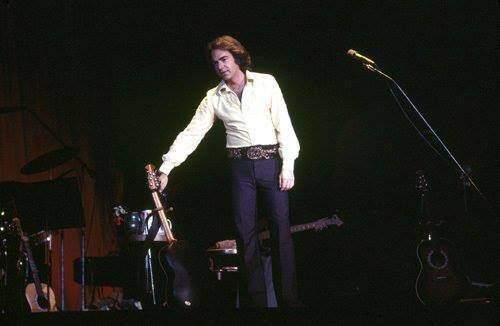
A newly recorded title track gave Neil Diamond’s 1996 career retrospective something rarer than completeness: a living voice looking back while still moving forward.
When Neil Diamond released In My Lifetime in 1996, the project was not simply another hits package pulled from the shelf. It was an elaborate three-CD career retrospective box set, a curated journey through decades of songwriting, stagecraft, pop ambition, and restless reinvention. At its center sat a crucial detail: the title track, In My Lifetime, was newly recorded for the collection. That matters. Instead of letting the box set function only as a museum of past triumphs, Diamond placed a fresh statement inside it, as if he wanted the archive to breathe.
By 1996, Diamond had already lived several musical lives. He had come out of the New York songwriting world, including the Brill Building orbit, with a gift for compact, emotionally direct songs. In the 1960s, records such as Solitary Man, Cherry, Cherry, and Kentucky Woman established him as a writer and performer whose songs could sound simple on first contact and then reveal a deeper ache beneath the surface. In the 1970s, he moved into larger rooms and broader emotional weather, with Sweet Caroline, Holly Holy, Cracklin’ Rosie, Song Sung Blue, and I Am… I Said becoming part of the shared language of American pop. He was not only a singles artist; he became a concert figure, a cinematic storyteller, and a performer whose gravel-warm voice could make private feeling sound communal.
That is why the 1996 context gives In My Lifetime its particular charge. A box set normally asks listeners to look backward. It gathers, orders, explains, and preserves. It turns a career into a map. But Diamond’s newly recorded title song does something more personal. It stands at the entrance like a handwritten note slipped into a family album. The familiar songs are there, but before the listener moves through the chapters, the artist steps forward in the present tense. He is not only the young songwriter chasing a break, or the arena performer leading thousands of voices, or the hitmaker whose melodies found permanent residence on radio. He is also the man in 1996, weighing the miles already traveled.
The power of the song lies in how naturally it fits the retrospective without sounding like a mere label for it. In My Lifetime carries the kind of title that could easily become grand or ceremonial, but in Diamond’s hands it suggests something more intimate: a reckoning with time, work, memory, and survival. His best writing has often lived in that space between public confidence and private uncertainty. Even at his most expansive, there is usually a lonely figure somewhere inside the song, measuring the distance between where he began and where he has arrived. On the 1996 title track, that tension feels especially appropriate. A career retrospective can celebrate achievement, but a newly recorded song can admit that achievement is not the same as arrival.
Musically, Diamond’s mature voice gives the recording its emotional center. By the mid-1990s, the brightness of youth had deepened into a more weathered authority. That change was not a loss; it was evidence. He could sing with the weight of experience, allowing the title phrase to feel earned rather than decorative. The song does not need to compete with the classics surrounding it. Instead, it changes the way those classics are heard. The early hits become beginnings. The concert favorites become milestones. The dramatic ballads become dispatches from different rooms of the same life. The new title track becomes the frame around the whole picture.
There is also something distinctly 1990s about the ambition of the box set itself. The compact-disc era encouraged artists and labels to rethink the long arc of a catalog. Retrospectives were not only commercial products; at their best, they were acts of self-definition. They placed hits beside rarities, demos, overlooked cuts, and contextual material, inviting fans to hear not just what succeeded, but how an artist developed. For Neil Diamond, whose career had crossed labels, styles, audiences, and critical assumptions, In My Lifetime offered a chance to gather the fragments into one long conversation.
That conversation is more complicated than simple nostalgia. Diamond has always inspired strong affection, but he has also been easy to misunderstand if one listens only to the surface of the spectacle. The sequined stage image, the big sing-along choruses, and the crowd-pleasing drama can obscure the craft underneath. A song like In My Lifetime, placed in a retrospective setting, redirects attention to the writer behind the gestures. It reminds listeners that the grandness was often built from plain human materials: longing, ambition, doubt, romance, exile, gratitude, and the stubborn need to keep singing.
He did not have to record a new title track for the box. The old songs were strong enough to carry the package. But by adding one, Diamond made the collection feel less like a sealed monument and more like a threshold. The past was not being locked away; it was being revisited by the person who had made it, with a voice altered by time and still recognizable at the core. That is the quiet beauty of In My Lifetime in its 1996 setting. It is not only a song title. It is a question every artist eventually faces: what does a lifetime of music add up to when the applause fades into memory?
For listeners, the answer may be found not in a single hit, but in the way the title track lets all the songs speak to one another. The young man, the star, the survivor, and the craftsman all seem to occupy the same room for a few minutes. In that room, Neil Diamond is not asking to be frozen in the era of his biggest choruses. He is asking to be heard across time, with the new song acting as a bridge between what he had done and what he still had the right to say.
