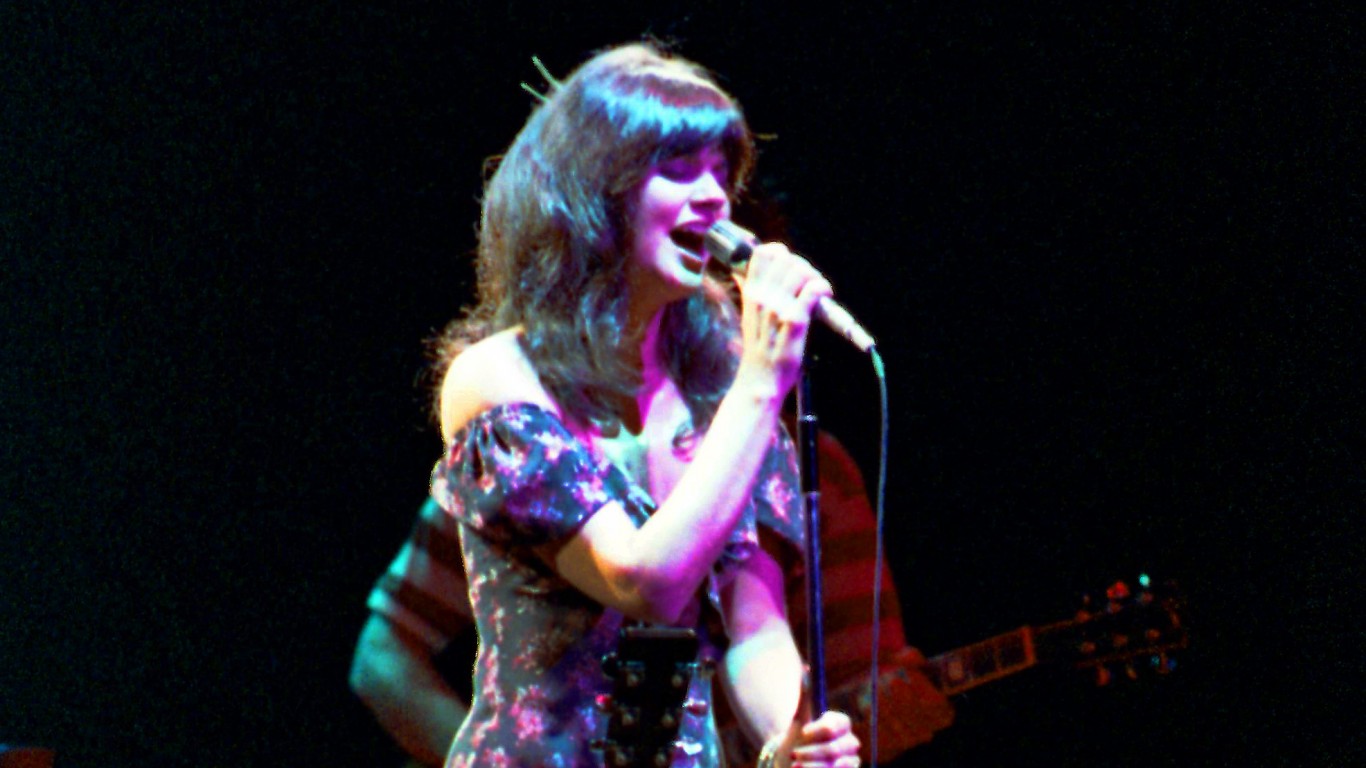
In El Toro Relajo, Linda Ronstadt did not simply revisit a song; she stepped into a living tradition with the force, color, and confidence of someone returning home.
Released in 1991, Más Canciones was Linda Ronstadt’s second major mariachi-centered album, following the landmark success of Canciones de Mi Padre in 1987. The album went on to win the Grammy Award for Best Mexican-American Album, but its importance reaches beyond prizes. It captured Ronstadt in a rare and revealing artistic position: not leaving her American pop, rock, country, and folk reputation behind, but widening the frame so that her Mexican family heritage could stand fully inside it.
Her rendition of the classic huapango El Toro Relajo is one of the album’s most vivid moments. It does not move like a museum piece or a polite tribute. It charges forward. The title itself suggests motion and unruliness, and the performance honors that spirit with a sense of bright pressure: rhythm underfoot, brass flashing across the arrangement, strings tightening the air, and Ronstadt’s voice meeting the music without hesitation. The result is festive, but never casual. It is joyous in the way demanding music can be joyous, when discipline and abandon have to share the same breath.
The huapango tradition, rooted in Mexican regional styles and often associated with the rhythmic vitality of son huasteco, carries a distinctive sway between meters, a push and pull that can make the music feel both grounded and airborne. In a mariachi setting, that rhythmic complexity becomes a showcase for ensemble precision: the guitarrón and vihuela giving the song its engine, violins drawing quick arcs of melody, and trumpets adding sharp bursts of color. El Toro Relajo gives Ronstadt no room to hide behind atmosphere. The song asks for agility, command, and emotional brightness. She answers with a vocal performance that feels alert from the first phrase.
What makes the track especially compelling is the way Ronstadt balances respect with personality. By 1991, she was already one of the most versatile American singers of her generation, known for moving between rock, country, folk, standards, and pop with unusual ease. But Más Canciones was not a genre exercise. Ronstadt had long spoken of Mexican music as part of her family memory in Tucson, Arizona, and these Spanish-language recordings carried a personal weight that differed from a normal career experiment. When she sings El Toro Relajo, the energy does not sound borrowed. It sounds remembered, reclaimed, and sharpened through craft.
That distinction matters. In the late twentieth-century American music marketplace, a mainstream star recording a full mariachi album in Spanish was still a bold move, even after the commercial breakthrough of Canciones de Mi Padre. Ronstadt was not translating Mexican music into pop terms to make it more convenient. She was placing traditional repertoire, instrumentation, and language at the center of the recording. Más Canciones continued that commitment, and El Toro Relajo shows how powerful that choice could be when the material was allowed to remain itself.
The performance is vibrant because it refuses to become merely pretty. Ronstadt’s voice has warmth, but also bite. She leans into the song’s quick turns, giving the phrasing a kind of athletic elegance. There is brightness in the upper notes, but also firmness in the way she holds the line against the arrangement’s momentum. The mariachi accompaniment does not simply decorate her voice; it challenges it. Each instrumental burst seems to ask for more presence, more command, more nerve. Ronstadt responds not by overpowering the ensemble, but by joining its current.
For listeners who knew her first through songs like You’re No Good, Blue Bayou, or her country-rock work with the Stone Poneys and the Southern California scene, El Toro Relajo could feel like a revelation. Yet it was not a contradiction. It revealed something that had been present all along: a singer whose identity was broader than the radio categories built around her. The mariachi albums did not erase her earlier work. They illuminated another room in the same house.
That is why El Toro Relajo still carries such force within Más Canciones. It is not solemn heritage music wrapped in reverence. It is heritage in motion: loud, nimble, proud, playful, exacting, and alive. Ronstadt’s performance lets the listener hear tradition not as something fragile kept behind glass, but as something strong enough to run, kick, and laugh. In that sense, the song becomes more than a standout track on a Grammy-winning album. It becomes a reminder that returning to one’s roots is not always quiet. Sometimes it arrives with trumpets, rhythm, and a voice ready to meet the charge.
