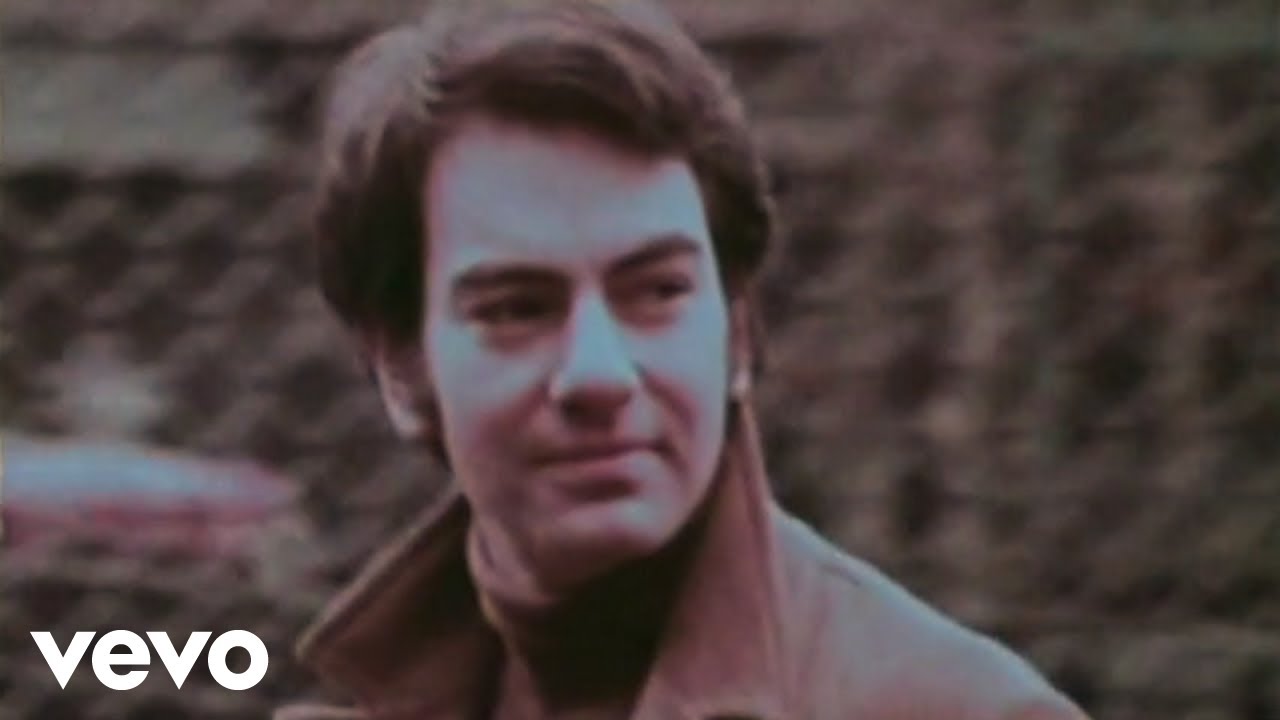
A great cover does not erase the original; it changes the light around it. On Neil Diamond’s 1969 reading of “Both Sides, Now”, Joni Mitchell’s quiet uncertainty becomes something fuller, steadier, and deeply lived-in.
In 1969, Neil Diamond included his version of “Both Sides, Now” on Touching You, Touching Me, an album that arrived during one of the most important stretches of his early recording life. This was the same period that gave him some of his most familiar work, and the album itself is often remembered for the presence of “Sweet Caroline”. Yet tucked inside that record is this striking interpretation of a song written by Joni Mitchell, already one of the most admired young songwriters of her generation. Diamond’s choice was telling. He was not simply borrowing a respected composition; he was stepping into a song whose power depended on shading, restraint, and the uneasy wisdom of seeing too much.
By the time Diamond recorded it, “Both Sides, Now” had already begun its unusual journey through popular music. Judy Collins had brought it to a wide audience before Mitchell released her own studio version on Clouds in 1969, and that mattered because the song was already living two lives at once: one as a widely recognized modern standard, another as a deeply personal piece of writing from Mitchell’s emerging catalog. When Neil Diamond took it on, he was entering that conversation from a very different angle. His voice did not hover. It did not suggest distance or delicate ambiguity. It carried gravity, warmth, and a kind of public confidence that changed the shape of the lyric without breaking it.
That is what makes this cover so interesting. Diamond does not try to sound like Mitchell, and he does not smooth the song into easy sentiment. Instead, he sings it as a man who understands that the lines about clouds, love, and life are not separate observations but versions of the same disappointment. In Mitchell’s writing, the song turns on perspective: what once seemed beautiful becomes confusing, what once seemed knowable slips away. In Diamond’s hands, those turns feel less like youthful revelation and more like a measured reckoning. The song loses none of its elegance, but it gains a different kind of mass.
The arrangement helps. Rather than the spare intimacy associated with the folk world, Diamond places the song within the polished pop setting that suited his records of the late 1960s. The sound is broader, more arranged, more consciously shaped for the studio, yet it still leaves room for the lyric’s uncertainty. That tension is part of the appeal. A song born from inward reflection is being carried by a singer whose gift was often to make private feeling feel large enough for radio, for concert halls, for the center of the room. The result is not a contradiction. It is a reminder that strong songwriting can travel across style without losing its nerve.
Touching You, Touching Me is an especially revealing place for the performance. Heard alongside Diamond’s own material, “Both Sides, Now” becomes more than a respectful cover. It feels like a statement of taste and temperament. Diamond had already proven he could write direct, memorable songs with tremendous commercial pull, but this recording shows another side of him: the interpreter drawn to complexity, to lines that do not resolve neatly, to material that asks for maturity rather than display. There is something almost intimate in that choice. He meets Mitchell not by imitating her sensibility, but by answering it in his own language.
That is why the recording still lingers. It is not the most frequently cited version of the song, and perhaps that is part of its charm. It lives slightly off the main road, waiting for listeners who know Diamond’s hits and Mitchell’s original brilliance, but may not have paused to consider what happens when those two sensibilities meet. And when they do, the song reveals another truth about itself. “Both Sides, Now” is often described as a song of reflection, but reflection does not always sound fragile. Sometimes it sounds centered. Sometimes it comes in a voice that has already learned how public life and private uncertainty can sit side by side.
Listening now, Diamond’s version feels like a document of 1969 in the best sense: a moment when the borders between pop sophistication and singer-songwriter introspection were still moving, still porous, still full of possibility. It captures a gifted interpreter recognizing the strength of another writer’s vision and trusting that he can carry it somewhere new. Not away from its meaning, but deeper into one of its hidden rooms. That is the quiet reward of this performance. It reminds us that a cover can be an act of admiration, but also an act of revelation.
