
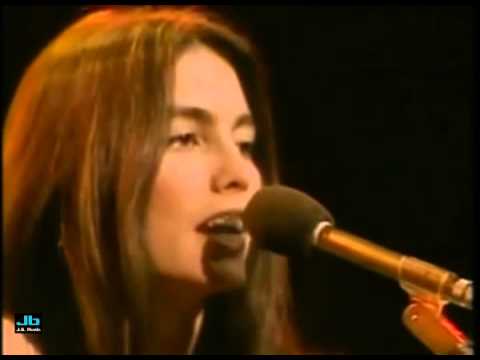
Red Dirt Girl is one of those rare songs that sounds like memory itself, and at Farm Aid 2005, Emmylou Harris sang it with the hush, gravity, and grace of a story that never stopped unfolding.
At Farm Aid 2005 in Tinley Park, Illinois, Emmylou Harris gave Red Dirt Girl exactly what it has always needed: room to breathe. She did not attack the song. She did not decorate it. She simply let it live in the open air, where its dust, sorrow, and hard-earned beauty could settle over the crowd. In that setting, the performance felt especially true. Farm Aid, founded in 1985 to support family farmers and rural communities, has always been more than a concert. It is a gathering built around land, labor, memory, and survival. Red Dirt Girl belongs naturally to that world.
Originally released in 2000 as the title track of Emmylou Harris‘s album Red Dirt Girl, the song was not a major country-radio chart smash, and that fact almost seems fitting now. It was never built for quick consumption. It endured because listeners heard themselves in it. The album itself reached the Top 10 on Billboard’s Top Country Albums chart and later won the Grammy Award for Best Contemporary Folk Album, confirming that Harris had created not just a strong record, but a defining late-career statement. More importantly, Red Dirt Girl marked a turning point because it was the album where Harris stepped forward more fully as a songwriter, not only as one of the great interpreters of other writers’ work.
That matters when we talk about this song. For years, Emmylou Harris had been cherished for the way she carried the songs of others, whether from Gram Parsons, Rodney Crowell, Townes Van Zandt, or the old country and folk tradition itself. But Red Dirt Girl felt different. It sounded like an artist writing from the inside of her own weather. The song is not strictly autobiographical in a literal sense, yet it feels emotionally autobiographical in every line. Harris drew on the textures of Southern life, on remembered places, on the ache of girlhood dreams, and on the knowledge that not every road out of town leads where people hope it will.
The story inside Red Dirt Girl is one of the finest examples of narrative songwriting in Harris’s catalog. It moves through friendship, longing, war, faith, small-town confinement, and the quiet wreckage left by time. There is nothing flashy about the writing, yet almost every verse opens another room of feeling. The genius of the song is that it never reduces its characters to symbols. These are not simply tragic figures. They are people with humor, youth, appetite, hope, and human contradiction. Harris understands how ordinary lives can carry epic emotional weight, and she writes them with such tenderness that the song feels both intimate and immense.
That is why the Farm Aid 2005 performance continues to linger. By then, the song had already had five years to settle into listeners’ hearts, and Harris sang it not as a new statement, but as a lived one. On that stage, it sounded even more grounded. The red dirt of the title was no longer just a poetic image. It felt like history underfoot. In a benefit concert centered on the dignity of rural lives, the song’s portrait of Southern working people, limited choices, and broken promises gained another layer of force. Harris did not need to explain any of that. The song carried it all within its own bones.
There was also something deeply moving in the contrast between the scale of the event and the inwardness of the performance. Farm Aid has often featured large personalities and rallying moments, but Emmylou Harris has long understood the power of restraint. Her voice, especially in this era, had a weathered radiance to it. It no longer floated with the untouched brightness of youth; instead, it carried grain, shadow, and experience. That served Red Dirt Girl beautifully. The song is about lives touched by beauty and damage at the same time. Harris sang it as someone who knew that both things can be true together.
Another reason the performance matters is that it reminds us how unusual Harris has always been. She never chased the easiest version of country stardom. Even when she stood close to the mainstream, there was always something more literary, more searching, more spiritually restless in her work. Red Dirt Girl is perhaps the clearest expression of that side of her artistry. It is country, but it is also folk narrative, Southern novel, memory piece, and moral reflection. When she brought it to Farm Aid 2005, she was not merely performing a fan favorite. She was placing a deeply American song in front of an audience gathered to think about the fate of the land and the people bound to it.
And that may be the deepest meaning of the song after all. Red Dirt Girl is about how place enters the bloodstream. It is about how dreams are shaped by geography, class, faith, family history, and the accidents of time. It is about the girls and boys who imagine larger horizons, and the world that meets those hopes with both beauty and resistance. Yet the song is not cynical. Sad, yes. Clear-eyed, absolutely. But not cynical. Harris sings these lives with too much love for that. Even in disappointment, she leaves room for dignity.
Some performances grow louder in memory because they were spectacular. Others last because they told the truth softly enough for us to really hear it. Emmylou Harris‘s performance of Red Dirt Girl at Farm Aid 2005 belongs to the second kind. It remains a reminder that the deepest songs do not age out of relevance. They gather years. They gather meanings. And when the right singer returns to them in the right place, they come back sounding even more human than before.
