
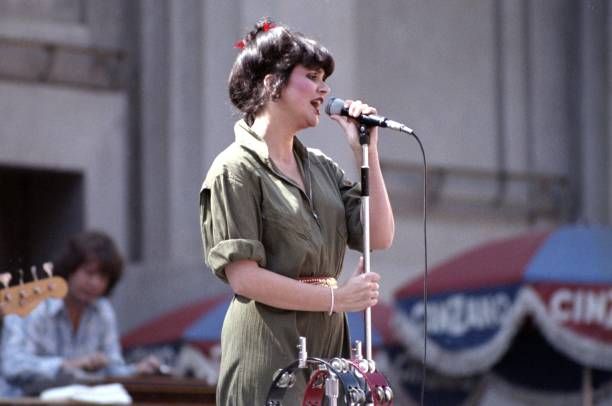
In I Still Miss Someone, Linda Ronstadt turns an already-classic country lament into something even more intimate: a memory that never quite stops echoing.
Some songs do not need dramatic language to leave a mark. They arrive softly, almost modestly, and then remain for years. I Still Miss Someone is one of those songs. Long before Linda Ronstadt ever sang it, the song had already earned its place in American music history. Written by Johnny Cash and Roy Cash Jr., it first reached listeners in the late 1950s and became closely associated with Cash’s early masterpiece The Fabulous Johnny Cash. It was also tied to the era of Don’t Take Your Guns to Town, the single that reached No. 1 on the Billboard country chart. By the time Ronstadt approached the song, it was not just a composition. It was a wound preserved in melody.
What makes Linda Ronstadt’s reading so affecting is that she does not try to overpower the song’s history. She does something finer than that. She steps inside it. Her version was not pushed as one of her major standalone Billboard singles, so it did not have a separate Hot 100 or country chart run under her own name. But that almost seems beside the point. Some recordings are made for the charts, and some are made for the human heart. Ronstadt’s I Still Miss Someone belongs firmly to the second category.
That is part of what made Ronstadt so extraordinary during her prime. Many listeners remember the chart triumphs first: You’re No Good, When Will I Be Loved, Blue Bayou. But beneath the hit-making brilliance was an artist with deep instinct for older songs, rural songs, songs that carried weather in them. She understood that country music, at its best, does not beg for attention. It simply tells the truth and trusts that truth will find its listener. In I Still Miss Someone, she honors exactly that tradition.
The song’s meaning is beautifully plain, and because it is plain, it hurts all the more. The lyric is not full of grand speeches or elaborate regret. It is built from everyday loneliness: leaves falling at the door, a cold wild wind, other lovers passing by together. That is the genius of the writing. The loss is not trapped in one moment of heartbreak; it keeps renewing itself in ordinary life. Each season, each familiar street, each passing couple quietly reminds the singer that absence can become a permanent companion. Ronstadt understands this emotional architecture completely. She sings as if she knows that the hardest sorrows are rarely the loudest ones.
Where Johnny Cash brought a grave, steady, masculine solitude to the original, Linda Ronstadt gives the song a different kind of ache. Her voice does not harden around the pain; it glows through it. There is tenderness in her phrasing, but no sentimentality. She does not decorate the line so much as live inside it. That balance mattered enormously in her career. Ronstadt was one of the rare singers who could move between rock, country, folk, and pop without ever sounding like she was visiting a style from the outside. Even when she covered a song with famous roots, she sounded emotionally native to it.
That quality places I Still Miss Someone in the same emotional universe as the best of her country-rooted work, the recordings that made albums such as Heart Like a Wheel and Simple Dreams feel so lasting. Even when she was one of the biggest stars in America, she never lost her ear for material that felt worn-in, wise, and true. She could sing a hit with force, but she could also sing sorrow with remarkable patience. That patience is what gives this performance its power. She never rushes toward a climax. She lets the emptiness stay in the room.
And perhaps that is why the song lingers. In lesser hands, a classic like this can become a respectful exercise, admired but not deeply felt. Ronstadt avoids that entirely. She reminds us that the song is not “old” in any limiting sense. It is ongoing. Anyone who has ever looked at a familiar place and suddenly felt the past return will recognize themselves in it. Anyone who has ever discovered that time does not erase longing, it merely teaches it better manners, will understand what she is doing.
There is also something deeply admirable in the restraint of the performance. Ronstadt had the vocal power to turn almost any song into a showcase, yet here she chooses honesty over display. That decision tells us a great deal about her musical intelligence. She knew that I Still Miss Someone does not ask for fireworks. It asks for stillness, clarity, and emotional trust. She gives it all three.
So while this may not sit among her biggest chart entries, it remains one of those recordings that reveals the core of Linda Ronstadt as an interpreter. She could take a song already rich with history and make it feel personal again, not by changing its essence, but by listening to it more deeply than most singers do. In her hands, I Still Miss Someone is not merely a cover of a Johnny Cash standard. It becomes a quiet confession suspended in time, a reminder that some melodies do not heal us by removing pain. They heal us by giving that pain a voice gentle enough to bear.
