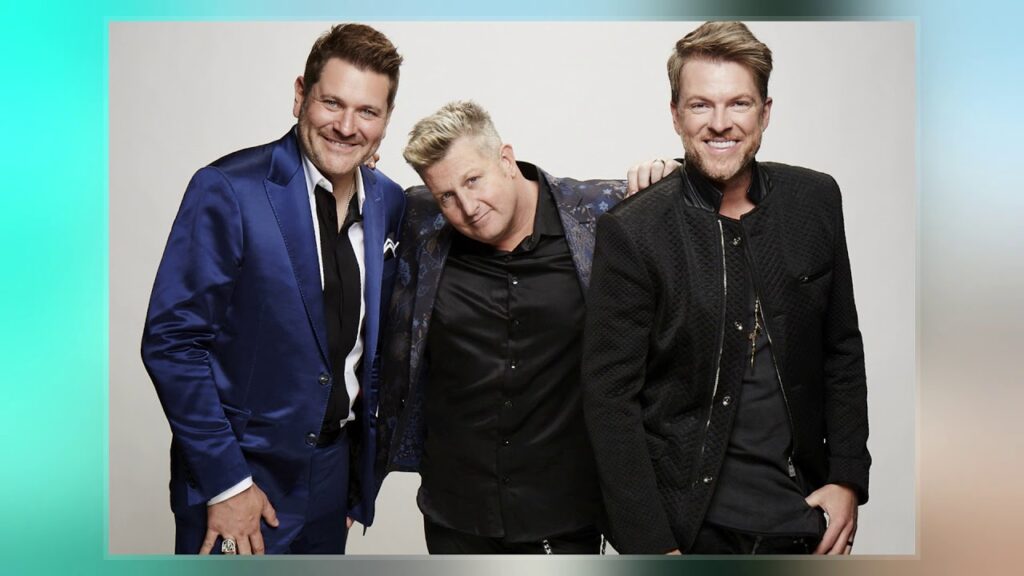
In “Bless the Broken Road,” Rascal Flatts sing heartbreak not as waste, but as preparation—the old pain, the wrong turns, the lonely miles all turning out to be part of love’s arrival.
There are love songs that begin in happiness and simply celebrate what has been found. “Bless the Broken Road” works differently. Its tenderness comes from memory. The joy in it is inseparable from what came before—the disappointments, the missed chances, the roads that seemed to lead nowhere until suddenly they led to the right person. That is why the song still feels so moving. It does not deny the hurt. It redeems it.
When Rascal Flatts released “Bless the Broken Road” in November 2004 as a single from Feels Like Today, they gave country music one of its warmest expressions of gratitude after struggle. Their version spent five weeks at No. 1 on Billboard’s Hot Country Singles & Tracks, reached No. 29 on the Billboard Hot 100, and later became a major long-term seller, earning multi-platinum certification in the United States. The songwriters—Marcus Hummon, Bobby Boyd, and Jeff Hanna—won the Grammy Award for Best Country Song for it.
But the most valuable part of the story begins earlier. “Bless the Broken Road” was not born with Rascal Flatts. It was written in 1994 and first recorded by the Nitty Gritty Dirt Band, then by Marcus Hummon himself in 1995, before passing through other hands on its way to becoming the version most people now remember. That long journey feels almost poetic, because the song’s whole meaning is about delayed arrival—about how the path only makes sense once you reach the person waiting at the end of it. Even the song itself had to travel a broken road before it found its defining voice.
And Rascal Flatts were exactly that voice.
Because they did not sing the song as a grand philosophical statement. They sang it as something personal. In their hands, the lyric does not sound abstract or neatly inspirational. It sounds lived in. The central idea is simple enough: every failed romance, every lonely mile, every aching detour was somehow preparing the heart for the love that finally stayed. But simplicity is exactly what gives the song its force. It speaks to a need almost everyone recognizes—the need to believe that pain was not meaningless.
That is what makes “Bless the Broken Road” more than a pretty ballad. It offers one of the most consoling ideas in popular music: that regret may not vanish, but it may be transformed. The road was broken, yes. It was not easy, straight, or fair. But it led somewhere. That thought can feel almost spiritual when the song is sung this warmly.
Gary LeVox’s lead vocal is a large part of why it works so well. He had a way of sounding both polished and vulnerable at once, and here that balance is everything. He does not oversing the gratitude. He lets it rise naturally out of remembered hurt. The performance understands that the song’s joy is only believable if the old loneliness still lingers at the edges. And it does. You can hear it. The happiness has depth because the sorrow has not been erased—only reinterpreted.
There is also a gentle irony in how enduring the song became. It was one of many versions of a song already moving through the country world, yet Rascal Flatts’ recording became the one that fixed itself in the culture. That tells you something important. Their version did not merely arrive at the right commercial moment. It arrived with the right emotional balance: hopeful without being shallow, romantic without becoming sugary, grateful without sounding smug. It made fate sound intimate.
And that may be why the song has lasted so beautifully at weddings, on radio, and in private memory. It is not only a song for people in love. It is a song for people who have survived enough disappointment to understand what love costs before it heals. The title itself is unforgettable for that reason. A broken road is not the image one expects in a love song, yet once you hear it, it feels truer than any perfect path could. Love, the song suggests, is not proven by how smooth the journey was. It is proven by the fact that the journey, however damaged, still brought you here.
So yes, “Bless the Broken Road” remains one of Rascal Flatts’ most beloved recordings because it turns romantic gratitude into something deeper and wiser. It does not simply say, I found you. It says, Everything that hurt me led me to you. And in that small shift lies the song’s lasting power. It blesses not only the happy ending, but the hard miles that made the ending feel like grace.
