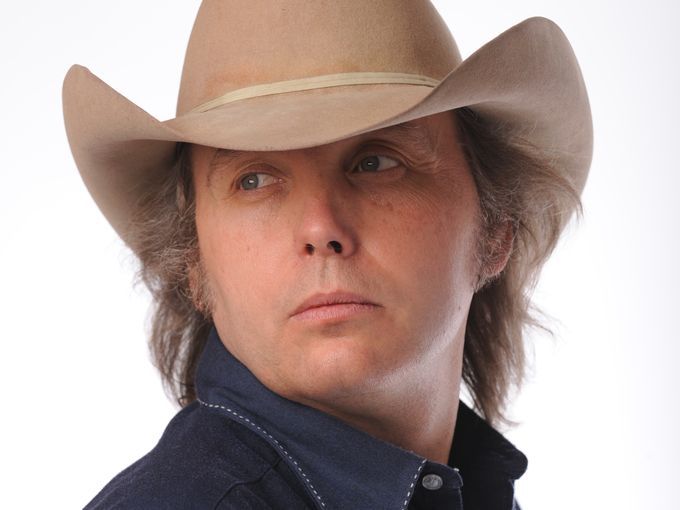
“Honky Tonk Man” mattered because Dwight Yoakam did more than revive an old hit—he kicked open the door and reminded country music that tradition could still sound dangerous, stylish, and gloriously alive.
When Dwight Yoakam recorded “Honky Tonk Man,” he was not simply choosing a good old song. He was making a statement. In the middle of the 1980s, when so much country music was leaning polished, softened, and carefully dressed for radio, here came this lean young singer in a hat and tight rhythm, reaching back to Johnny Horton’s 1956 hit and singing it as if the jukebox had suddenly jolted back to life. That is the first truly valuable thing about the song: it was a beginning with an attitude. Not nostalgia for its own sake, but a declaration that the old honky-tonk pulse still had blood in it. Yoakam’s version became his debut single in 1986 and rose to No. 3 on Billboard’s Hot Country Songs, while the album Guitars, Cadillacs, Etc., Etc. went on to hit No. 1 on Billboard’s Top Country Albums. The original Johnny Horton recording had reached No. 9 on Billboard’s country chart in 1956, so Yoakam was not rescuing a forgotten tune—he was taking a known country song and giving it a new swagger for a different era.
But the deeper spark, the one that still gives this recording its heat, is emotional rather than statistical. “Honky Tonk Man” is one of those songs that can easily be mistaken for carefree mischief. On the surface, it rolls along with a grin: restless, playful, flirtatious, half-wild. Yet beneath that bounce is something more revealing—the portrait of a man who cannot slow himself down, who keeps chasing noise, motion, women, music, and neon because stillness might force him to hear something he would rather outrun. That is what makes the song live. It is not just about having a good time. It is about compulsion dressed up as charm.
And Dwight Yoakam understood that instinctively. He never sang this material like a museum curator dusting off a relic. He sang it like a man who knew that old country songs survive because they carry recognizable human weakness inside them. In his voice, “Honky Tonk Man” becomes wiry, hungry, slightly reckless. The performance has style, yes, but not empty style. It has edge. It feels like movement for its own sake, like a man laughing on the outside while somewhere underneath the laugh there is a little loneliness he would rather not name.
That is why the song landed so hard. It sounded old, but it did not feel old. It carried the snap of Bakersfield and the spirit of classic honky-tonk, yet it arrived with a visual and musical confidence that made people pay attention. Yoakam’s debut helped announce that tradition did not have to be dusty, timid, or apologetic. It could still be sexy. It could still be sharp. It could still walk into the room with its collar turned up and take up space. Sources close to Yoakam’s catalog and career history also widely credit “Honky Tonk Man” as the first country video aired on MTV in 1986, which only deepens the song’s symbolic place in his story: an old-school tune becoming the vehicle for a modern breakthrough.
What remains so appealing about “Honky Tonk Man” is that it never overexplains itself. It does not sit down and confess. It just moves. And in that movement, it reveals a great deal. There is bravado here, but also appetite. There is humor, but also unrest. The song knows that people often turn their restlessness into performance. They dance harder, laugh louder, stay out longer, and call it freedom. Sometimes it is freedom. Sometimes it is escape. The beauty of a song like this is that it lets both truths breathe at once.
So when people remember Dwight Yoakam’s “Honky Tonk Man,” they are remembering more than a catchy debut. They are remembering the sound of an artist arriving with his identity already intact. A young singer taking an old song and, without disrespecting its roots, making it feel quick, dangerous, and newly essential. That is why it lasts. Not because it is merely lively, but because beneath its bright boots and swinging rhythm, it carries the old country secret: the wild ones are often running from something, and that is exactly why we cannot stop watching them.
