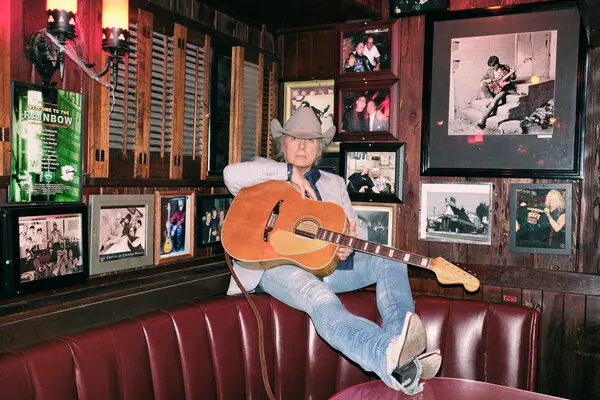
A title like “Guitars, Cadillacs” promises heartbreak with style, and Dwight Yoakam delivered it with such hard-edged swagger that country music suddenly felt dangerous again.
Some songs sound like they were born wearing polished boots. “Guitars, Cadillacs” is one of them. Before the first line settles in, the title has already built a world — neon, smoke, jukebox light, and a man trying to hold himself together with the last scraps of pride that still look good under barroom glare. When Dwight Yoakam recorded it, he did not soften that world or dress it up for easy approval. He leaned straight into it. The song was released as a single on June 30, 1986, from his debut album Guitars, Cadillacs, Etc., Etc., and it rose to No. 4 on the U.S. Billboard Hot Country Singles chart. The album itself, released on March 12, 1986, went on to become No. 1 on Billboard’s Top Country Albums chart, the first of three straight chart-topping country albums for Yoakam.
What made “Guitars, Cadillacs” hit so hard was not simply that it was catchy, though it certainly was. It was that the record felt like a clean, defiant break from what much of mainstream country had become in the mid-1980s. While slicker production was dominating Nashville, Yoakam came in with something leaner, sharper, and proudly rooted in honky-tonk and Bakersfield spirit. The song sounds like classic country with the chrome still gleaming, but it never feels nostalgic in the lifeless sense. It feels immediate, hungry, and just a little bit mean around the edges. That was part of the shock. Dwight Yoakam was not reviving an old sound as a museum piece. He was making it kick again.
The brilliance of the title is how perfectly it holds the song’s emotional split. Guitars suggest music, bravado, movement, the old ritual of turning pain into noise. Cadillacs suggest style, glamour, and the illusion that heartbreak can be outrun if the car is long enough and the night is loud enough. Put together, the phrase sounds almost triumphant. But the song itself knows better. Behind all that shine is a man knocked sideways by loss, trying to survive by surrounding himself with the symbols of a certain kind of American cool. It is heartbreak dressed for the honky-tonk, and that is why it lasts. The sadness is real, but it refuses to crawl. It stands up straight, orders another drink, and dares the room to look away.
That quality suited Yoakam perfectly. From the beginning, he carried a rare combination of old-school discipline and restless edge. He could honor country tradition without sounding trapped by it. On “Guitars, Cadillacs,” produced by Pete Anderson, that combination found one of its purest expressions. The arrangement walks with confidence, the guitar twangs like it means it, and Yoakam sings with that unmistakable ache-tightened cool that would soon become his signature. Nothing is overplayed. Nothing is wasted. The song knows exactly how much hurt it wants to show and how much it wants to hide behind style.
There is also something deeply appealing in the way the song turned Dwight Yoakam into more than just another promising newcomer. It announced an attitude. Billboard at the time praised its “walking bass, twangy guitar, fiddle” and called it a “pure hillbilly delight,” while later critics would look back on the album as a record that changed the face of country music. That larger reputation matters because “Guitars, Cadillacs” did more than become a hit. It helped redraw the lines of what mainstream country could sound like again — tougher, truer, and much less interested in smoothing away its rough edges.
And that is why the song still carries such force. Not because it belongs to some dusty tradition alone, and not because it survives only as a period piece from the 1980s, but because it catches a feeling country music has always understood at its best: heartbreak does not always collapse a person. Sometimes it sharpens the silhouette. Sometimes it sends him deeper into the night with his pride buttoned up tight and the jukebox turned louder than before.
So “Guitars, Cadillacs” remains one of Dwight Yoakam’s defining moments because it sounds exactly like what its title promises — style, sorrow, movement, and survival, all packed into one hard, shining phrase. A lesser artist might have turned that into a gimmick. Yoakam turned it into a statement, and country music has never quite sounded the same since.
