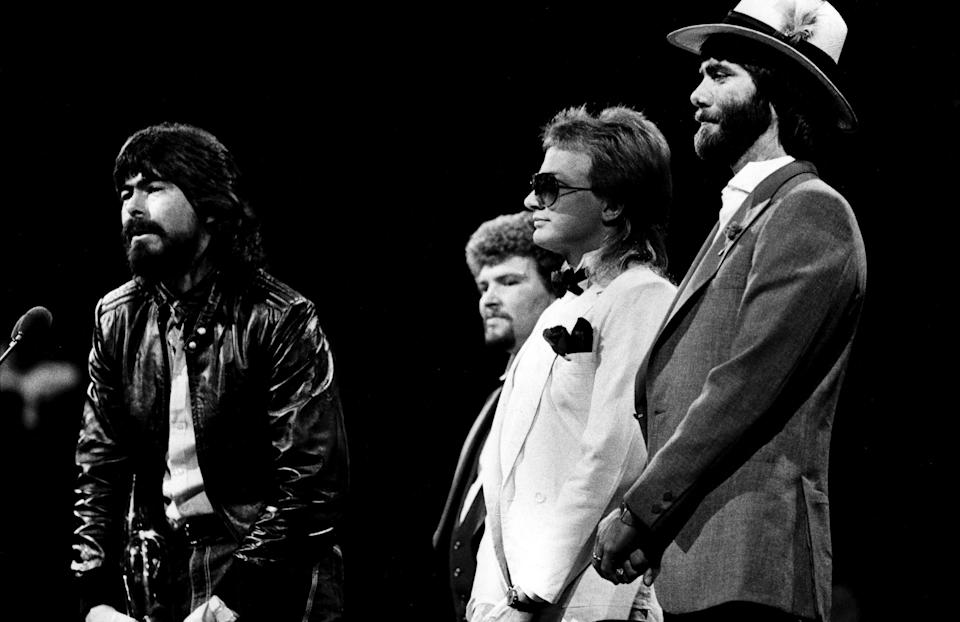
“Song of the South” endures because it does more than remember hard times—it sings of survival with such warmth and pride that hardship itself becomes part of the family story, not the end of it.
There are songs that succeed because they are catchy, and there are songs that live on because they carry the weight of memory. Alabama’s “Song of the South” belongs to the second kind. Released as a single on November 7, 1988, from the album Southern Star, it became one of the group’s signature recordings, reaching No. 1 on Billboard’s Hot Country Singles chart and No. 1 in Canada. When Southern Star followed in early 1989, it produced four straight country chart-toppers and gave “Song of the South” a permanent place near the front of Alabama’s most beloved work. The album itself reached No. 1 on Billboard’s Top Country Albums and crossed into the pop market as well, peaking at No. 68 on the Billboard 200. These facts matter, because they tell us at once that this was not merely a well-liked album cut. It was a major record, a defining hit, and one of those songs that seemed to speak to people before it had even finished its first chorus.
Yet the reason “Song of the South” lasts is bigger than chart history. The song was written by Bob McDill, one of Nashville’s finest craftsmen, a songwriter celebrated for turning ordinary Southern lives into vivid, emotionally exact stories. The Country Music Hall of Fame notes that in “Song of the South,” McDill portrayed a family losing the farm during the Great Depression and trying to begin again under Franklin Roosevelt’s New Deal. That is the heart of the song: not nostalgia for comfort, but memory of endurance. It does not romanticize poverty. It remembers hunger, uncertainty, and the hard, unspectacular courage required to keep moving.
And that is why the opening lines still land with such force. “Song of the South” does not ease into its subject. It brings us straight into a household where money is scarce, where politics is not theory but supper on the table, and where history is felt not in monuments but in daily survival. There is something deeply moving in the way the song balances hardship with motion. Even as it describes a family battered by circumstance, it refuses to sound defeated. Alabama understood that tension beautifully. Their version has drive, lift, and a communal pulse that keeps the story from sinking under its own sorrow. The rhythm pushes forward as if to say that life, however bruised, does the same.
That balance is the secret of the record’s emotional power. A lesser performance might have leaned too heavily into sadness or turned the song into a simple regional anthem. Alabama found the middle path. They made it feel lived-in. There is pride in the performance, but not vanity; warmth, but not sentimentality. The group had always known how to merge country roots with broad, singable appeal, and here that gift serves the material perfectly. The melody is inviting enough for everyone to join in, yet beneath that easy chorus lies a far tougher truth: families often survive not because life grows easier, but because they learn how to carry difficulty together.
The story behind the song deepens its meaning further. Before Alabama turned it into a No. 1 hit, “Song of the South” had already traveled a rougher road. It was first recorded by Bobby Bare on his 1980 album Drunk & Crazy. Later, Johnny Russell took it to No. 57 on the U.S. country chart in 1981, and Tom T. Hall with Earl Scruggs carried it to No. 72 in 1982. Only then did Alabama finally take the song where it seemed destined to go. There is something poetic in that history. A song about struggle and perseverance had to persevere itself before finding the voices that would make it unforgettable.
The imagery also explains why the song remains so beloved. The references to Roosevelt, to a farm sold to the county, to the long shadow of the Depression, and to the stubborn humor of people who had so little they “couldn’t tell” when the markets fell—these are not just clever details. They are the details that make the song breathe. They give it dirt under the fingernails. They turn it from a slogan into a portrait. This is one of Bob McDill’s great strengths as a writer: he does not describe “the South” as abstraction. He gives us people, weather, work, bad luck, stubbornness, and song.
And perhaps that is why “Song of the South” still feels so alive after all these years. It is not merely a regional hit, nor simply one more glossy country success from the late 1980s. It is a song about what families remember, what communities pass down, and how music can hold both pain and pride in the same breath. Alabama did not just sing it well. They recognized its soul. They heard that beneath the catchy refrain was something older and deeper: the sound of people refusing to be erased by hardship.
That is why “Song of the South” still stirs the heart. It smiles, but it remembers. It celebrates, but it does not forget the cost of survival. And in that rare balance—between joy and struggle, memory and motion, history and melody—Alabama gave the song its lasting home.
