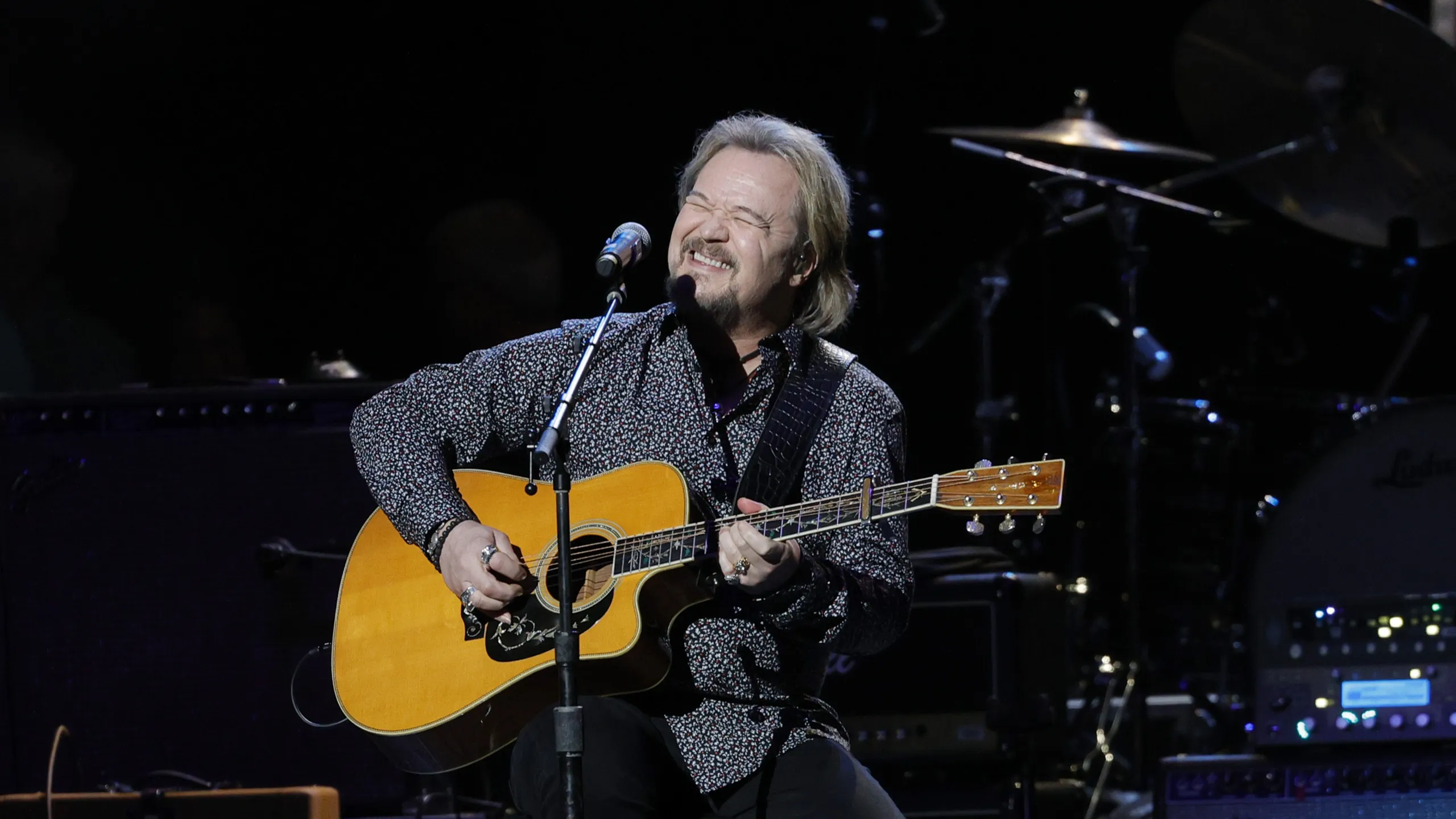
“T-R-O-U-B-L-E” is pure Travis Tritt at his most grinning and dangerous—swaggering, rough-edged, and alive with the kind of rebellious energy that makes trouble sound less like a warning than a way of walking into the room.
There is something wonderfully unapologetic about “T-R-O-U-B-L-E” because it does not waste a second pretending to be polite. From the first bars, the song comes at you with its chin up, its boots planted, and a smile that already knows exactly the kind of impression it is making. In Travis Tritt’s hands, it becomes more than a lively cover. It becomes a declaration of personality. He is not merely singing about a man who brings trouble with him. He sounds like someone who has already accepted that reputation, worn it comfortably for years, and found that it suits him just fine. That is why the record still has such punch. It is not trying to be cool. It simply is.
The song itself had a strong history before Tritt ever got to it. “T-R-O-U-B-L-E” was written by Jerry Chesnut and first recorded by Elvis Presley, who released it in April 1975 from his album Today. Elvis’ version carried its own sly swagger, but it was more of a rock-and-roll strut than a country hit, reaching No. 42 on Billboard’s Easy Listening chart and No. 31 in the UK. When Travis Tritt recorded it in 1992 for his third studio album T-R-O-U-B-L-E, he did not just revive an old song. He found the place where its mischief, bravado, and Southern heat met his own musical temperament perfectly.
That fit matters. By 1992, Tritt was already one of the most distinctive voices in country music’s early-1990s rise—not because he sounded slick or safe, but because he brought a little grit, a little outlaw swagger, and a little Southern rock muscle into a scene that often preferred cleaner edges. His album T-R-O-U-B-L-E, released on August 18, 1992, went on to be certified 2× Platinum in the United States, and the title track became the album’s third single, peaking at No. 13 on Billboard Hot Country Songs and No. 17 in Canada. Those numbers may not place it among his very biggest chart smashes, but they do not need to. Some songs last because they define an attitude more clearly than a chart peak ever could.
And attitude is the whole game here. What makes “T-R-O-U-B-L-E” so memorable is that it does not present rebellion as anguish or self-destruction. It presents it as charm. That is a difficult thing to pull off. A song like this can collapse into cartoonish swagger if the singer leans too hard on the joke. Tritt avoids that trap because his voice has enough grain and conviction to make the cockiness feel earned. He sounds amused, yes, but never lightweight. There is always some dirt under the fingernails. That is why the song lands. He makes trouble sound lived-in rather than manufactured.
The arrangement helps too. Contemporary Billboard coverage praised how Tritt transformed the song with boogie-woogie piano, slide guitar, and a super-fast tempo, making it feel like a rowdy barroom charge with a little Little Feat spirit in it. That description still fits beautifully. Tritt’s version has bounce, but it also has bite. It does not glide. It barrels. The musicianship gives the song real swing, and that swing is crucial because the lyric depends on movement. This is a song about a man whose very presence stirs things up. The band has to sound like it believes that. Tritt’s band absolutely does.
What I especially like about “T-R-O-U-B-L-E” is that it reveals something central about Travis Tritt as an artist. For all the power ballads, the wounded love songs, and the more reflective records in his catalog, he always had a strong instinct for songs that let him show his grin, his edge, and his refusal to sound domesticated. He was never simply the sensitive country singer, and never simply the rowdy one either. He worked best when both sides rubbed against each other. A song like “T-R-O-U-B-L-E” lets the rowdier side take center stage, but even here there is craft in the performance. He is not just barking attitude. He is shaping it.
That may be why the song has stayed so enjoyable. It captures a singer fully aware of the image he projects and fully capable of making that image feel like honest musical pleasure rather than empty pose. When Travis Tritt spells out “T-R-O-U-B-L-E,” it is not merely a hook. It is a character sketch, a self-myth, and a wink all at once. He knows the crowd is going to love it, and he knows exactly why.
So “T-R-O-U-B-L-E” endures because it gave Travis Tritt one of his best showcases for pure swagger. It took a strong Jerry Chesnut song, already stamped by Elvis Presley, and turned it into something louder, looser, and more country-rock alive. The result is a record that still feels like a good time with a dangerous smile behind it. And sometimes that is all a song needs to be unforgettable.
