
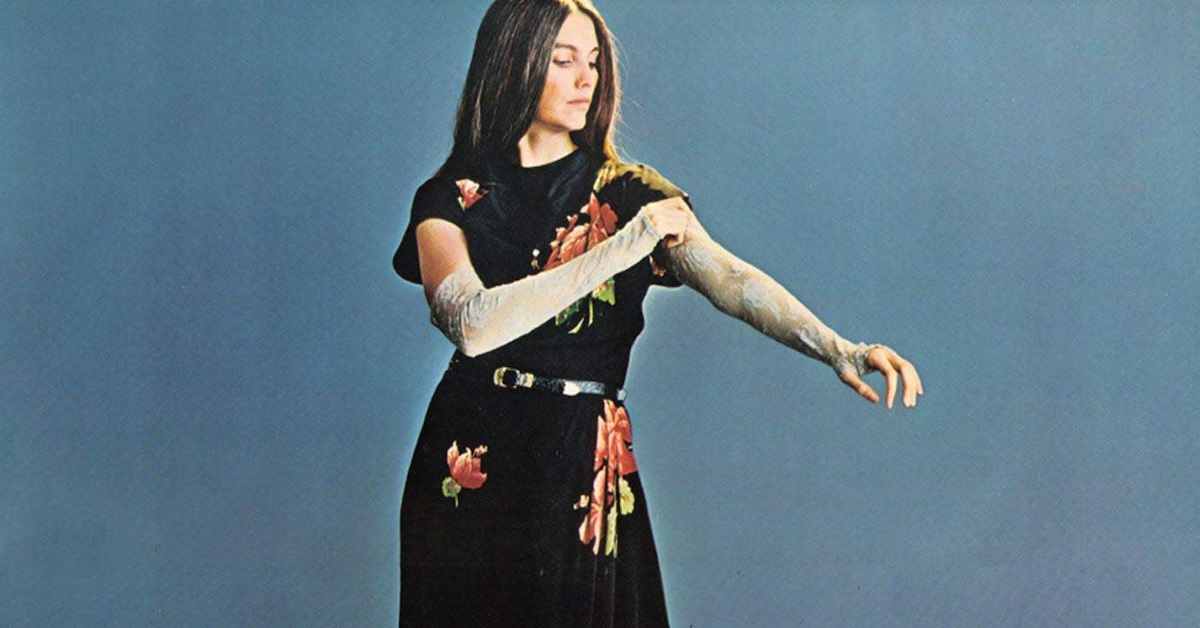
“Kern River” in Emmylou Harris’s voice becomes a river-song of grief, memory, and helpless love—one of those ballads where nature is not scenery, but fate itself, flowing on long after the heart has broken.
One of the most important facts to place right at the beginning is that “Kern River” comes from Emmylou Harris’s 2008 album All I Intended to Be, released in the United States on June 10, 2008. The song was written by Merle Haggard, who first recorded it in 1985 as the title track and only single from his album Kern River. Harris’s version was not released as a major charting single, so it has no separate Billboard peak of its own; its chart context comes through All I Intended to Be, which debuted at No. 22 on the Billboard 200 and reached No. 4 on Top Country Albums, making it one of the strongest late-career commercial showings of her solo work.
That lineage matters enormously, because “Kern River” is not an ordinary cover. It is one great artist stepping into one of another great artist’s darkest songs. Merle Haggard’s original is already steeped in dread and grief: a lover drowns in California’s Kern River, and the singer is left speaking into the current as if memory itself might answer back. The song reached No. 10 on Billboard’s Hot Country Singles in 1985, which tells us that this grim, haunted ballad was strong enough to cut through mainstream country radio on its own terms. When Emmylou Harris chose to record it in 2008, she was not selecting a familiar, easy crowd-pleaser. She was choosing a song with river mud on it, a song full of silence, fatal beauty, and the terrible knowledge that some losses cannot be argued with.
And that is where Harris becomes the perfect interpreter. Few singers in American music have ever understood better how to carry sorrow without overplaying it. “Kern River” requires exactly that. The song is devastating not because it screams, but because it does not. The tragedy has already happened. The water has already taken what it was going to take. All that remains is the voice of the one left behind, and the awful permanence of the river itself. In Emmylou Harris’s hands, the ballad grows even more spectral. Her voice does not fight the current. It seems to drift with it, which somehow makes the grief feel even larger. She sings the song not as a public drama, but as a private haunting.
The deeper meaning of “Kern River” lies in the way the river becomes more than a place. In songs like this, water is never only water. It is time. It is fate. It is memory moving forward whether the heart is ready or not. The singer may still be standing on the bank, still calling inwardly to what is lost, but the river does not stop. That is what makes the song so cruelly beautiful. It understands that grief often feels like that: the world continues in motion while the soul remains fixed at the site of disaster. Harris catches that feeling with extraordinary grace. She does not try to tame the song’s darkness. She lets the darkness keep its own shape.
Placed within All I Intended to Be, “Kern River” takes on even greater resonance. This was an album full of reflection, mature judgment, and songs chosen not for trend value but for emotional truth. Alongside “Broken Man’s Lament,” “Gold,” and “Take That Ride,” “Kern River” belongs to a larger late-period Harris landscape where memory, endurance, and sorrow are treated with calm authority. By 2008, she no longer needed to prove anything commercially. That freedom allowed her to make records of great inwardness. “Kern River” fits perfectly into that world: a song older than the album, but made to sound as if it had always been waiting for her voice.
There is also something especially moving in the fact that Harris chose Merle Haggard’s writing here. She had always been a great bridge between strands of American roots music—country, folk, gospel, bluegrass, singer-songwriter confession—but she never treated those traditions as museum displays. She entered them. On “Kern River,” she meets Haggard not by imitating his gravity, but by answering it in her own way. His version has the worn authority of a man staring at irreversible loss. Hers has the luminous ache of someone who knows that memory can make absence feel almost visible. The song survives the crossing because it is strong enough to bear both truths.
So “Kern River” deserves to be heard as one of the most haunting late recordings in Emmylou Harris’s catalog: a 2008 interpretation of Merle Haggard’s 1985 masterpiece, carried on All I Intended to Be, an album that gave Harris one of her best chart showings in decades. But beyond the facts lies the reason the song lingers. It knows that some sorrows do not heal into peace. They simply deepen into landscape. And in Emmylou Harris’s voice, that landscape becomes almost unbearably beautiful—water, memory, and love still calling into the current long after the answer is gone.
