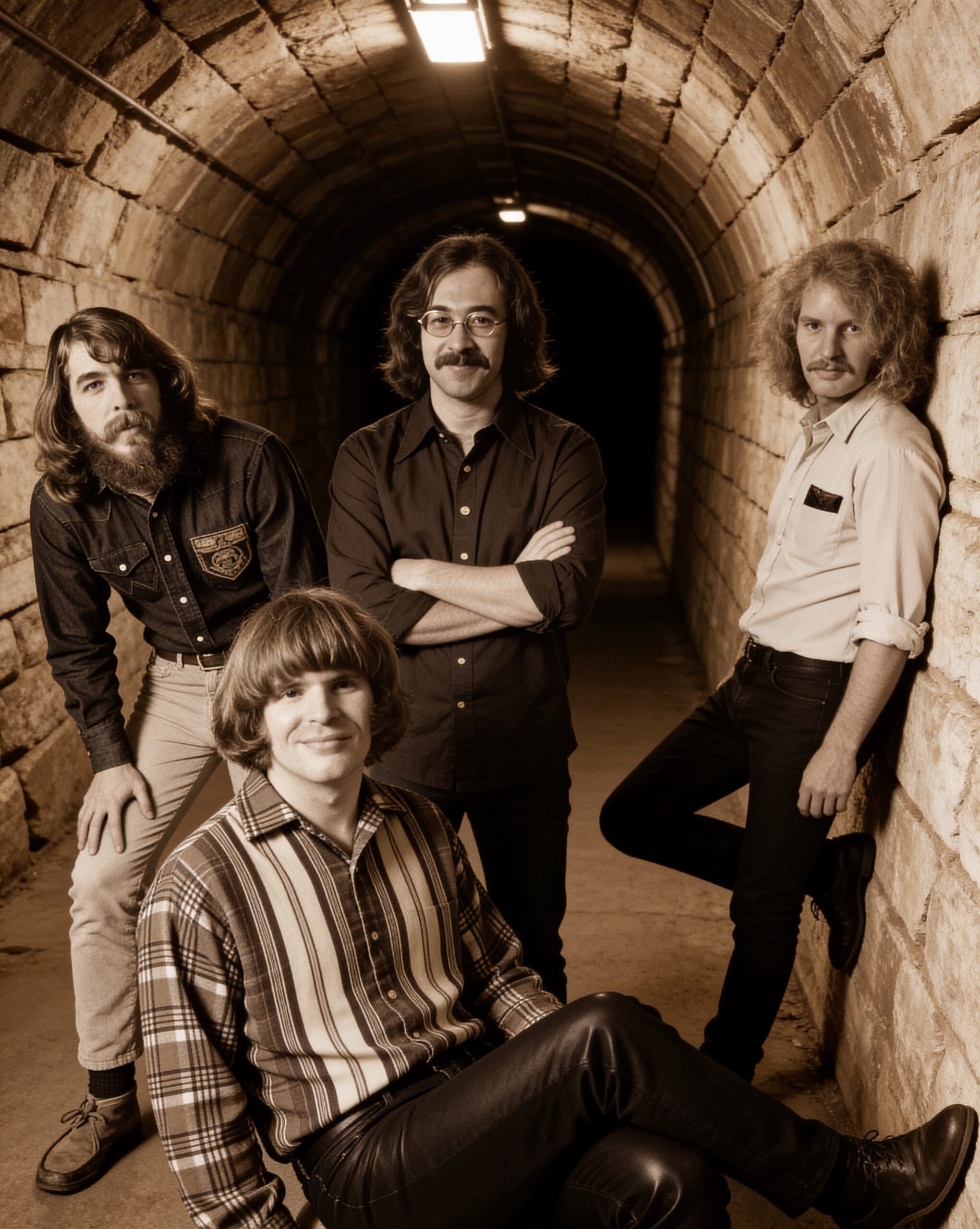
From a five-dollar warning in San Bernardino, John Fogerty shaped bad luck into a hard-driving Creedence Clearwater Revival fable.
John Fogerty wrote “Tombstone Shadow” for Creedence Clearwater Revival’s 1969 album Green River, and its origin rests in a concrete, almost ordinary encounter: a fortune teller session in San Bernardino, California. The place enters the song through the nickname San Berdoo, while the scene itself is rendered with folk-blues directness: money on a table, a warning of trouble, and a traveler suddenly measuring the road ahead against bad luck.
That plainness is part of the song’s force. Fogerty does not turn the fortune teller into elaborate theater, and he does not surround the omen with gothic decoration. “Tombstone Shadow” moves like someone trying to outrun a thought that has already found him. The title image is blunt and physical: a shadow from the grave stretching across the path before the grave itself has arrived. In a few words, the song catches the strange power of suggestion, the way a prediction can change the temperature of an ordinary day.
Musically, Creedence Clearwater Revival gives that feeling a lean, relentless body. The arrangement is built from the group’s familiar economy: a tight guitar attack, a firm rhythm section, and Fogerty’s voice pushed forward with urgency rather than ornament. There is blues repetition in the structure, but the performance refuses to settle into a slow lament. It drives. The groove feels less like despair than pursuit, as if the band is moving fast because standing still would let the bad news catch up.
That sense of motion matters because the warning in the song is about danger following the speaker wherever he goes. A fortune teller’s prediction could have become a novelty lyric, something playful or theatrical. Fogerty instead gives it the weight of a working anxiety. The road, the machine, the trip, the next bit of good news shadowed by possible punishment: these are not abstract ideas inside the song. They are practical pressures translated into rock and roll language, brief enough to feel like a flash of panic, strong enough to remain in the memory.
On Green River, “Tombstone Shadow” sits near other Fogerty songs drawn toward omens, weather, memory, and unease. “Bad Moon Rising” turns approaching trouble into a public forecast; “Lodi” narrows disappointment into the life of a stalled musician; “Wrote a Song for Everyone” measures expression against distance and failure to communicate. “Tombstone Shadow” belongs to that same atmosphere, but its threat feels smaller and therefore sharper. It begins not with the sky, not with history, but with a person sitting across from another person and hearing something that cannot easily be unheard.
The San Bernardino detail gives the song a valuable edge. Creedence Clearwater Revival, a Bay Area band, was often associated with swampy textures, Southern-flavored imagery, and the mythic geography of American roots music. Here, though, the spark is distinctly Californian. San Berdoo is not an imagined crossroads; it is a real inland city with roads, heat, commerce, and passing strangers. Fogerty’s gift was to let that local incident expand into a larger folk-like shape without sanding away its rough address. The song sounds mythic, but it keeps one foot on pavement.
There is also a dry human comedy beneath the dread. The situation is almost absurd: paying for a warning and then having to live with it. The song understands that superstition does not require full belief to do its work. A person can laugh at a prediction and still carry it. A shadow does not need permission to fall across a path. Fogerty sings the premise straight, which is why the track never collapses into camp. The band treats the omen as real enough for three urgent minutes, and that is all the song needs.
In the larger story of 1969, when Creedence Clearwater Revival was releasing music at a remarkable pace, “Tombstone Shadow” shows the discipline behind Fogerty’s songwriting. He could take a small encounter, strip it to its hardest images, and make it feel both personal and communal. The fortune teller session did not have to be dramatic in itself. The drama came from what a songwriter heard inside it: the rhythm of warning, the weight of a phrase, the uneasy comedy of trying to keep ahead of fate.
That is why the origin story still deepens the record. Knowing that “Tombstone Shadow” began with a fortune teller in San Bernardino does not reduce the song to trivia. It makes the performance more vivid. It reminds us that songs often enter the world through side doors: a passing stop, a stray sentence, an odd transaction, a place name that sounds right when sung. Fogerty turned that moment into a compact meditation on fear, luck, and movement. The shadow in the song may be ominous, but the act of writing it is the opposite: a musician taking the thing that unsettled him and giving it a rhythm strong enough to walk through.
