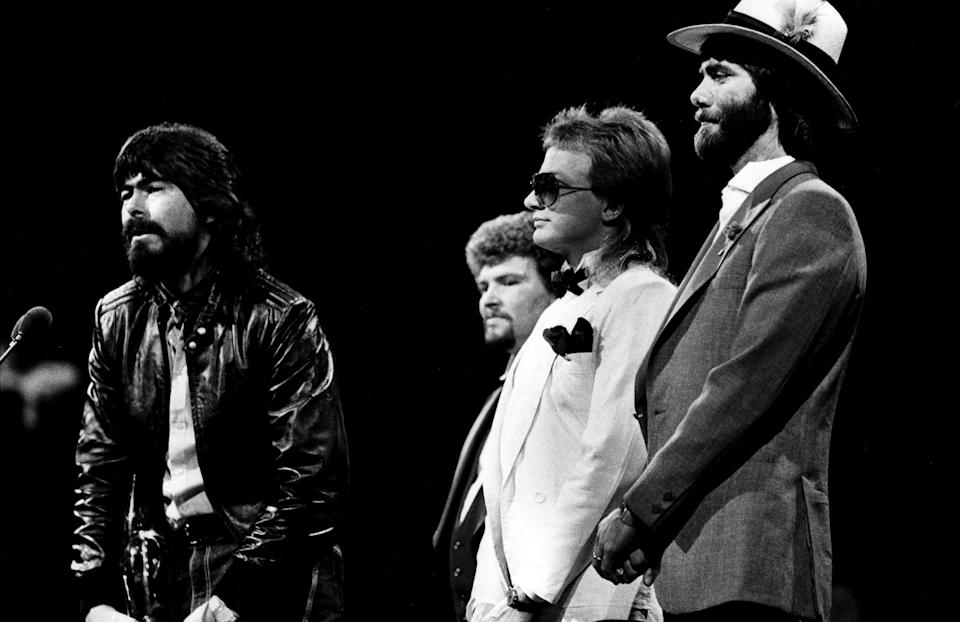
In Alabama’s 1983 No. 1, harmony turns a country road into a shared memory.
Released in 1983, Alabama’s Dixieland Delight became a country chart-topper from the band’s quadruple-platinum album The Closer You Get…. Written by Ronnie Rogers, the song arrived at a moment when Alabama had already made the sound of a self-contained country band feel newly central to the genre. It did not need a grand premise. It moved along a Tennessee back road, watched the evening settle, and let three voices make an ordinary escape feel complete.
That simplicity is part of the recording’s quiet strength. Dixieland Delight is built less like a dramatic story than like a drive that keeps revealing small pleasures: the road, the open air, the closeness of company, the promise of a night outside the usual demands of work and schedule. The arrangement has a warm, unhurried pulse. It does not rush toward a climax. Instead, it settles into motion, giving the song the feeling of wheels turning steadily under a clear destination that does not have to be named too loudly.
The most defining instrument, however, is the blend. Randy Owen’s lead vocal carries the melody with an easy brightness, but the identity of the record comes from the way Teddy Gentry and Jeff Cook fold around him. Their harmonies do not merely decorate the chorus; they change the emotional scale of the song. What begins as one person’s view of a backwoods evening becomes a shared sound, as if the memory belongs to a group before it belongs to an individual.
That was one of Alabama’s great gifts. The band could make polish feel communal rather than distant. On Dixieland Delight, the harmonies are clean, but they are not sterile. They have the rounded confidence of singers who understand where each voice should stand, when to press forward, and when to leave room. The result is a chorus that feels open, not crowded. The lead line remains relaxed while the harmony voices lift the edges, creating the sensation of space widening around the song.
In the early 1980s, country music was absorbing different kinds of smoothness: pop production, arena-scale performance, and radio-ready choruses that could travel beyond traditional boundaries. The Closer You Get… belongs to that era, but Dixieland Delight keeps its country center visible. Its imagery is rural, its pace is conversational, and its pleasures are plainspoken. Yet the record also shows how modern country could sound expansive without losing the grain of place. The band’s vocal discipline made the song accessible, while its setting kept it rooted.
The title itself points toward a regional feeling rather than a literal travel guide. The song’s landscape is specific enough to picture, but broad enough to invite listeners into their own version of it. For some, it may be a mountain road. For others, a county line, a Saturday night, or a stretch of pavement where the radio makes distance feel lighter. Alabama’s performance leaves that space open. It does not over-explain the feeling. It lets the harmonies suggest that joy can be modest and still feel full.
There is also restraint in the way the band handles pleasure. The recording never turns rowdy for its own sake. Its energy comes from ease, not force. That choice matters because it keeps the song from becoming a caricature of Southern leisure. Instead, it becomes a portrait of release: not escape from life altogether, but a short passage into air, companionship, and rhythm. The smoothness of the vocal blend is what makes that release believable. Three voices align, and the whole scene seems to breathe.
As a chart-topping single, Dixieland Delight helped confirm Alabama’s place in country music’s changing landscape. But its endurance is not only a matter of success. The song remains persuasive because it understands a small human truth: some memories are carried less by events than by atmosphere. A road, a melody, a harmony entering at exactly the right moment—these can hold a season of life with surprising clarity.
Listening back, what stands out is not just the craftsmanship, though the craftsmanship is everywhere. It is the generosity of the blend. No voice seems determined to dominate the others. The beauty lies in agreement, in the patience required to make separate lines sound like one feeling. In that sense, Alabama’s Dixieland Delight is a gentle lesson in group singing and in shared joy: the road feels wider when every voice knows how to belong.
